

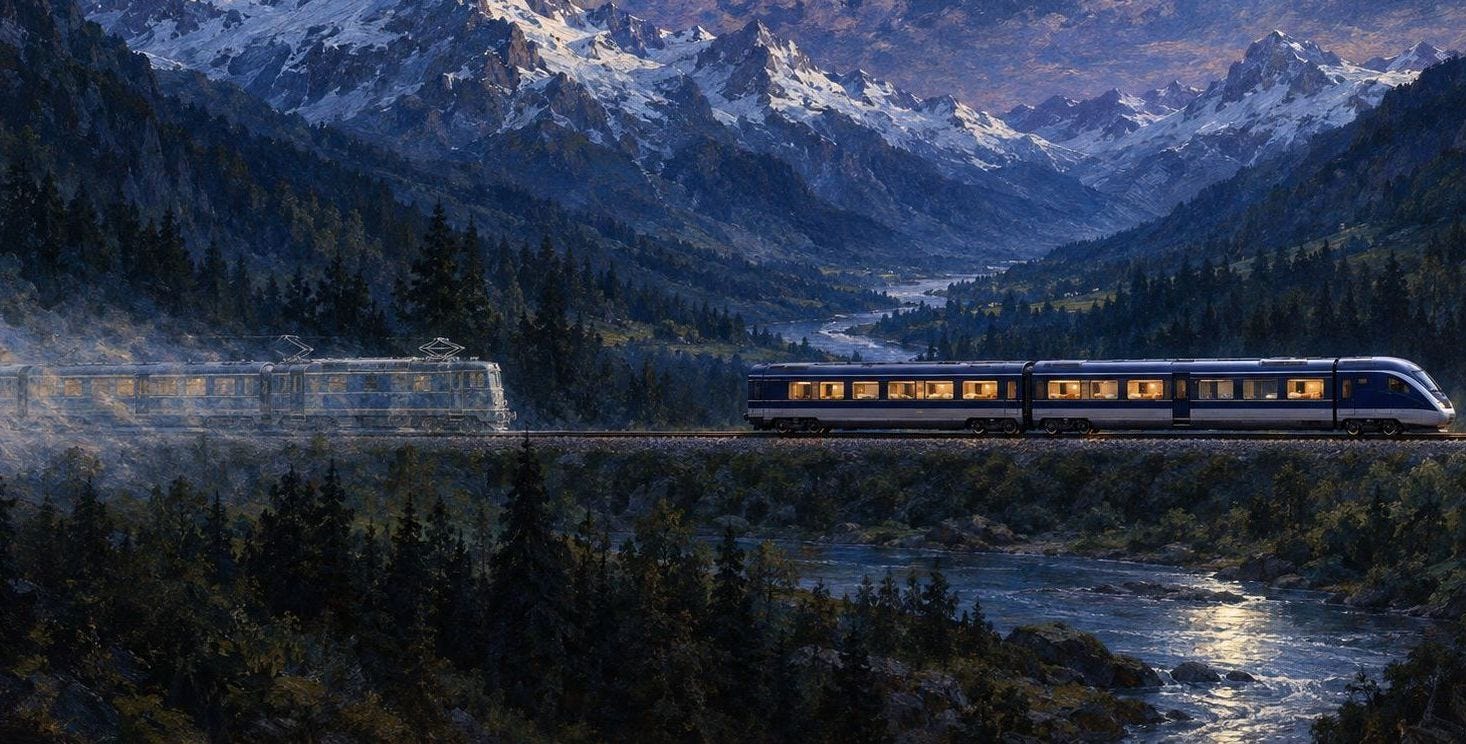
Austrian Federal Railways (ÖBB) runs 32 international night trains a day, according to its figures for 2025 – nine years after Germany’s DB shut down its own sleeper business.
For most of the two decades before 2021, Europe’s night network shrank while air travel grew on the back of low-cost airlines, according to a study by consultancy Steer for the European Commission. The revival since then rests on one state operator that stayed in the market, a handful of small private companies and governments prepared to pay for individual routes.
The same study found that night services remained well below the level of 20 years earlier, even after the first signs of recovery in 2020 and 2021. That gap is what the new operators have spent the years since trying to close.
How the network shrank
The number of long-distance cross-border routes in Europe fell significantly over two decades, and night services fell sharply with them, according to the study. Air travel grew over the same period, driven by the rapid spread of low-cost routes. The study covered the EU’s 27 member states plus the UK, Switzerland and Norway.
When ÖBB ordered new night trains in 2018, it had made no new purchases for night services for a long time, according to the company. In 2023, it expected the full order to almost double its night capacity, and it presented the first new-generation train that year, ahead of a planned start on the Innsbruck–Hamburg route in December.
DB announced at the end of 2015 that it would end its night trains, citing years of losses and coaches more than 40 years old. Its last City Night Line services ran at the timetable change in December 2016, replaced in part by overnight ICE and Intercity trains with seats only. ÖBB bought 42 of its sleeping cars and 15 couchette cars.
The operator that stayed
ÖBB took the opposite decision. Andreas Matthä, its chief executive, announced in October 2016 that the company would take over almost half of DB’s night business, add six routes in Germany and run 15 routes under a new brand, Nightjet, from the December timetable change. The investment was put at EUR 40m.
At the end of 2025, ÖBB’s older night fleet counted 159 seating, couchette and sleeping cars, plus 33 car-transport wagons. The new-generation sets are seven-car trains with two seating coaches, three couchette cars and two sleeping cars, with mini cabins for single travellers and showers in the sleepers.
ÖBB’s daily night trains rose from 31 in 2024 to 32 in 2025. They run under the Nightjet name and as EuroNight, a brand several railways use for international night trains.
What brought them back
Climate policy changed the political value of a sleeper. The European Commission adopted an action plan to boost long-distance and cross-border passenger rail on 14 December 2021, naming redundant national rules, complicated ticketing and the slow uptake of digital technology among the main barriers. In January 2023 it selected 10 pilot services under the plan, among them a European Sleeper night train from Amsterdam to Barcelona.
The legal route into the market had opened earlier. Since 2010, EU rules have allowed any licensed operator to run international passenger trains at its own commercial risk, and since December 2020 the 4th Railway Package has extended that right to domestic routes. Neither requires a state contract.
Dutch-Belgian operator European Sleeper started its third route, Milan–Brussels, on 9 September 2026 without public support. The company reports more than 300,000 passengers on over 980 night departures since 2023. In Germany, start-up Nox Mobility plans a Hamburg–Munich night train from 23 March 2027 [uverificeret], with three departures a week in each direction, in rebuilt former DB Intercity coaches from the 1980s [uverificeret].
Why the comeback is fragile
Routes that depend on subsidy end when the subsidy does: ÖBB ended its Vienna–Paris and Berlin–Paris services on 14 December 2025 after French state support was withdrawn.
In September 2026, Swedish transport administration Trafikverket signed only a six-month contract for its Stockholm–Duved night train from December, with extension options that only the agency can trigger. In June it had awarded SJ the Stockholm–Narvik/Umeå night trains from December 2026 to 2028, with the agency supplying the rolling stock.
Sweden also paid state operator SJ to run a Stockholm–Hamburg–Berlin night train for four years from 2022. When the contract expired, German operator RDC Deutschland said it would take the route over on a commercial basis from 1 September 2026, with three departures a week in each direction, compared with 244 days a year under SJ’s contract.
Trafikverket has separately ordered 91 sleeping cars and 10 Vectron locomotives from Talgo for its northern routes from 2030. By September 2026 it had not named an operator for the new trains.
The private operators carry their risk themselves. European Sleeper is member-owned, works with partners such as Train Charter Services and Arenaways to run and haul its trains, and leases rolling stock from companies including Railpool and Alstom. Nox Mobility raised EUR 2m in pre-seed funding in April 2026 [uverificeret] and has no public contract.
What still limits it
Rolling stock is the tightest constraint. ÖBB’s new-generation Nightjet sets carry 254 passengers each, and the company planned in 2021 to have 33 of them in service by 2025. New Nightjets reached Zurich–Hamburg in December 2025 and Zurich–Vienna in June 2026, according to Swiss operator SBB, which runs the Nightjet services from Zurich together with ÖBB.
Capacity on the tracks is the second constraint. In 2023 the Commission proposed new rules on how track capacity is allocated, saying differences in national rules impede its efficient use, in particular on cross-border lines. At its launch, European Sleeper’s Milan–Brussels train needed timetable slots, known as train paths, from the four companies that manage the tracks in Italy, Switzerland, Germany and Belgium.
The network of 2026 is the sum of separate decisions by ÖBB, by governments buying individual routes and by private operators raising capital one line at a time. Europe has night trains again. It does not yet have a night train network.