

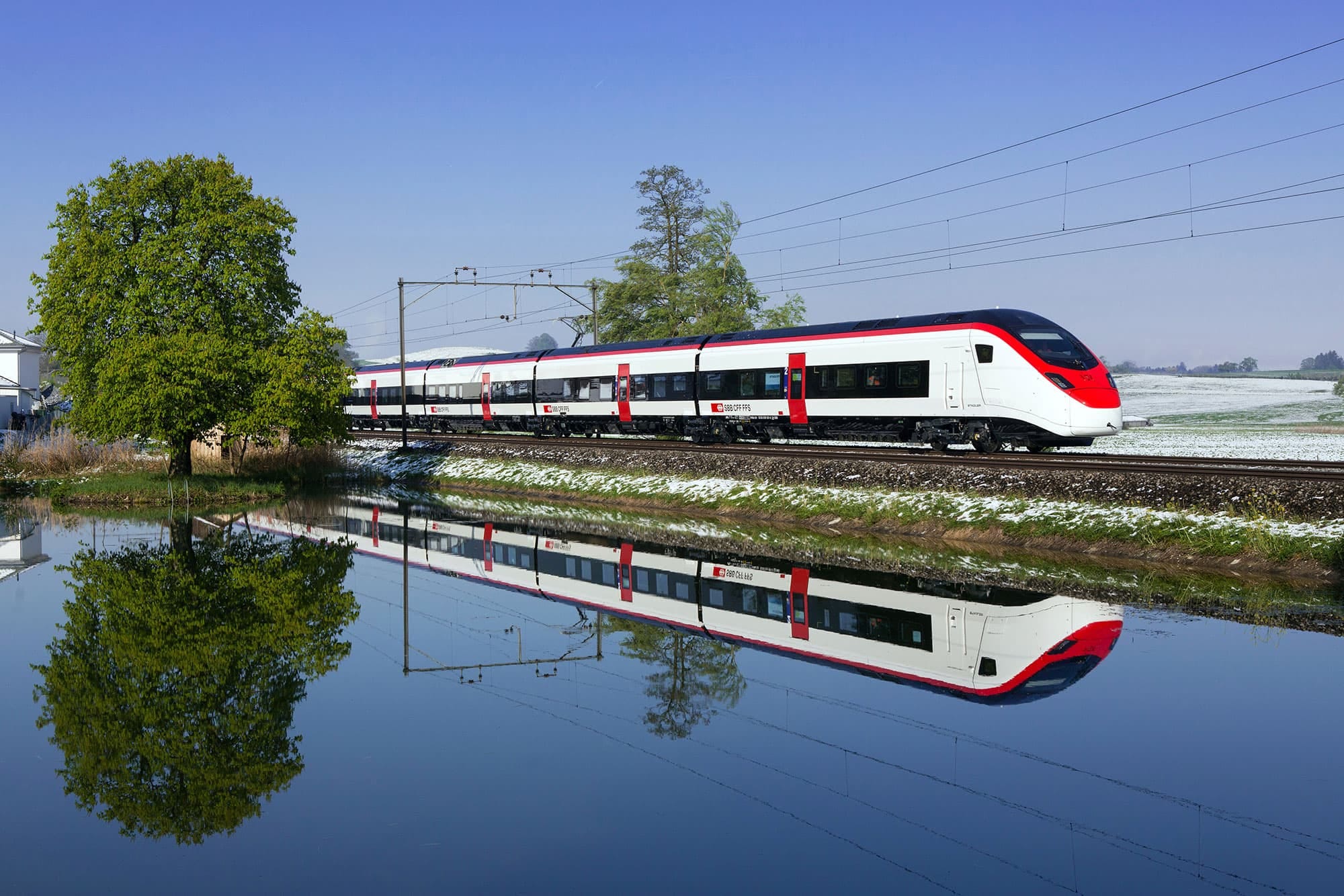
Behind every railway vehicle sits a negotiation between subsystems that were never designed by the same company, yet have to behave as one machine from the first day in service.
A passenger or freight vehicle combines a carbody structure, a running gear assembly (bogies or axle sets), a braking system, a coupling and buffering interface, an electrical and control architecture, and auxiliary systems covering heating, ventilation and air conditioning (HVAC), doors, lighting, and passenger functions.
Each of these subsystems has its own supplier base and its own standards.
Shared loads, shared constraints
These subsystems are not independent products bolted together at final assembly. They share loads, exchange signals, and impose constraints on each other’s design.
Brake deceleration rates are determined partly by suspension characteristics. Coupler forces affect carbody structural requirements, and axle load limits constrain bogie mass and wheel dimensions.
Regulation at subsystem level
The European regulatory framework treats rolling stock at subsystem level. The Technical Specification for Interoperability for Locomotives and Passenger Rolling Stock (TSI LOC&PAS, Commission Regulation (EU) No 1302/2014, as last amended by Commission Implementing Regulation (EU) 2025/675) defines essential requirements and conformity assessment procedures for vehicles intended for cross-border operation.
Vehicle authorisations for placing on the market are issued under Commission Implementing Regulation (EU) 2018/545. ERA issues the authorisation where the vehicle’s area of use spans more than one member state; where the area of use is limited to a single member state, the applicant may choose between ERA and that state’s national safety authority.
Standards architecture
Rolling stock subsystems sit under a layered standards architecture. EN 50155 defines environmental and electrical requirements for all electronic equipment on rail vehicles.
EN 45545 establishes fire protection requirements for materials, components, and layouts, with three hazard levels (HL1, HL2, HL3) applied according to vehicle operating scenario and evacuation time.
EN 14363 governs running dynamics assessment, setting limits for track forces, ride quality, and derailment safety. Individual subsystems carry dedicated standards on top: EN 13260 for wheelsets, EN 13749 for bogie frames, EN 15227 for crashworthiness, and EN 15595 for wheel slide protection.
Brake systems are split by vehicle type: EN 15734-1 covers high-speed trains built for speeds up to 350 km/h on dedicated infrastructure, EN 14198 covers locomotive-hauled trains, and EN 16185-1 covers multiple units. Pneumatic continuity across coupled vehicles from different owners is governed contractually by International Union of Railways (UIC) leaflet 540, rather than by a harmonised EN standard.
The cumulative effect is that a vehicle entering European service faces several hundred normative requirements before type approval is complete.
Fleet renewal and market context
European mainline fleets are being replaced faster as regulation, climate targets and vehicle age converge. The Commission’s Sustainable and Smart Mobility Strategy, presented in December 2020, set a target of doubling high-speed rail traffic by 2030 and tripling it by 2050, both measured against a 2015 baseline, alongside a 50 percent increase in rail freight by 2030 and a doubling by 2050.
Rolling stock orders placed with European manufacturers in 2020–2025 included programmes for electric multiple units, battery-electric multiple units, and bi-mode vehicles, procured by operators including Deutsche Bahn, SNCF, and SJ.
Component supply chains for bogies, braking, couplings, and sealing are concentrated among a limited number of specialist manufacturers, each typically serving multiple original equipment manufacturer (OEM) programmes simultaneously.
Procurement and the aftermarket
Vehicle operators and maintenance organisations increasingly procure components directly rather than through OEM supply channels — particularly high-wear items such as brake discs and pads, wheel profiles, and seals.
Regulation (EU) 2019/779 requires entities in charge of maintenance (ECM) to maintain documented component supply and control processes, and an independent component aftermarket operates alongside OEM-authorised supply.
Component interoperability — substituting one manufacturer’s part for another’s within the same vehicle design — is constrained by type approval scope.
Modifications outside the approved design specification are assessed for significance under Commission Implementing Regulation (EU) 2018/545 and, where a safety risk assessment is required, under the common safety method (CSM) for risk evaluation and assessment, Commission Implementing Regulation (EU) No 402/2013 as amended by Commission Regulation (EU) 2015/1136.