

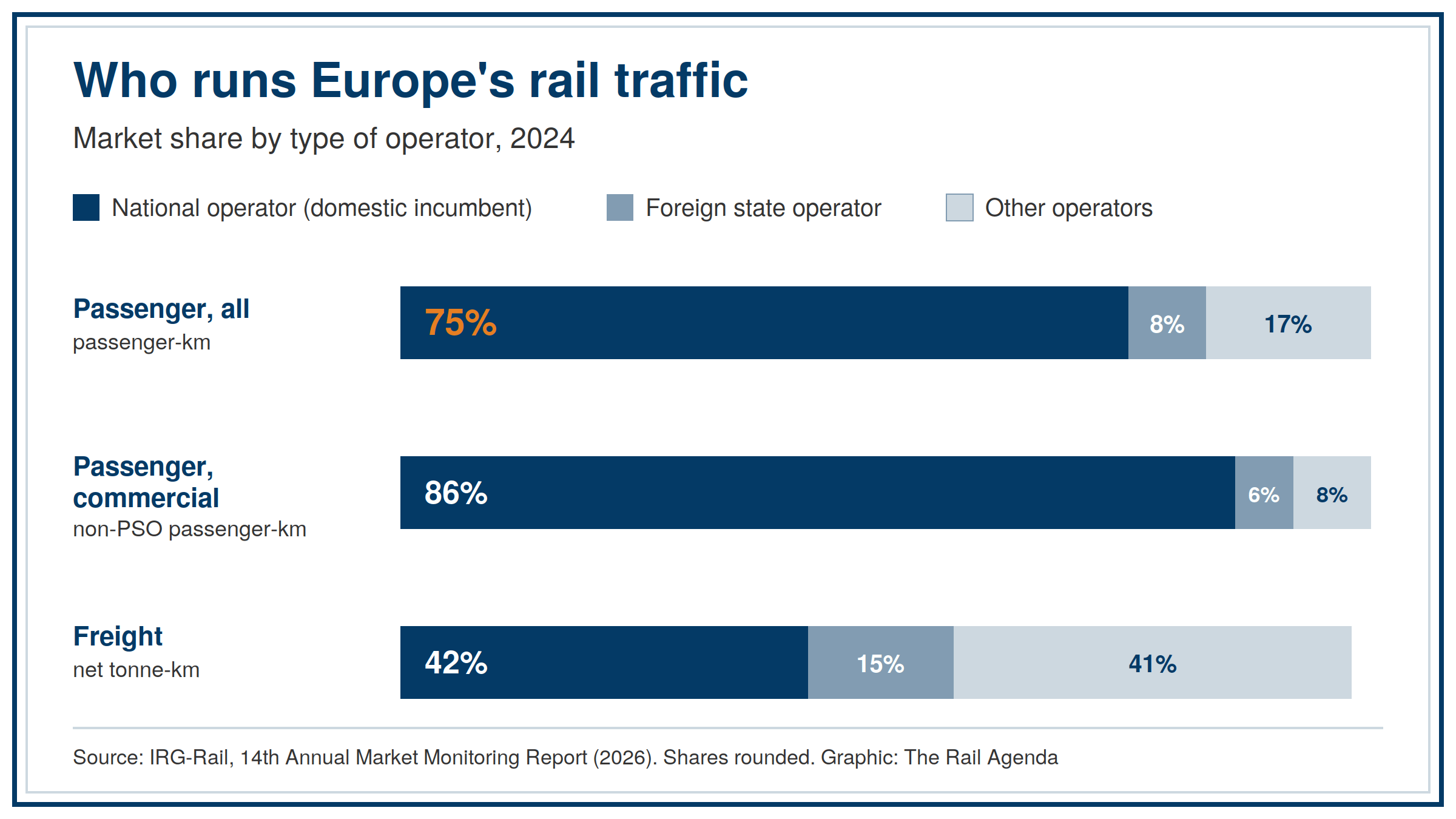
Europe’s railways are still largely in state hands. National operators, nearly all of them state-owned, carried 75% of passenger-kilometres in their home markets in 2024.
The figures come from the latest market monitoring report of the Independent Regulators’ Group – Rail (IRG-Rail), which collects data from national rail regulators in 31 countries, inside and outside the EU. Its members include the UK, Norway and Switzerland, and the latest report covers 2024.
The question has two answers, because EU law splits the railway into two roles. An infrastructure manager builds, maintains and sells access to the track. A railway undertaking runs the trains and pays for that access.
Who owns the track
IRG-Rail counted 232,191 km of railway route in its member countries in 2024, run by 290 infrastructure managers. Germany alone reported 148, most of them regional or local networks alongside the national infrastructure manager, DB InfraGO. Sixteen countries had a single infrastructure manager for the whole national network.
The large national infrastructure managers are publicly owned. EU law lets each state choose how close its track sits to its own operator, provided the infrastructure manager allocates capacity and sets charges independently. Spain keeps Adif and Renfe as separate state companies, and Deutsche Bahn and Italy’s FS group hold track and trains within one state-owned group.
Privately owned main-line track is rare. High Speed 1, the 109 km line between London St Pancras and the Channel Tunnel used by Eurostar, is held under a concession running to the end of 2040. The concession company is owned by funds managed by infrastructure investors InfraRed and Equitix, and its access charges are regulated by the Office of Rail and Road, the British rail regulator.
Who runs the trains
Domestic incumbents, the national operators that ran the market before it opened, carried 75% of passenger-kilometres in 2024, down from 78% in 2020. State operators from other countries carried 8% and all other operators 17%. Eleven countries reported a de facto monopoly, with almost all passenger traffic run by the national operator and its subsidiaries.
Most passenger traffic – 65% of passenger-kilometres – runs under public service obligation (PSO) contracts, in which a ministry or region specifies the service and pays for what fares do not cover. Competitors held 31% of that market in 2024, and around 40% of PSO traffic ran under contracts awarded by tender, most of it in Germany and the UK. Under the Fourth Railway Package, competitive tendering has been the default for new PSO contracts since 25 December 2023, with limited exceptions.
Commercial services, which operators run at their own risk, have opened less. Competitors ran around 14% of non-PSO passenger-kilometres in 2024, split between foreign incumbents at 6% and other operators at 8%. In Spain, commercial traffic has grown steadily since the high-speed market opened to competing operators.
State operators abroad
Many of the challengers are state operators from next door, competing outside their home market. In Spain’s high-speed market, Renfe competes with Ouigo, owned by France’s SNCF, and with Iryo, whose largest shareholder is Italy’s state-owned Trenitalia. Competitors’ share of the Spanish passenger market rose by 18 percentage points between 2020 and 2024.
In Belgium, foreign incumbents ran all commercial passenger traffic in 2024. Wherever they run, the infrastructure manager must sell them capacity on the same terms as the national operator. Before running in another country, an operator needs a safety certificate for that network and trains authorised to run on it.
IRG-Rail’s other operators are a mixed group. The category covers private companies and publicly owned ones with no link to an incumbent, such as operators held by regions or counties. In 2024, Sweden was the only country where the national operator still existed but carried less than half of PSO passenger traffic.
Where private capital sits
Italo has run private high-speed trains in Italy since 2012, in competition with Trenitalia on the country’s main high-speed lines. Shipping group MSC and infrastructure investor Global Infrastructure Partners hold joint control of the company, a deal the European Commission cleared in 2024. The company has since set out plans to enter Germany’s high-speed market with Siemens Velaro trains.
State operators have also sold to private owners. Deutsche Bahn completed the sale of Arriva, its bus and rail operator in other European countries, to infrastructure investor I Squared Capital in June 2024. DB had bought Arriva in 2010 and sold it to concentrate on rail in Germany.
Freight, opened to competition earlier than passenger services, is the most open part of the market. Domestic incumbents carried 42% of rail freight tonne-kilometres in 2024, against around 15% for foreign incumbents and 41% for other operators, whose share has been rising since 2017. Leasing companies such as Akiem own locomotives and hire them to operators across borders.
Britain brings its trains into public ownership
Britain handed its passenger services to private franchise operators in the 1990s. Under the Passenger Railway Services (Public Ownership) Act 2024, each operator’s services pass to DfT Operator, the Department for Transport’s operator holding company, when its contract expires. South Western Railway was the first to transfer, on 25 May 2025, followed by c2c, Greater Anglia and West Midlands Trains.
After Govia Thameslink Railway’s services moved on 31 May 2026, publicly owned operators delivered eight in 10 of the passenger journeys that will pass to Great British Railways (GBR), the planned public body for track and trains, according to the Department for Transport.
Chiltern Railways followed on 20 September 2026, Great Western Railway is due on 13 December 2026, and the government expects the programme to be complete by the end of 2027. The Railways Bill that would create GBR was introduced in Parliament in November 2025.
Network Rail, the public body that manages the track, is to be brought together with the train operators in GBR. The programme covers services run under Department for Transport contracts. Open-access operators that run at their own commercial risk are outside it.