

European Sleeper’s night train from Milan to Brussels crosses four infrastructure managers and depends on three other rail companies to run. Among Europe’s private night-train operators, the name on the ticket often belongs to a company that neither holds the safety certificate nor owns the coaches.
North of the Italian border, Train Charter Services runs the train on its own safety certificate. Arenaways hauls it between Chiasso and Milan, and RDC Germany supplies the coaches. European Sleeper sells the journey, carries the commercial risk and buys paths from RFI, SBB, DB InfraGO and Infrabel.
Three kinds of organisation run Europe’s night trains: state operators working under contracts with governments, state operators running night trains on their own account, led by ÖBB with the largest network, and private newcomers that assemble their services from partners. Under EU law, the railway undertaking legally responsible for running a train is separate from the infrastructure manager that sells access to the track.
The five layers behind a night train
A single night service can involve five separate roles, and on many routes each one is held by a different company:
Seller – the brand that markets the train, sets fares and sells tickets. European Sleeper and Nox Mobility work at this level.
Railway undertaking – the licensed company legally responsible for running the train, with a safety certificate for each network it enters.
Traction provider – the company that supplies the locomotive and driver, often a different one on each side of a border.
Coach owner – the company that owns and maintains the sleeper and couchette cars.
Infrastructure manager – the national body that allocates train paths and charges for access to the track.
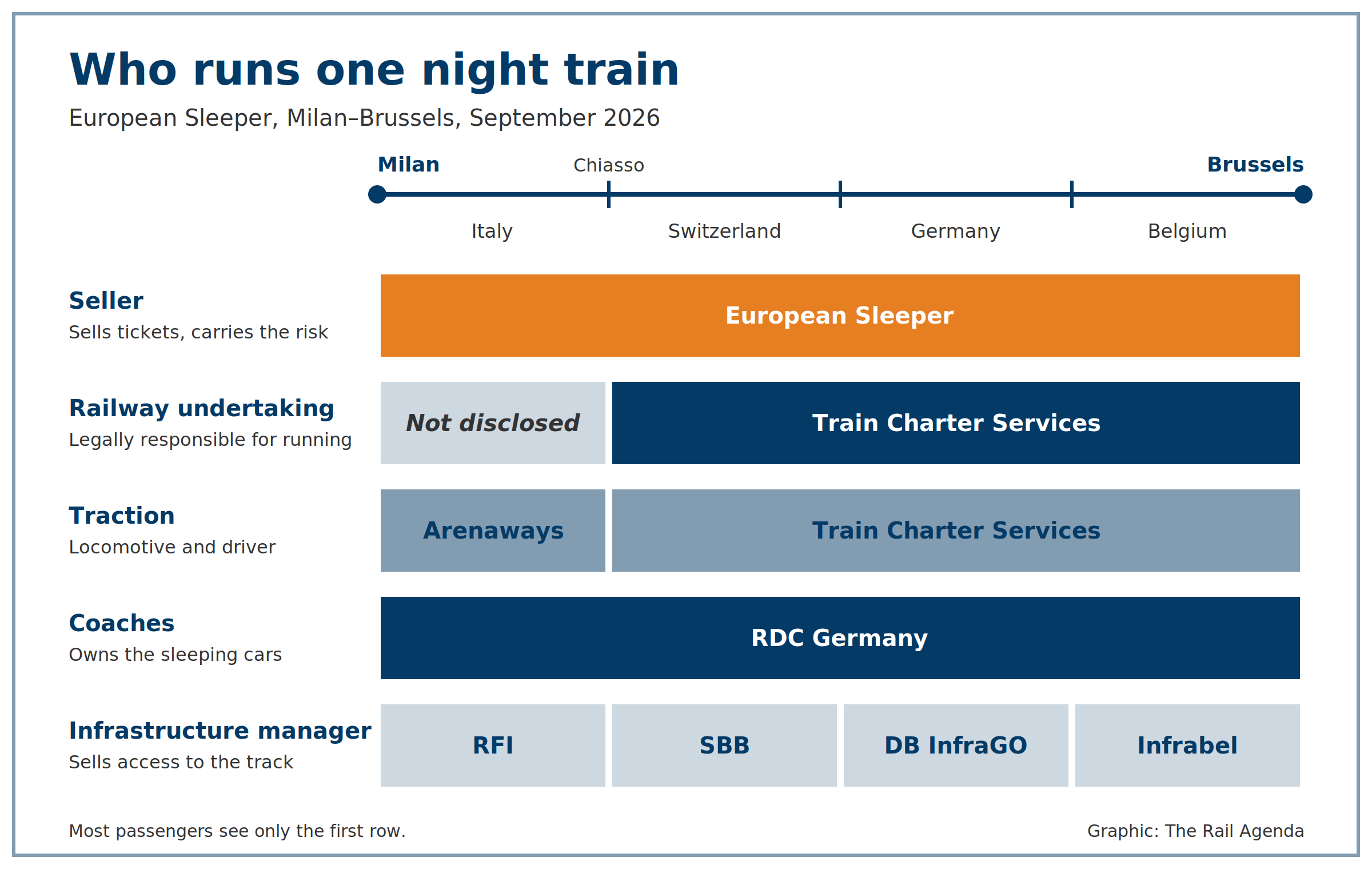
At the large state groups, most of these roles sit inside one group. The newer private operators hold one or two of them and contract the rest, which is why the same train can change hands at a border without the passenger noticing. For most travellers, the seller is the only layer they ever see.
Night trains bought by governments
The French state is the organising authority for the Intercités de nuit, operated by SNCF Voyageurs under a convention covering 2022 to 2031. On 1 January 2026, the network had five national night lines, linking Paris with destinations including Briançon, Nice, Cerbère, Tarbes and Latour-de-Carol. The state sets routes and frequencies and covers the gap between fares and costs.
Italy uses the same model, and Trenitalia‘s Intercity Notte runs under a service contract with the transport ministry, which decides the offer and pays a fee for routes that lose money. Trenitalia has ordered 70 new night coaches, worth EUR 140m, for its services to and from Sicily. The Caledonian Sleeper between London and Scotland has been owned by the Scottish Government through Scottish Rail Holdings since June 2023.
A contracted night train runs only as long as the funding lasts, and the terms can be short. The agreement between SJ, Sweden’s state operator, and Trafikverket, the Swedish transport administration, for Stockholm–Östersund–Duved covers six months, to 13 June 2027, and only the state can extend it. When the French government ended its support for international night trains, ÖBB stopped its Vienna–Paris and Berlin–Paris Nightjets in December 2025, because few night trains cover their costs from fares alone.
ÖBB and the Nightjet network
ÖBB launched the Nightjet brand in December 2016, the month DB stopped running night trains of its own. By September 2026, the network reached more than 25 European cities, and DB sells Nightjet tickets through its own channels. ÖBB counted roughly 1.5 million night-train passengers in 2019, the last year before the pandemic.
Many routes are joint services. Trains sold as Nightjet or EuroNight are run with partners including the Czech, Hungarian, Polish and Croatian state operators ČD, MÁV, PKP and HŽ, each responsible for its own section of the journey. ÖBB brands the network, and the partners share the operation.
ÖBB has also ordered a new fleet: 33 new-generation Nightjet trainsets from Siemens Mobility, each with seven cars and up to 254 places, authorised for Austria, Germany, Italy, Switzerland and the Netherlands. Each network a coach enters must accept it, one reason cross-border rolling stock is slow to change.
Private operators and rented trains
By September 2026, European Sleeper, a member-owned company based in the Netherlands and Belgium, operated Brussels–Berlin–Prague, Paris–Berlin and Milan–Brussels commercially. It reported more than 300,000 passengers on over 980 night departures since 2023, and its Milan route started that month without public subsidy. The company grows on coaches leased from others.
RDC Germany, owned by US-based Railroad Development Corporation, is the rare private operator that owns its sleepers. It maintains them in its own workshops in Lengerich and Niebüll. It announced it would take over Berlin–Hamburg–Stockholm as a commercial service from 1 September 2026, after SJ’s contract with Trafikverket ended.
RDC also leases coaches to European Sleeper and plans a Brussels/Amsterdam–Copenhagen–Malmö night train with it from April 2028. On the routes linking Scandinavia with the continent, RDC is both European Sleeper’s partner and an operator in its own right. On the same corridor, Snälltåget has run seasonal night trains on a package-tour model since 2012.
Dependencies in the private model
Nox Mobility shows the thinnest version of the private model. The Berlin start-up plans a Hamburg–Munich night train from 23 March 2027, with TRI Train Rental as the railway undertaking and other companies providing traction and on-board service. Nox keeps the brand and the ticket sales and will use refurbished former DB InterCity coaches from the 1980s.
Every partner adds a dependency. European Sleeper’s Milan service began almost three months later than planned because of track works in Germany and certification in Switzerland. SJ, which ran night trains to Germany for four years, said when it won the contract in 2021 that its own coaches were too wide for the continental loading gauge and named RDC as its main partner for coaches, crews and train operation in Germany.
RDC supplied coaches under SJ’s contract and now runs Berlin–Stockholm with its own. In a market built on leased assets, the owner of the rolling stock is the party most likely to stay.