

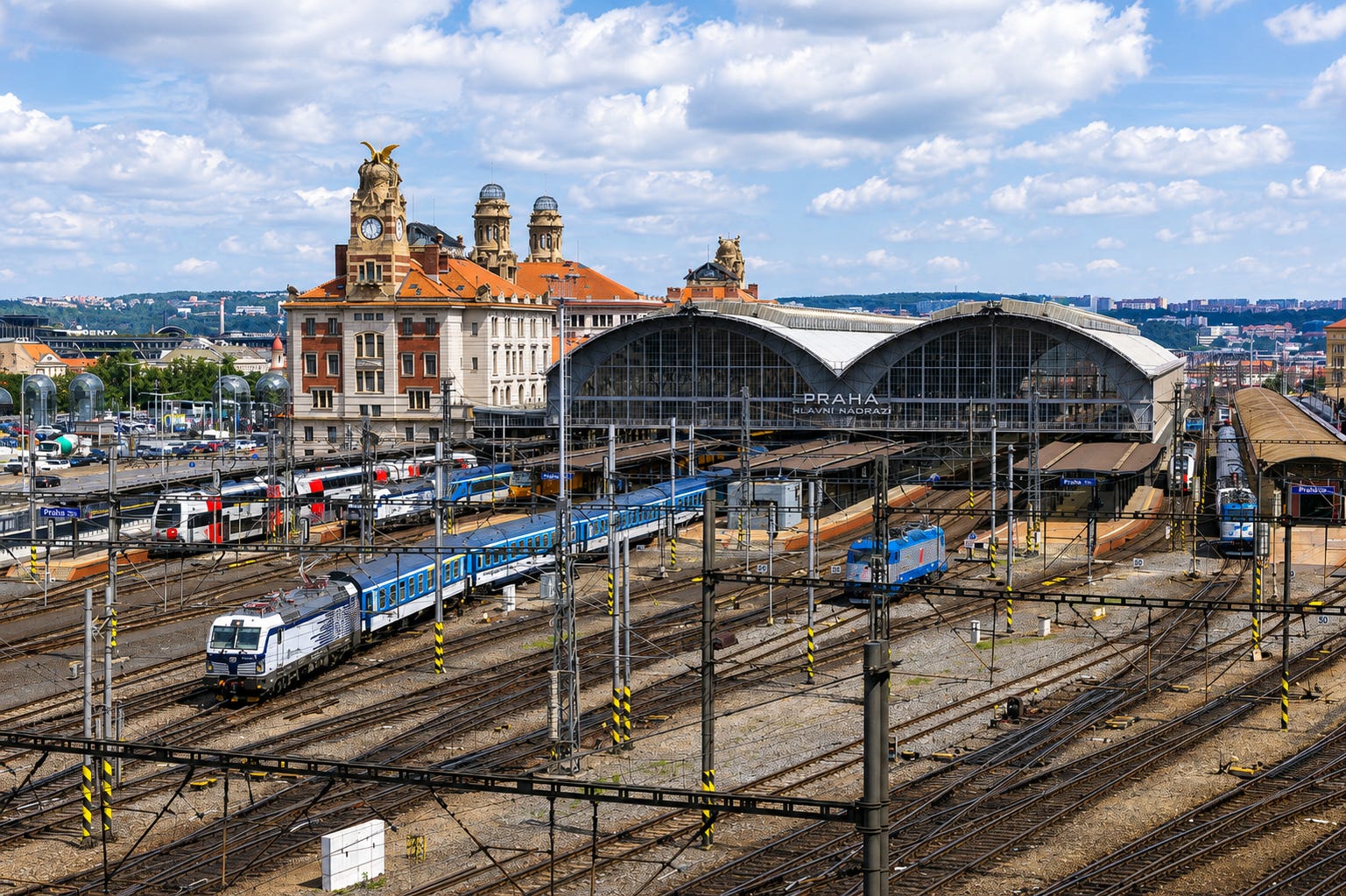
Two scandals hit state rail leadership in one day
CZECHIA: The chief executive of national operator České dráhy has surrendered his security clearance, prompting a supervisory board review. Separately, police have charged the former head of infrastructure manager Správa železnic over a public tender.
The clearance was among the requirements of the recruitment process that put the ČD chief in post. The supervisory board must now assess whether he can continue without it.
At Správa železnic, the charges follow the November 2025 raids linked to major station projects in Brno and Pardubice. The organisation itself has already changed leadership, with a new chief executive in office since February.
Both developments emerged on the same day, and no connection between the two cases has been indicated.
Finland-Sweden passenger trains return after 38 years
CROSS-BORDER: The first scheduled passenger train from Finland to Sweden since 1988 reached Haparanda on 10 August. Finnish state operator VR now runs two daily return services from Oulu under a state-purchased contract.
The service is publicly purchased, not commercial: Traficom pays for it as an addition to VR’s existing contract, with contributions from Tornio, Oulu and regional development funding.
Through-running is not possible — Finland’s broad gauge ends at Haparanda, so onward travel means changing to Norrtåg’s standard-gauge trains, which VR also operates. Cross-border timetable coordination improves from December.
All Leo Express Talgo services stop again — no return date
CZECHIA: Leo Express has run none of its four daily Talgo services between Bohumín and Prague since 31 July — the third disruption in three months, and this time without an end date.
No Talgo departures are on sale for any future date. The operator attributes the stop to an unresolved technical issue, not an intervention by any authority.
The timing matters for December: the Prague–Munich takeover is built around 13 Talgo sets and 59 refurbished ex-DB coaches, and the sets have now been suspended three times since entering service in April.
FS Italiane orders the fleet for its Paris–London launch
CROSS-BORDER: FS Italiane has ordered 19 high-speed trains from Hitachi Rail in an investment of around EUR 2bn covering construction and long-term maintenance. The fleet will carry Trenitalia France’s expansion — including the Paris–London service now confirmed to launch in 2029.
The order converts the EUR 1bn plan announced in April 2025 into a EUR 2bn commitment that also covers a new maintenance site near Paris. The train platform has not been named.
The fleet strengthens the existing French routes first; the cross-Channel service follows in 2029, leaving roughly three years for build and certification for Channel Tunnel operation.
Germany leaves Brenner tunnel waiting until 2043
GERMANY: The new line meant to carry Brenner Base Tunnel traffic through Bavaria is planned to enter service in 2043 — eleven years after the tunnel itself is scheduled to open. The federal government has informed the Bundestag that preliminary planning is complete, moving the project’s further course into parliament’s hands.
The report opens a parliamentary phase, not construction: no funding is committed, approval documents are due in 2028, and building is set to begin in 2034.
Until the Bavarian line opens, traffic from the tunnel — scheduled for 2032 — must use the existing Inntal route, which already operates near its limit. Austrian politicians want the gap raised at EU level.
France has no plan yet to fund thin TGV routes
FRANCE: TGV services to smaller cities will keep depending on SNCF’s internal cross-subsidy for at least another three to five years. The government has published the Bussereau review of how to pay for loss-making high-speed routes in an opening market — and kept only its mildest levers, leaving the question of long-term financing open until the 2030s.
The government adopts only the near-term measures — efficiency work, framework-agreement instruments and modulation of access charges — while an equalisation fund or regional contracts are deferred to the 2030s.
Meanwhile, competing operators are entering precisely the profitable routes whose margins currently finance the loss-making ones, with a further entrant planned on the Atlantic corridor in 2028.
Deutsche Bahn delivers its first half-year profit since 2019
INSIGHT: Deutsche Bahn’s rail business made a profit in the first half of 2026, the first since 2019. The full-year outlook carries risks, DB says, with DB Cargo as the main one: it has to be profitable by the end of December to meet the European Commission’s conditions.
The EUR 147m result reverses a EUR 760m loss a year earlier and covers the rail-only group after the Schenker sale. Net debt rose as DB self-finances a growing share of the construction programme.
The binding deadline sits in Brussels: under the state-aid conditions, DB Cargo must reach sustainable profitability by end-2026 — and closed the half-year at minus EUR 1m.
Couplers from four manufacturers meet in DAC trials
INDUSTRY: A 12-week test campaign in Poznań combines digital automatic coupler heads and draft gear from different manufacturers. The tests begin in August under the Europe’s Rail FP5-DACtiVate project and bring PKP and a Polish research institute into DAC testing for the first time.
The campaign examines whether components from Dellner, Knorr-Bremse, Voith and Wabtec can be mixed at a defined interface — the precondition for a multi-supplier market in wagon conversion.
Results feed a validation plan due by December 2026; certification and authorisation lie outside the project and would follow in a separate process.
That’s The Rail Agenda for today. If you found this newsletter useful and relevant, please forward it to someone you know.