

Top: Poland launches first 320 km/h train tender
PKP Intercity has issued Poland’s first tender for high-speed trains designed for operation up to 320 km/h — a first procurement step in Poland’s high-speed rail programme.
The tender covers the purchase of 20 trainsets, with options for additional units depending on the final scope. It is the first time Poland has formally gone to market for 320 km/h-capable rolling stock, putting supplier capacity, delivery slots and long-term support at the centre of the discussion.
Delivery timing has not been published; a realistic first-delivery window is late 2020s, depending on contract award and production slots.
2. Hungary buys 93 refurbished Swiss GTW EMUs via Stadler
Hungarian State Railways (MÁV) has contracted Stadler to acquire and refurbish 93 second-hand GTW multiple units currently operating in Switzerland, and deliver them into MÁV service.
GTW is Stadler’s modular regional train platform, built around a central power module between passenger sections, making the train straightforward to configure and overhaul.
This approach shortens lead times versus ordering new trains, at a time when new-build production slots across Europe remain tight.
It also shifts risk from manufacturing to refurbishment execution: scope control, parts availability, reliability improvement, and time-to-availability once the units enter Hungarian service.
3. ÖBB RCG adds new TransFER routes across Europe
ÖBB Rail Cargo Group (RCG) is expanding its TransFER network, strengthening links between Austria, Germany and the Netherlands and adjusting its intermodal offer to Romania.
RCG is introducing a new Duisburg–Rotterdam service and adding a Salzburg–Offenbach connection, improving options for customers moving volumes into and across Germany’s logistics hubs.
In parallel, RCG is modifying its intermodal offering towards Romania, where routing flexibility is becoming more important for pan-European supply chains.
Operationally, this is not just a timetable addition: it tests path availability, terminal interfaces, wagon and locomotive allocation and corridor reliability across borders — the factors that decide whether “new routes” turn into stable, repeatable capacity.
4. CargoBeamer plugs Alpine gap with Liège–Domodossola
CargoBeamer has launched a new tri-weekly intermodal service between Liège and Domodossola, aiming to capture traffic after the discontinuation of an Italy–Germany Rolling Highway service in December.
The route links Belgium to northern Italy via the Alpine corridor, where capacity, terminal performance and disruption sensitivity are structural constraints.
By moving quickly after the previous service ended, CargoBeamer is betting there is demand for a replacement service that can be run reliably and scaled.
Whether the service grows will depend on train paths, terminal throughput and customer commitment in a corridor where reliability is constrained by scarce capacity and frequent disruption.
5. France delays planned night train rolling stock order
The French government has postponed a planned order to renew the national night train fleet, expected to include 180 night train coaches and around 27 electric (multi-system) locomotives, with entry into service targeted from 2030.
The decision is cited as being driven by budget constraints and spending priorities.
A delayed rolling stock order creates immediate uncertainty for fleet planning: operators must stretch existing assets longer, maintenance strategies become more conservative, and network upgrades become harder to schedule against firm delivery timelines.
For suppliers and the wider industrial pipeline, delays disrupt production planning and the allocation of scarce manufacturing slots — particularly in a market where long-lead rolling stock programmes compete for limited engineering and factory capacity.
Catch up: Polish train manufacturer gains direct route into Germany’s urban rail market
Polish train manufacturer Pesa is acquiring insolvent German tram builder HeiterBlick in Leipzig — a direct route into Germany’s urban rail market at a time when Europe’s tram manufacturing sector is under pressure, particularly on delivery timelines.
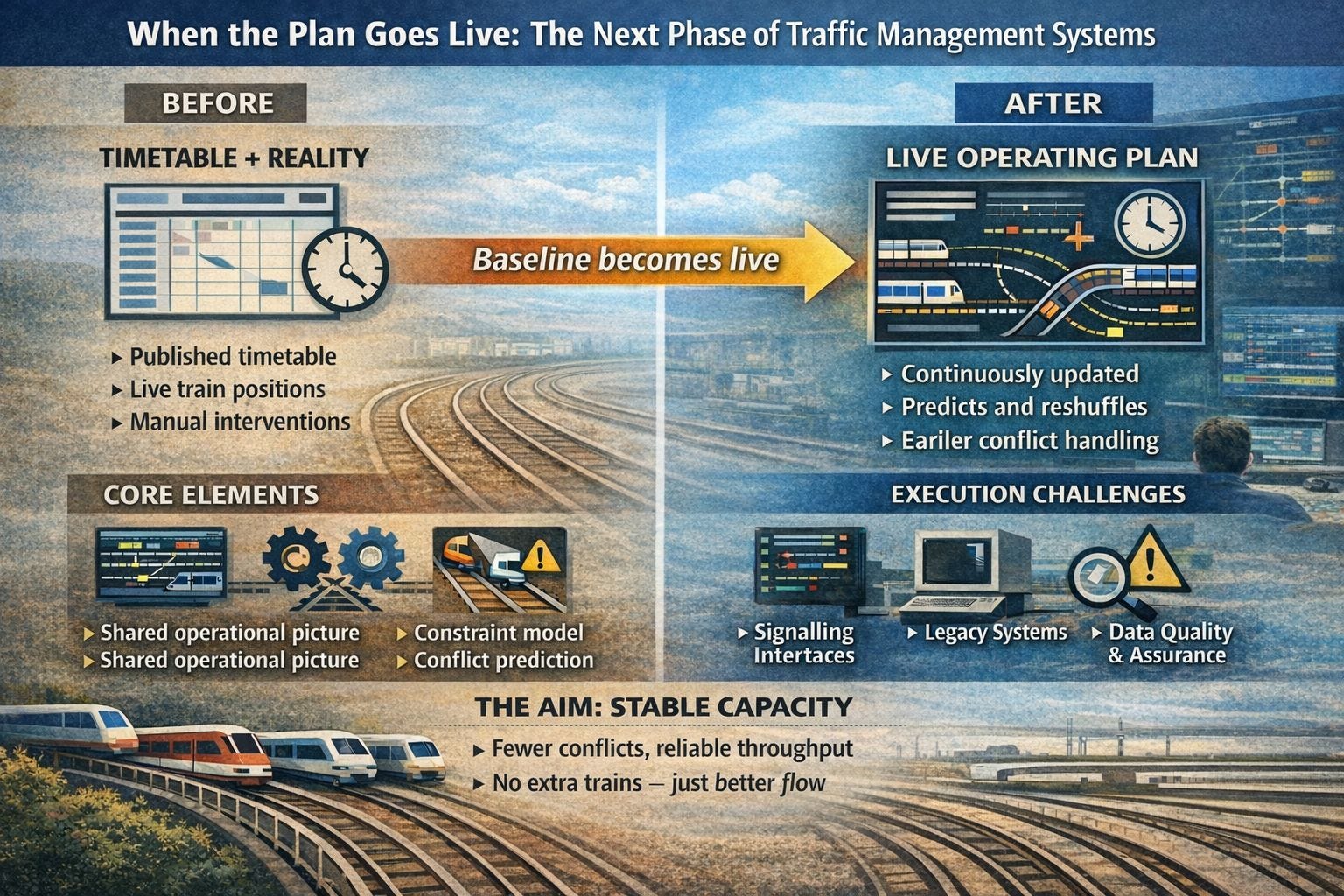
Explainer: Making the operating plan a live system
Traffic Management Systems are central to day-to-day railway regulation. This explainer focuses on the next phase: shifting the baseline from the published timetable to a continuously updated operating plan shared across control desks and checked against real constraints.
Thank you for reading The Rail Agenda’s newsletter. If you found it valuable, consider forwarding it to someone who might enjoy it.