

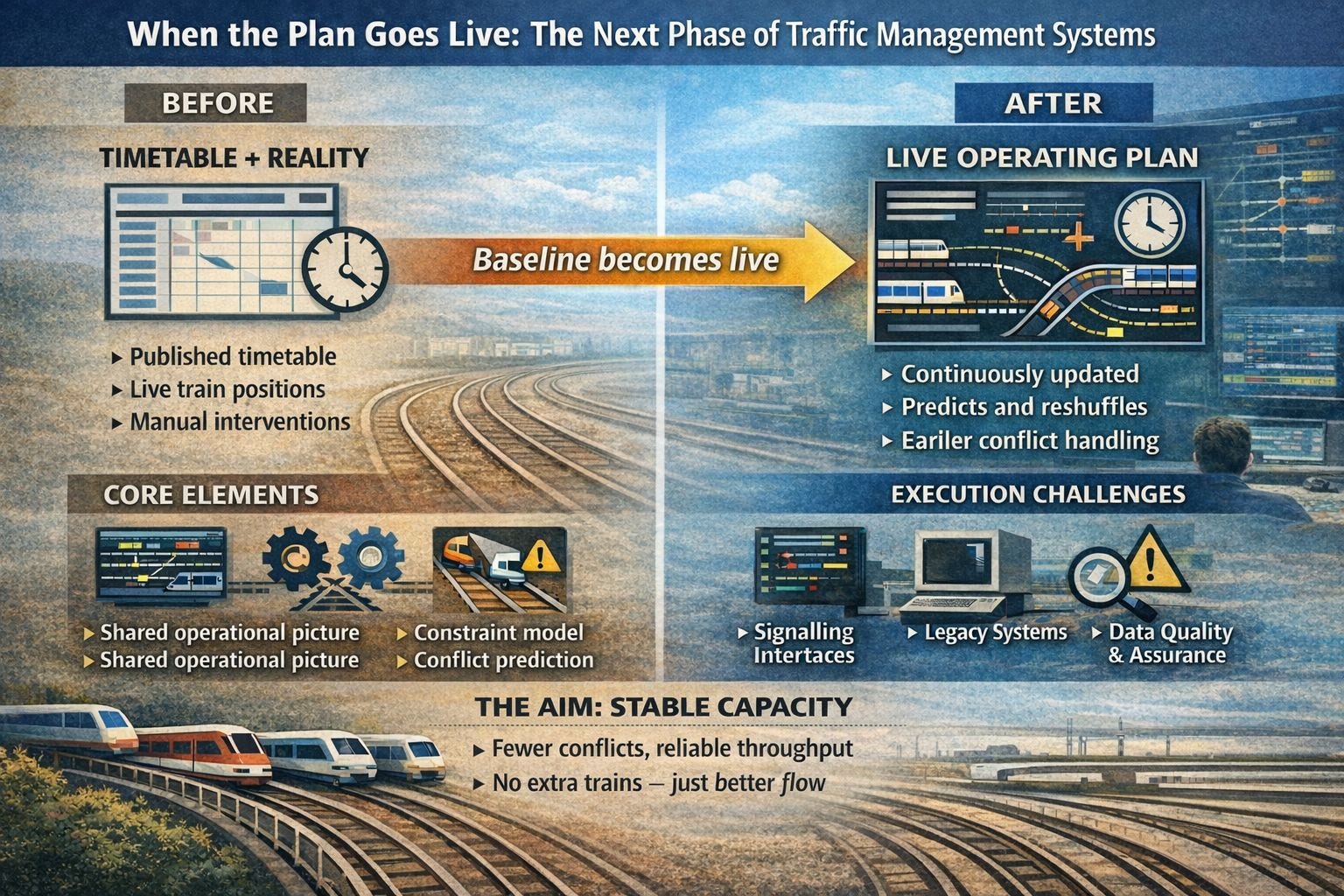
Traffic Management Systems (TMS) are the layer that turns a working timetable into a running railway. They merge the published plan with live train positions and route availability. When reality diverges, they support regulation decisions under real operating constraints.
Traditionally, the timetable is treated as the baseline and controllers rely on manual interventions: holding a train, re-ordering movements, absorbing knock-on delay.
“The plan goes live” describes the next step. Here, baseline means the best current operating plan — not the published timetable. The current plan is updated continuously, shared across desks, and checked against real constraints over the next few hours.
What TMS is, in operational terms
TMS is neither long-term planning software nor just a display. It is decision support for day-to-day regulation: maintaining a coherent operational picture and helping controllers choose actions that keep traffic stable within constraints.
A modern TMS typically supports:
A live view of train order, delays, route occupation, and predicted conflicts
Regulation options (holding, re-platforming, re-routing) and their consequences
Cross-boundary coordination so local fixes do not simply export delay
“The plan goes live” as a continuously revised baseline
A live plan keeps the current operating plan updated as new information arrives. The look-ahead can be minutes for immediate regulation and hours for keeping a corridor stable.
Three elements define the shift.
First, a rolling horizon: the plan is refreshed continuously rather than re-issued.
Second, prediction: the system estimates future train positions and resource usage.
Third, earlier conflict handling: conflicts are flagged early enough that action can be taken before they become hard stops. It can reshuffle train order at a junction 30–60 minutes ahead while keeping the wider corridor plan stable over the next 2–4 hours.
This does not remove disruption. It changes timing and coordination: earlier interventions, with clearer visibility of downstream effects.
The technical backbone behind a live plan
For a live plan to work, it must be consistent, constraint-aware, and explainable. Much of the complexity sits below the user interface, in data and modelling.
Core building blocks include:
A common operational picture shared across desks
A constraint model of infrastructure, rules, and temporary restrictions
Prediction, conflict detection, and a decision trace (what changed and why)
Operators need to see why a move is feasible under the rules (routes, headways, platform constraints) — and what delay or knock-on risk it shifts elsewhere.
Why execution integration sets the pace
A live plan only matters if it can be executed safely and consistently. That depends on execution integration (interfaces to signalling and route-setting), and sometimes on automation layers (functions that apply a decision quickly).
This is where programmes often slow down. Data that is good enough for planning can be late or incomplete; for route-setting it cannot. Interfaces must respect interlocking logic, headways, and local operating rules.
The system also needs fallbacks when feeds degrade, communications drop, or controllers override proposals. In practice, interfaces to signalling are what usually slows programmes down.
The engineer’s reality check: legacy, latency and governance
The shift is real, but rarely a clean cutover. Railways carry decades of legacy systems, uneven data standards, and local rules that are hard to normalise.
A live plan also raises accountability questions: who owns the plan, who approves overrides, and how decisions are assured across boundaries?
Key limits tend to be:
Legacy integration and bespoke interfaces
Data quality and latency in real-time feeds
Governance, assurance limits, and incremental transition
This also clarifies “capacity”. Live planning does not create new physical paths. It aims to deliver capacity more reliably: fewer unstable conflicts, faster recovery, and more predictable throughput under disruption.
The gain is stability and utilisation, not magic extra trains on a saturated network.