

Every train on Europe’s railways pays the infrastructure manager for the use of the track. In 2024 those charges came to EUR 24.8bn across 29 countries. What a single train pays depends as much on national policy as on the cost of running it.
Track access charges are set out in each infrastructure manager‘s network statement, the published rulebook for access to its network, and billed mostly per train-km. They cover the minimum access package: the allocated path, the use of track, points and junctions, and train control from signalling to dispatching.
The figures come from the Independent Regulators’ Group – Rail (IRG-Rail), which brings together national rail regulators. Per train-km, passenger services paid more every year from 2020 to 2024, and freight charges rose 6% in 2024 after a slight decline from 2020 to 2023. In 2024 passenger trains accounted for 91% of the total.
What the money pays for
The charge flows to the infrastructure manager – the body that builds, maintains and runs the network, including signalling and traffic management. Infrastructure managers in the 21 countries that reported spent EUR 64bn on their networks in 2024. According to the regulators’ report, charges cover only a minority of that bill, and public money pays the rest.
The Recast Directive (2012/34/EU) requires an infrastructure manager’s accounts to balance over a period of no more than five years. Income from charges, other commercial income and state funding must at least match infrastructure spending. Each member state decides the mix.
That choice largely sets the level of the charge. The more of the network a government funds directly, the lower the charge in the network statement can be. Some states also pay part of the bill on the operator’s behalf, through repayments or inside a public service compensation package.
How the price is built
The directive starts from a floor. Charges for the minimum access package must be set at the cost directly incurred by running the train service, which in practice means the wear and running costs a train adds. Commission Implementing Regulation (EU) 2015/909 lays down how that cost is calculated.
On top of that floor, the directive allows a limited set of additions and adjustments:
Scarcity charge – a premium on identifiable sections during periods of congestion.
Environmental adjustment – differentiation by environmental effect, used mainly to vary charges by the noise of freight wagons.
Mark-ups – surcharges to recover the full cost of the network, where the market can bear them, set per market segment. The minimum segments are freight, passenger services under a public service contract and other passenger services.
Investment charges – higher charges on specific projects completed after 1988, based on their long-term costs.
ETCS differentiation – lower charges for trains equipped with the European Train Control System on designated corridors, with no change in the manager’s overall revenue.
Reservation charge – a fee for paths that are allocated and not used.
Mark-ups are where national choices show most clearly. The directive sets one limit: a market segment that can pay at least the direct cost plus a rate of return the market can bear must not be priced off the network. Discounts are allowed only to reflect administrative savings, or for a limited time to encourage new services or the use of underused lines.
According to the regulators’ report, the level reflects national public support to a large extent, not only the cost of using the track. The same directive therefore produces charges from below EUR 1 to more than EUR 21 per train-km.
Who sets the charge
The member state sets the charging framework, and the infrastructure manager determines and collects the charge within it. The network statement must be published at least four months before the deadline for capacity requests, in at least two official EU languages. Every railway undertaking that runs trains signs an access agreement with the manager of each network it uses.
Charging decisions are one of two essential functions that must sit with a body that does not itself run trains. The other is path allocation. Where the infrastructure manager belongs to the same group as an operator, it must take these decisions independently of the group, and a member state may hand them to a separate charging body.
A national regulatory body oversees the charges and acts as appeal body for operators. In 2024 the Croatian regulator found that the national infrastructure manager had broken the directive by billing the minimum access charge for replacement buses, where no train had run.
Why the same train-km costs more in some countries
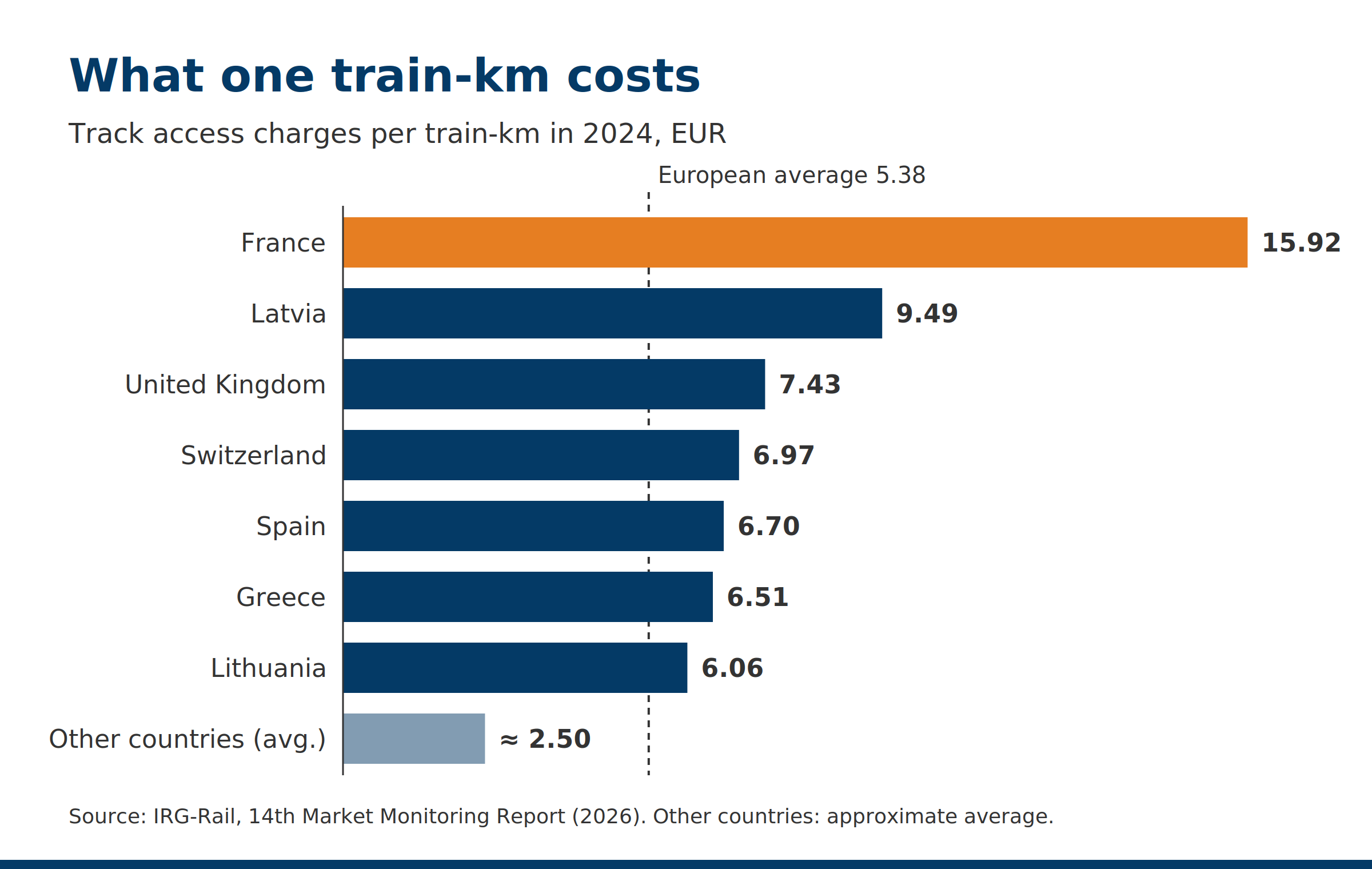
The European average in 2024 was EUR 5.38 per train-km. France charged EUR 15.92, nearly three times the average and the highest in Europe. Latvia, the UK, Switzerland, Spain, Greece and Lithuania also sat above the average, while the remaining countries averaged roughly EUR 2.50.
Open-access services (those without a public service contract) in France paid over EUR 21 per train-km, and France recorded the highest load in Europe at 270 passenger-km per passenger train-km. The regulators’ report links the two, noting that high charges push operators on the SNCF Réseau network towards large trains run less often. Measured per passenger-km, the French charge is close to other countries’.
Across Europe, open-access services paid on average 75% more per train-km than contracted services. The regulators describe that gap as a significant cost barrier to new services. Charges took almost a quarter of passenger operators’ revenue, and more than 25% in France, Germany and Spain, compared with 11% for freight operators.
What moves the charge
Charges move with funding decisions and with costs. Norway halved its mark-up rates in 2024, and passenger charges per unit fell by around 20%. In the UK, freight charges rose 50% the same year after an inflation uplift and higher usage and electrification charges.
The per-train-km model weighs hardest on trains that cover long distances with few seats, which is part of why [night trains struggle to break even]([LINK: nr. 6]). A train crossing borders pays a separate charge on each network under different rules, one reason running trains across European borders is so hard.
Capacity is the other half of the access regime. Regulation (EU) 2026/1184, published on 10 June 2026, rewrites how paths are planned and allocated across Europe and amends the directive that sets the charges. The level of the charge remains a decision for each member state and its infrastructure manager.