

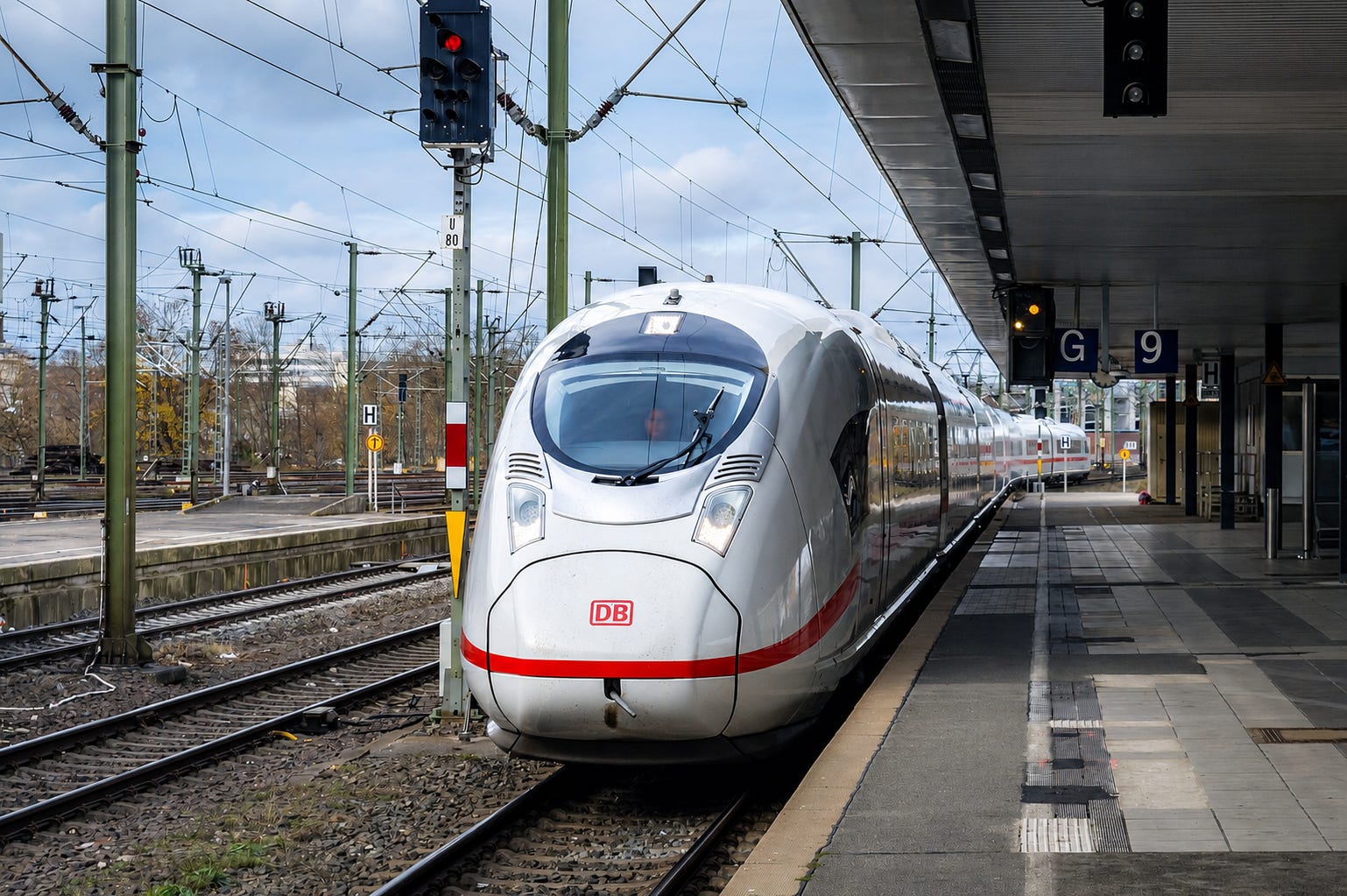
Three operators have independently concluded that Deutsche Bahn’s hold on Germany’s high-speed network is weak enough to enter — but one infrastructure manager holds the key to whether any of them can.
By Dan Jensen
Italian open-access operator Italo has told DB InfraGO it needs confirmed train paths by the end of May. Without them, a EUR 1.2bn contract with Siemens Mobility for 26 high-speed trainsets cannot be signed — and the company’s planned 2028 launch on the Munich–Berlin–Hamburg and Munich–Cologne–Dortmund corridors becomes unviable.
FlixTrain and Netinera, the German regional subsidiary of Italy’s state-owned railway group FS, are moving on the same market from different directions. The convergence is not coordinated — it reflects a common assessment of DB’s structural position: chronic underperformance, a congested and ageing network, and a long-distance market insulated from competition for decades.
One deadline, three bets
FlixTrain, the rail arm of German travel group Flix SE, has ordered up to 65 Talgo 230 trainsets in a EUR 2.4bn framework contract — 30 firm, with an option for 35 more. The trains run at 230 km/h, hauled by leased Siemens Vectron locomotives, with launch targeted for 2028 in Germany only.
European deployment was announced alongside the order in May 2025. Seven months later, it was shelved.
Netinera is a different proposition. Through subsidiaries including ODEG, Metronom and Die Länderbahn, FS Group already runs regional rail in 14 German federal states — this is an upgrade of an established position, not a market entry from scratch.
In May 2025, Netinera issued a tender for 14 single-deck trains capable of 300 km/h, delivery targeted December 2027, with an option for 36 more. No manufacturer has been selected. No domestic route plan has been published.
Italo is the most advanced and the most exposed. The company has a German subsidiary, an operating licence, and a EUR 3.6bn commitment on the table: EUR 1.2bn for 26 Siemens Velaro trainsets on the same platform as DB’s ICE 3neo, and EUR 2.4bn covering 30 years of maintenance, staff training, station infrastructure and IT systems.
The contract with Siemens is agreed. It has not been signed.
Why 2028
The convergence on 2028 is not accidental. Three structural conditions have aligned.
The Talgo 230 platform is available and certified. Italo’s Velaro choice is designed to minimise certification risk — the platform already runs on German infrastructure under DB colours.
The EU’s Fourth Railway Package has been fully in force since December 2020. Germany’s domestic long-distance market is formally open to competition.
DB’s weakness is structural and documented. Long-distance punctuality hit 62.5% in 2024 — the worst in at least 21 years. October 2025 brought a new low: 51.5% on time. DB InfraGO’s own status report, published 7 May 2026, puts the infrastructure investment backlog at EUR 124.5bn.
DB InfraGO holds the key
DB holds approximately 95% of Germany’s long-distance high-speed market. It has made no public statement on the three challengers.
DB Fernverkehr is not the decision-maker here. The company that determines whether Italo launches in April 2028 is DB InfraGO — the infrastructure subsidiary that allocates train paths annually and controls access to station facilities across the network.
Annual allocation is the structural barrier no regulatory package has dismantled. Italo’s Chairman Luca di Montezemolo made the problem explicit: investors need stable, long-term access agreements to justify multi-billion-euro commitments. DB InfraGO has not responded publicly to Italo’s path request.
The ECJ ruled in March 2026 that Germany’s track access charge system violates EU law — it had effectively subsidised regional operators at the expense of long-distance and freight. The ruling puts the entire charging regime under revision. The new German government has signalled further unbundling of DB InfraGO from the DB group.
The Italian precedent
Italo launched in Italy in April 2012 as Europe’s first private open-access high-speed operator. The early years were not clean: in 2013 the Italian Competition Authority found that Trenitalia and infrastructure manager RFI had deliberately tried to exclude NTV. RFI was fined for anti-competitive practices in 2018.
What followed is the case Italo now makes to Germany. Italy’s high-speed ridership nearly tripled in four years. Ticket prices fell approximately 40% over the same period, according to NTV adviser Andrea Giuricin. A 2022 peer-reviewed study found Trenitalia’s advance fares fell 21–26% on key routes after competition began. NTV broke even in 2015 and posted EUR 151m in profit by 2019.
The argument is coherent. It is also made by a company with a direct commercial interest in Germany believing it.
What the infrastructure decides
Three operators have assessed the same market and reached the same conclusion. They have different models, different owners and different levels of commitment.
DB InfraGO has not answered Italo’s path request. The June deadline will answer it instead.
Italo sets May deadline for German HSR entry

GERMANY: Italian open-access operator Italo has told infrastructure manager DB InfraGO it needs train path confirmation by end of May — or a June contract signin…