

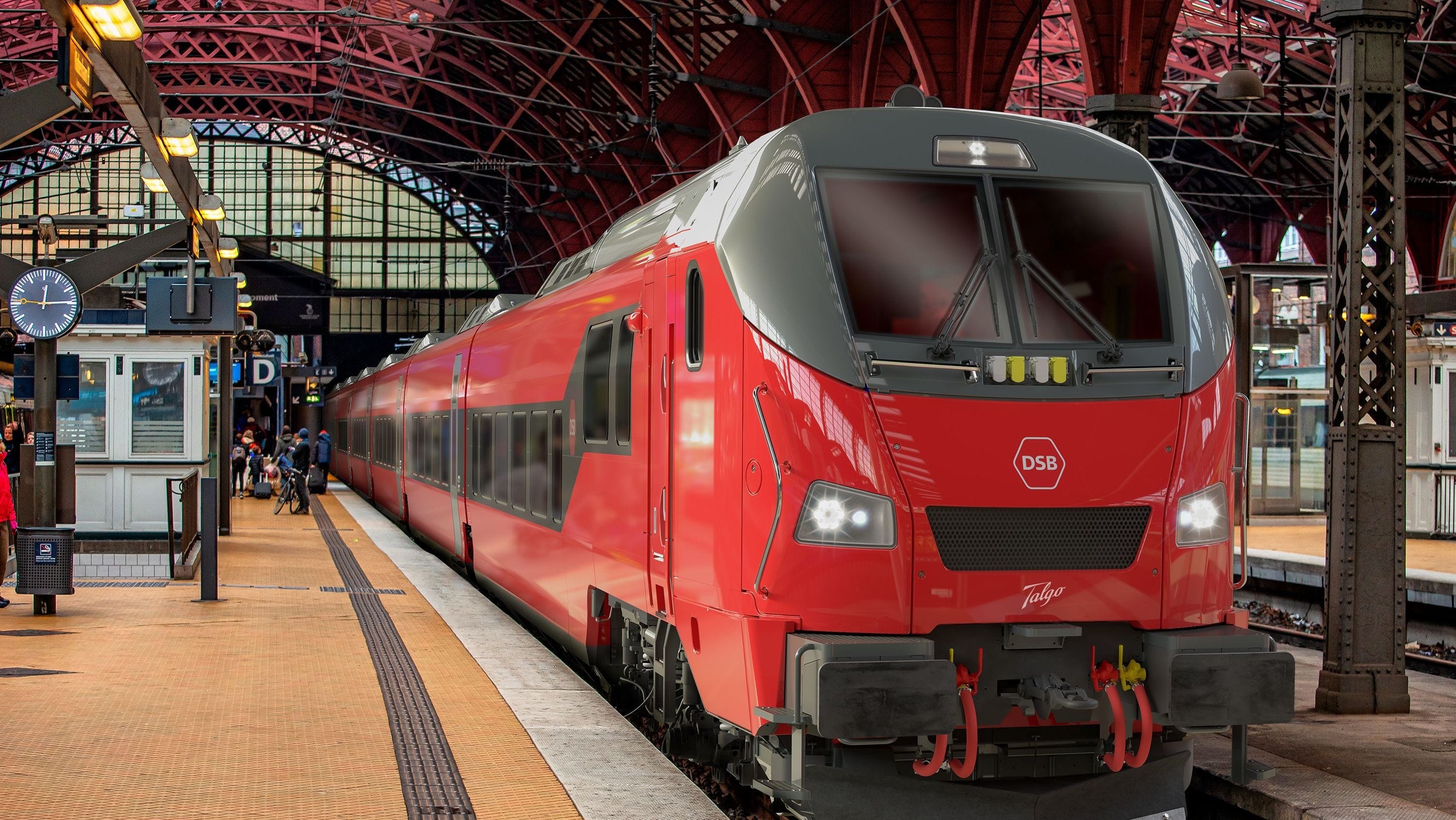
DENMARK: DSB’s Talgo-built EuroCity sets ran an average of 5,182 km between failures in January–August, the operator’s own figures show. That is the lowest of any DSB fleet, including the trouble-plagued IC4 diesel units.
The EuroCity (EC) sets entered service between Copenhagen and Hamburg on 3 November 2025, about a year later than DSB had planned. The operator ordered eight in February 2020 and doubled the order to 16 in 2023.
August was their best month so far at 11,795 km, and the first in which they ran further between failures than IC4, which recorded 6,720 km. In each of the other seven months of 2026 the EC sets came out below IC4.
IC3 runs seven times further between failures
Year to date, DSB’s IC3 diesel units ran 36,741 km between failures, about seven times the EC figure. The IR4 electric units recorded 34,090 km and the Vectron locomotives that haul the EC sets 33,142 km.
IC4, built by Italy’s AnsaldoBreda and delivered years behind schedule, stood at 7,852 km. It remains the benchmark for failed rolling stock procurement in Denmark. Eight months of data cannot show whether the EC fleet is heading the same way.
The EC figure covers the coaches alone, as DSB counts the locomotives separately. The IC3, IC4 and IR4 figures also include failures in their own traction systems. The German IC1 coaches, which ran alongside the Talgo sets until May, recorded 10,256 km between failures in 2026 before DSB withdrew them.
Fewer than seven sets for service
DSB had nine EC sets approved for service at the end of August, one more than the first batch of eight. In August an average of 1.24 sets a day were in the workshop, 0.76 of them for repairs and 0.48 for scheduled maintenance. One more set was held as planned operating reserve, leaving fewer than seven for scheduled services.
Today the sets are hauled by Vectron locomotives, typically one at each end. The rest of the second batch is due by 2027 together with 16 driving trailers. According to Talgo, a driving trailer will replace one of the longer end cars in each set, allowing push-pull operation with a single locomotive.
Monthly figures
The monthly figure has varied widely, with falls in April, May and July. At 3,402 km, May was the weakest month since January.
DSB publishes the figures every month under its public service contract with the transport ministry.
Three reasons, no bicycles
Each set has space for eight bicycles. DSB has not sold bicycle tickets for them since services began in November 2025, so the spaces have never been used by passengers.
Curiously, the operator has given three different explanations. Asked by Danish tabloid Ekstra Bladet, DSB first said it held back to secure stable operations, then pointed to summer track work that put passengers on replacement buses. It now cites the fitting of driving trailers.
It hopes to start selling bicycle tickets in early 2027, more than a year after the trains entered service.
The Talgo 230 platform behind the EC sets has also been ordered by Deutsche Bahn as ICE L and by FlixTrain for up to 65 trains. Sweden’s Trafikverket has ordered 20 day and night trains.