

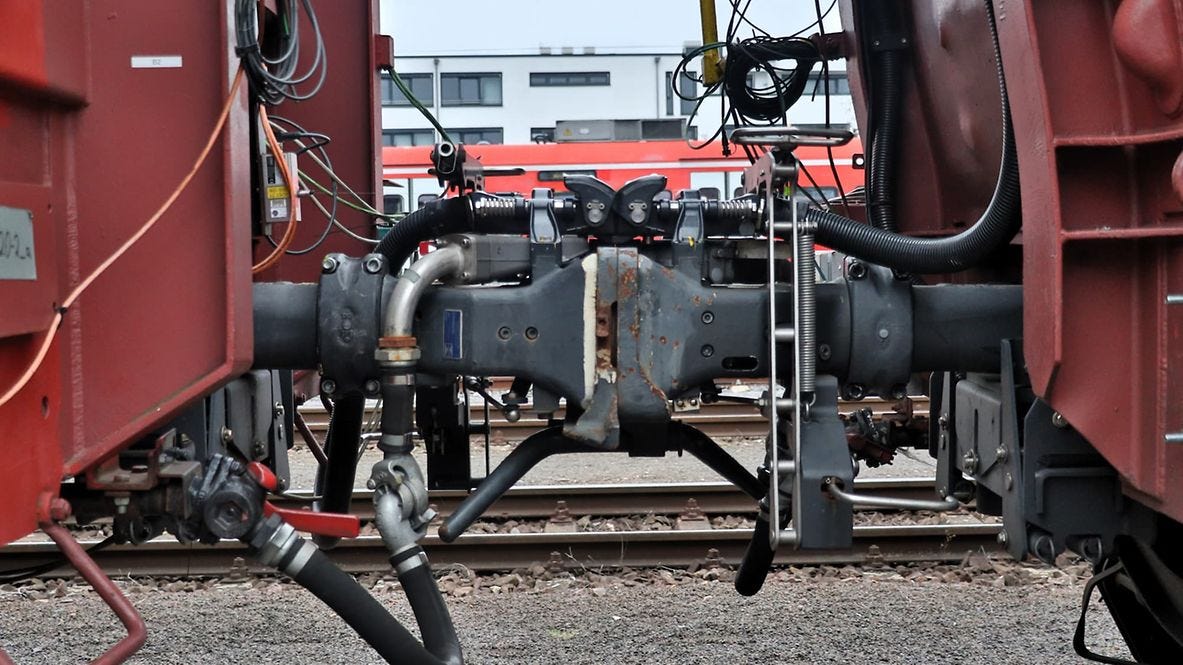
A bogie is the wheeled underframe assembly on which a rail vehicle carbody rests, guiding the vehicle along the track and isolating its structure from wheel–rail interaction forces.
A standard bogie consists of a steel frame carrying two wheelsets, primary suspension between the axle boxes and the frame, secondary suspension between the frame and the carbody, and a braking arrangement acting on the wheels, on wheel-mounted discs, or on axle-mounted discs.
Function and layout
The bogie transfers traction and braking forces longitudinally through a centre pivot or traction links; in normal operation, lateral forces pass through the shear stiffness of the air springs and the lateral dampers, with side stops engaging only at large displacements as an end limit.
As with other rolling stock components, bogie design is a compromise between competing load paths rather than a single fixed solution.
Steered bogies, used on some high-speed and articulated designs, adjust wheelset yaw actively or passively to reduce flange forces in curves.
Two-axle bogies are standard on most European passenger rolling stock. Three-axle bogies appear on heavy freight locomotives, where the extra axle spreads the vehicle’s weight to keep axle load within limits.
Primary and secondary suspension
Primary suspension acts between the axle box and the bogie frame, using coil springs, rubber–metal conical elements, or a combination of both. Its function is to absorb high-frequency wheel–rail irregularities and limit axle box movement relative to the frame.
Secondary suspension acts between the bogie frame and the carbody, providing ride comfort and lateral stability.
Air springs are standard on modern passenger stock. They maintain constant carbody height under varying loads by adjusting internal pressure, and their lower vertical natural frequency improves ride comfort compared with steel springs.
Running dynamics and standards
Vehicle running dynamics — including the contribution of the bogie and its suspension — are assessed against EN 14363, which defines limits for wheel–rail forces, body accelerations, and derailment safety criteria.
The Nadal criterion governs the ratio of lateral (Y) to vertical (Q) wheel forces; exceedance indicates derailment risk. EN 14363 assessment is based primarily on on-track testing, supplemented by stationary tests and, under defined conditions, simulation; roller rigs are used for stability research rather than as an approval route in their own right.
EN 13749 specifies structural requirements and fatigue assessment methods for bogie frames.
Minimising unsprung mass reduces track forces and wear at high speed, and is a primary design constraint on motor and brake disc mounting arrangements.
Unsprung mass is the wheelset’s mass together with all components fixed to it that are not vertically isolated by the primary suspension — axle-mounted brake discs, gear wheels, bearings and axle boxes among them — plus half the mass of the primary suspension itself; bogie-frame-mounted traction motors count as sprung mass even though their driveline rotates.
Active suspension
Electro-hydraulic and electro-pneumatic active lateral suspension systems are in service on selected high-speed platforms, applying corrective forces to the carbody in curves to reduce passenger lateral acceleration.
Active lateral suspension shifts the passenger comfort limit rather than the underlying track forces: running a curve faster at unchanged cant still increases unbalanced lateral force, and the relevant design margin is cant deficiency — the shortfall in cant relative to the speed being run — not cant excess, which arises at speeds below the balancing speed. Raising the permissible curve speed itself is the function of body tilting, a separate technology from active lateral suspension.
Passenger comfort limits are set in EN 12299, with permissible cant deficiency defined in EN 13803 and in the TSI for Infrastructure (TSI INF).