

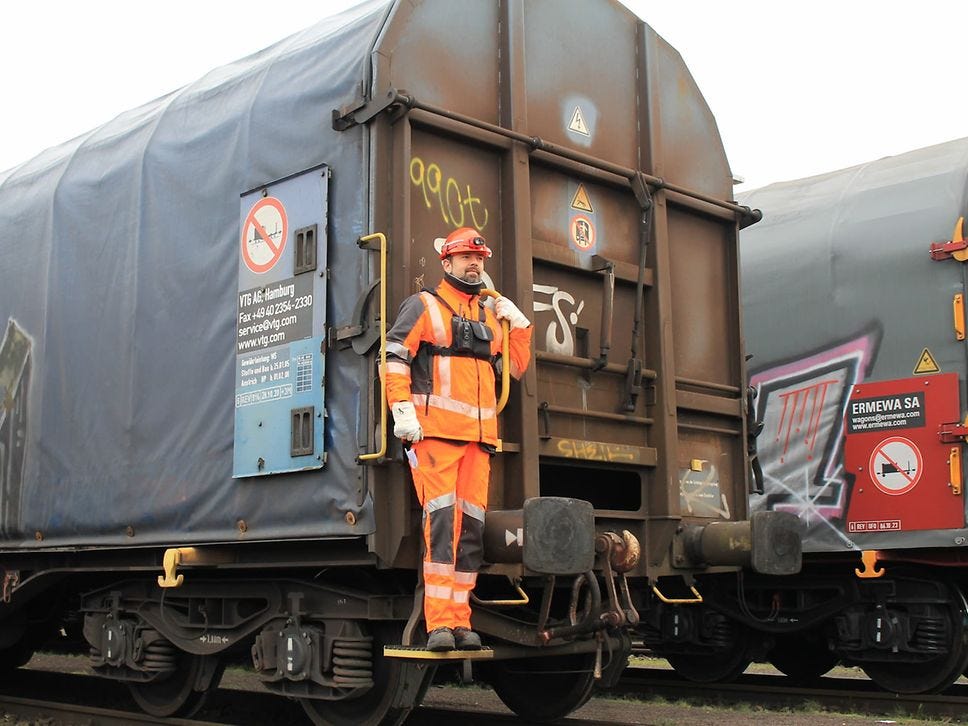
GERMANY: DB Cargo can mobilise around 900 freight wagons, 300 of them immediately, to carry chemicals and steel that can no longer move by river, after the Rhine at Cologne fell to its lowest level on record. The company is also preparing to bring wagons that have stood unused for years back into service, according to a paper its chief has given the transport ministry.
The paper by DB Cargo chief executive Bernhard Osburg went to the transport ministry’s cross-modal low-water coordination round and was reported by Rheinische Post on 15 August. It states that further wagon capacity will be sought in the European market and that extra trains for chemical and steel customers are being run “with full focus”. He has said 900 wagons can replace around 200 barges.
The Cologne gauge read 55 cm on 12 August, below the previous record low of 69 cm from October 2018, and stood at around 48 cm on 15 August. The long-term mean is 2.97 m.
400 wagons, 900 three days later
At a video conference of federal and Land transport ministers on 12 August, the DB Cargo chief executive said the company could mobilise around 400 wagons ad hoc and up to 500 more over the coming months for a permanent standby fleet — with the financing of that fleet still to be settled, according to Deutsche Presse-Agentur (dpa). Federal transport minister Steffen Bilger said after the meeting that levels on the Rhine and Danube would stay very low for now.
DB’s group statement of 6 August put DB Cargo at up to 1,500 freight trains a day and said standby concepts were being agreed with energy suppliers as low water pushed up demand for coal transports. DB InfraGO has appointed a special low-water coordinator for north–south flows along the Rhine and Elbe.
The road takes the rest
Twelve Länder had by 13 August relaxed or suspended the Sunday driving ban for lorries, with exemptions running until the end of September at the latest. The passenger lobby PRO BAHN said on 14 August that regional and long-distance passenger services must not be thinned out to make room for freight.
The extra trains run on a network already constrained by corridor closures under the Generalsanierung. Neither DB Cargo nor the ministry has published figures for how much traffic has so far moved from barge to rail.
Restructuring year
The low-water traffic falls in the year DB Cargo is required to run profitably under the EU state-aid decision on its restructuring. The freight operator closed the first half of 2026 with a net loss of EUR 1m.
Who pays to hold a standby fleet between low-water years is not settled. DB Cargo has named the number of wagons, not the source of the money.