

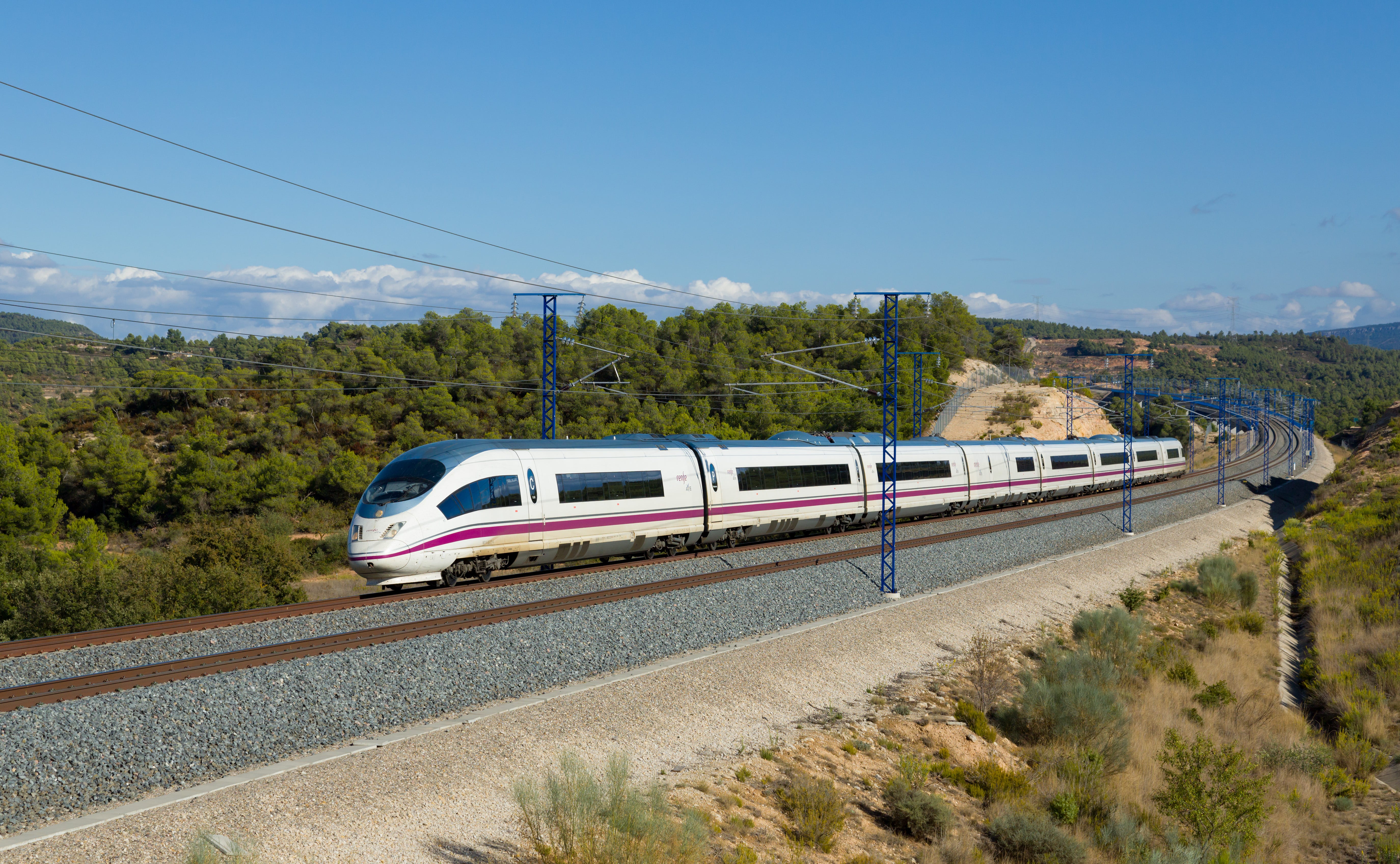
COMMENTARY: Spain’s transport minister argued that Chinese production speed made CRRC a legitimate contender. The tender’s delivery criteria turned that argument against him.
By Dan Jensen
Spain’s national operator approved the purchase of up to 40 trainsets at 350 km/h on 25 March, with the base order valued at EUR 1.36bn. The first five trains must be in service within 40 months of contract award.
The filter in the small print
The political theatre around this tender has been running. Transport minister Óscar Puente toured Chinese factories. He made statements about not letting protectionism get in the way of operational urgency. CRRC was in the frame. The headline wrote itself: Spain’s transport minister: our next high-speed fleet may be Chinese.
Then the actual tender document landed.
Read it carefully and the China question effectively answers itself. The first five trainsets must be in service before month 40. The full fleet must be operational by month 78, with one new train delivered every six weeks.
Manufacturers without an established European homologation track face a certification process that can take up to two years of testing on continental infrastructure — making the month-40 threshold difficult to meet from a standing start. Where a trainset is authorised for use across more than one member state, approval from the European Union Agency for Railways (ERA) is required.
CRRC has no high-speed train with ERA type authorisation. The CR450 platform, which generated the ministerial interest, has never turned a wheel on European infrastructure. For CRRC to bring a certified high-speed trainset into Spanish service within 40 months of contract award would require clearing a regulatory process that established European manufacturers have spent years navigating.
The delivery argument that backfired
Puente’s case for keeping China in contention rested on a specific premise: that European manufacturers cannot deliver fast enough, and that CRRC’s production capacity makes it a legitimate answer to an urgent operational problem. It is not an unreasonable argument on its face.
CRRC produces at volumes no European manufacturer can match. Factory-to-platform lead times from Qingdao are genuinely shorter than from Munich or Valenciennes, if production capacity is all you are measuring.
Austria’s Westbahn made exactly that calculation. The private operator ordered CRRC double-deck units after concluding that Europe’s rail market was an oligopoly — too few suppliers, too little competition, rising costs. The trains are now nearing approval after a certification process that began with test runs in 2022.
It worked. But it took years, and the trains are regional units, not 350 km/h high-speed sets operating under ERA multi-country authorisation.
In service or not in service
A train leaving a Chinese factory is not a train in service in Spain. Between those two points sits ERA type authorisation, approval from Spain’s national safety authority AESF, integration and testing of ETCS and Spain’s ASFA train protection system on live infrastructure, crew training, spare parts supply chains and maintenance setup.
Puente was comparing two different things: Chinese production speed and European delivery speed. They are not the same measure. The harder he pressed on delivery pace as the decisive criterion, the more he was cementing precisely the requirement that makes CRRC’s position most difficult.
Who actually has it on the shelf?
The real competition runs between manufacturers with active high-speed programmes in Europe and at least some existing relationship with Spanish or ERA certification processes.
Siemens is the frontrunner. The Velaro platform has been running on Spanish infrastructure for years — the S-103 fleet has operated on the Madrid–Barcelona corridor since 2007. Siemens is pitching the Velaro Novo, the next-generation development of the same architecture, currently in advanced testing. Spanish infrastructure familiarity, existing maintenance relationships, established ERA authorisation track record. The box-ticking exercise is relatively short.
Hitachi enters with the Frecciarossa 1000, which holds ERA multi-country authorisation and has operated in Spain — Iryo uses it. That gives Hitachi a genuine Spanish operational reference and a very strong position. Renfe will push hard on delivery capacity and industrial footprint questions.
Alstom brings the Avelia Horizon — the TGV-M — but carries baggage. The platform is new, has not accumulated the operational hours of the Velaro, and Alstom’s production pipeline is currently under strain from delivery backlogs on contracts in France, Germany and Denmark. Not impossible, but complicated.
Talgo is the wild card and the politically loaded one. Talgo is developing a faster, distributed-traction evolution of the Avril specifically for this tender. The Avril itself just cleared European certification — but part of the fleet had to be taken out of operation in 2025 due to the discovery of cracks in bogie frames, and its 350 km/h successor is not yet built.
Talgo is essentially bidding on a development programme, not a production-ready product. Renfe awarded Talgo the last major high-speed contract in 2015–16, and those trains were delivered more than two years late.
CAF is effectively ruled out, as it does not produce trains certified for 350 km/h operations.
The structural logic
Delivery speed as a scored criterion is a legitimate and frequently used instrument. Whether it was designed with CRRC specifically in mind is a question that will not be answered in any official document.
What the tender actually reveals is simpler: when the political noise settles, Renfe needs trains that can be certified, delivered and maintained within a realistic industrial timeline.
That narrows the field considerably — and Siemens, with a proven platform, Spanish infrastructure experience and a functioning production line, starts in the strongest position.
Previously on this topic:
Renfe issues high-speed tender with China in play – Mar. 2026
Spain raises stakes on delivery speed in Renfe high-speed tender – Jan. 2026
Hungary: Europe’s bottlenecks are making us consider “100 trainsets from China” – Jan. 2026
Spain’s transport minister: our next high-speed fleet may be Chinese – Dec. 2025
China-built trains are coming — because Europe can’t keep up – Nov. 2025