

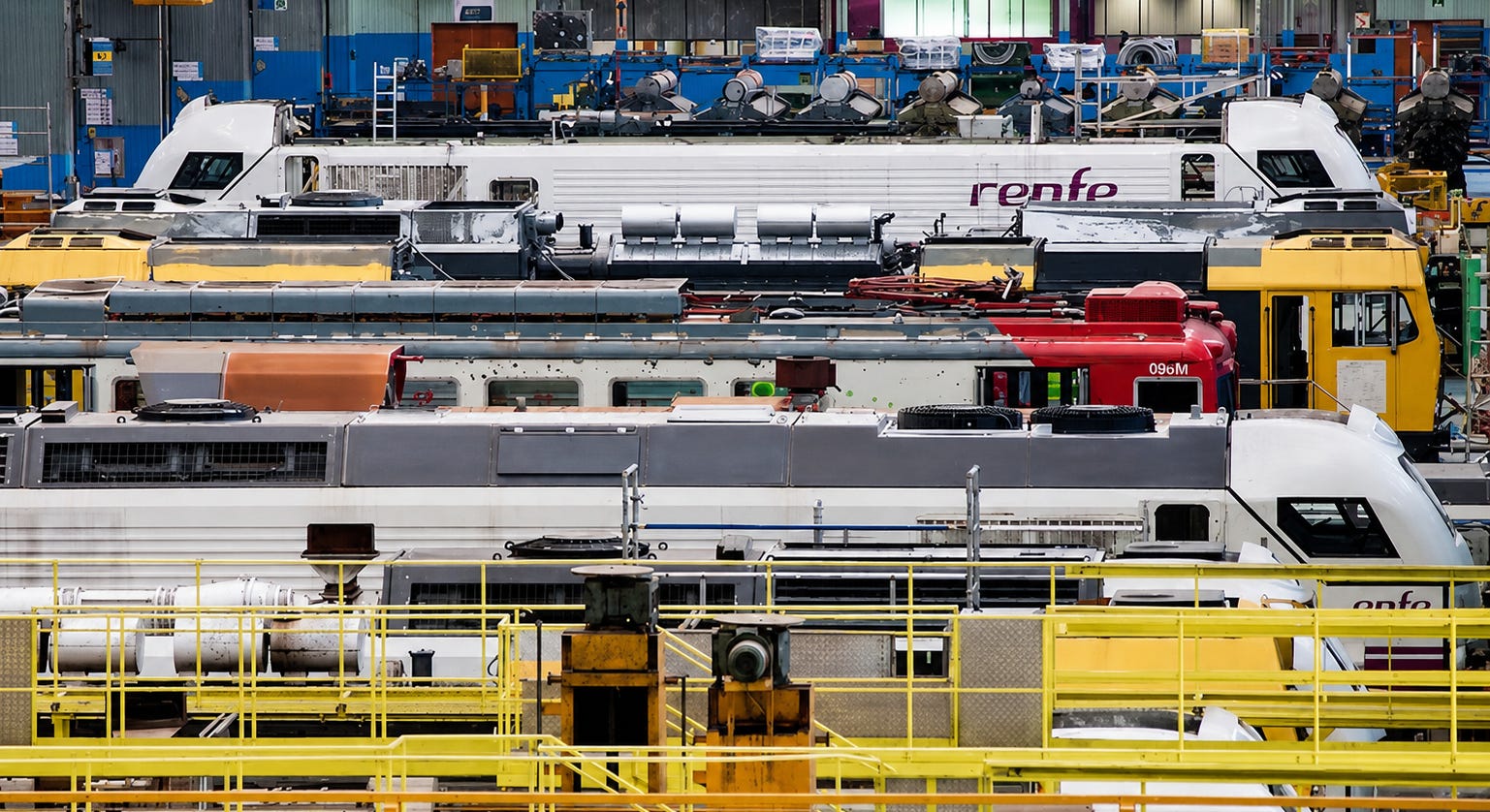
SPAIN: Renfe has filed a legal challenge against Spain’s competition regulator after it ordered the national operator to open its heavy maintenance workshops to rival Iryo — a move that tests whether liberalisation extends beyond tracks and timetables to the industrial infrastructure that keeps trains running.
Spain’s competition regulator, the Comisión Nacional de Mercados y la Competencia (CNMC), ordered Renfe to provide Iryo access to its La Sagra and Valladolid facilities for heavy maintenance of the operator’s 109-series trains. Renfe filed proceedings at the Audiencia Nacional in mid-May.
The case goes to the core of what open access means in practice: Iryo operates Frecciarossa 1000 trainsets that require specialist heavy maintenance capacity that does not exist outside Renfe’s network in Spain.
Maintenance bottleneck at the centre of access dispute
CNMC’s order is based on non-discriminatory access obligations under Spanish and EU rail-access rules: because Renfe publishes and offers heavy maintenance as a service, it is required to provide it to competitors on equal terms. For Iryo, the stakes are operational. Without access to heavy maintenance, the 109-series trains cannot remain in service on the schedule Iryo needs to compete.
Renfe’s position is the inverse. Opening La Sagra and Valladolid to a direct competitor means sharing infrastructure built and financed for its own fleet — and potentially subsidising the operational capacity of the operator taking market share on Spain’s highest-revenue corridors.
Eighteen months of failed negotiations
The dispute did not begin in court. Iryo and Renfe spent eighteen months in negotiations over workshop access. By December 2025 a commercial agreement was close. In February 2026, Renfe broke off talks without explanation. CNMC’s intervention followed.
That sequence matters for how the legal challenge is read. Renfe is not contesting a regulator that moved without warning — it is contesting an order that arose directly from its own decision to walk away from a near-finished deal.
The limits of liberalisation
Spain opened its high-speed network to competition in 2021. Iryo launched in 2022, running Frecciarossa 1000 trainsets on the Madrid–Barcelona and Madrid–Valencia corridors. The liberalisation framework addressed access to paths, stations and slots.
Heavy maintenance sat in a different category — covered under service-facility rules but not operationally resolved. No independent facility in Spain is equipped to handle the overhaul cycles that high-speed trainsets require. That left Iryo structurally dependent on the operator it competes with.
What the court decides next
The Audiencia Nacional will now determine whether CNMC’s order stands. If it does, Renfe must open its facilities on terms the regulator sets. If it falls, Iryo’s maintenance options remain constrained by whatever commercial arrangement — if any — Renfe chooses to offer.
Either outcome will be read beyond Spain. European open-access operators on mature networks face variants of the same structural problem: liberalisation frameworks designed around infrastructure access have not systematically resolved the maintenance capacity that makes access usable. The Spanish case is among the first times a regulator has moved to correct that gap through a formal order — and the first time an incumbent has taken that order to court.