

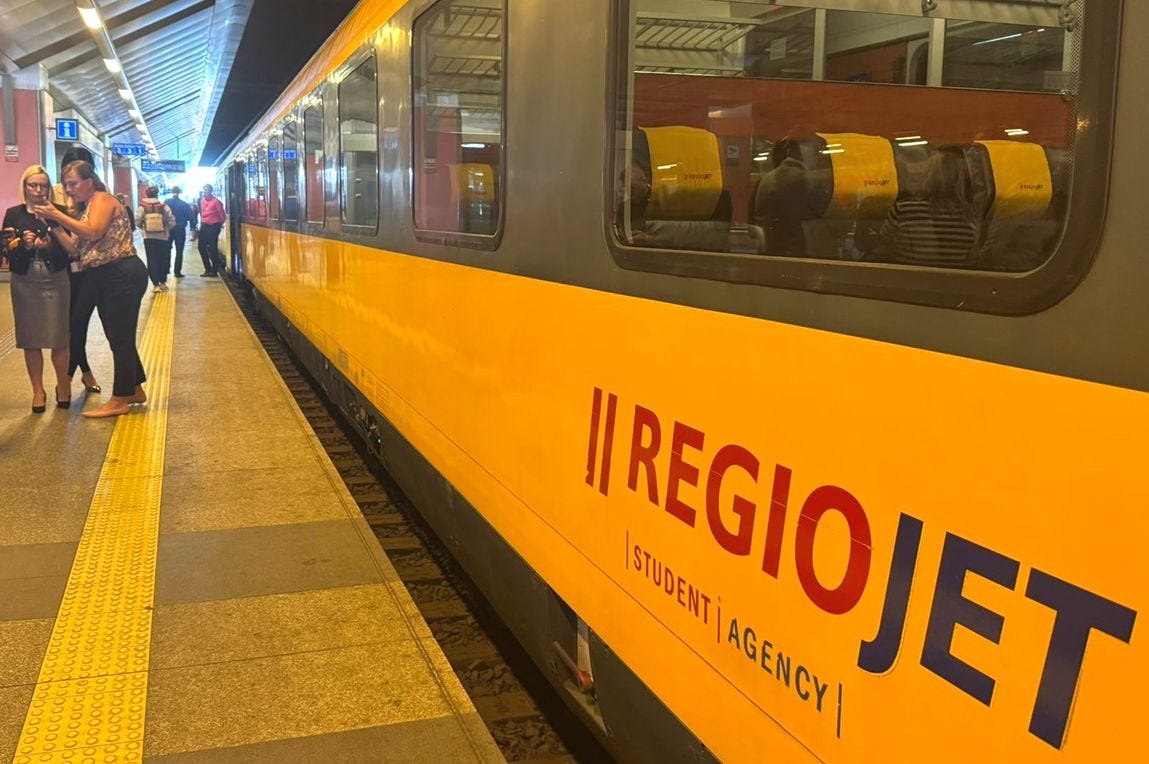
COMMENTARY: The barriers RegioJet described when it left Poland were real. They were also known before a single ticket was sold.
By Dan Jensen
On 7 April, Poland’s rail regulator UTK ruled that RegioJet had violated collective passenger interests by failing to operate 23 scheduled services in December 2025.
The finding was precise: opening ticket sales creates a binding legal obligation to passengers, regardless of what goes wrong operationally. Offering refunds does not undo the violation.
Two days later, RegioJet announced it was leaving Poland.
What RegioJet knew before it launched
RegioJet’s first domestic Polish train ran on 18 September 2025. At that point, the Czech operator had no depot of its own in Poland, no employed drivers of its own in Poland, and no guaranteed access to station sales points. These were not obstacles that emerged during operations. They were the conditions under which RegioJet chose to launch.
The depot situation illustrates the problem. RegioJet had won an auction for a maintenance facility in Warsaw’s Praga district in August 2025 — the only bidder, at over 55 million PLN. The sale was never finalised. RegioJet says PKP SA repeatedly postponed it. PKP SA has not addressed the allegation directly. What is not in dispute is that RegioJet went into its December timetable expansion without the facility it had expected to have.
The driver situation is more straightforward. RegioJet relied on an external supplier for train drivers at launch while simultaneously recruiting Polish staff with substantial sign-on bonuses. When that supplier could not meet the demand of the expanded December timetable, 23 services failed to run.
Approximately 1,080 scheduled runs were disrupted across the Christmas period, affecting an estimated 250,000 seat bookings. UTK had been writing to RegioJet about substitute transport failures since 5 December — before the timetable change had even taken effect.
The barriers were real — but they were not new
RegioJet’s allegations against the PKP group deserve to be taken seriously. PKP Intercity’s promotional pricing on Kraków–Warsaw following RegioJet’s entry — Pendolino tickets that had rarely fallen below 169 PLN appearing at 50 PLN — was independently observed by Polish financial media, not just by RegioJet’s press office.
PKP PLK removed four train paths from RegioJet in January 2026 on utilisation grounds, reassigning them to PKP Intercity. PKP SA confirmed an internal audit was underway into the leasing of station space to companies competing with PKP Intercity — a notable concession that the issue was not invented.
None of this was hidden. The structural conditions of the Polish market — a PKP holding group with influence across infrastructure, stations and the dominant operator — were visible before RegioJet sold its first ticket.
RegioJet knew it was entering a market that would resist it. It chose to scale aggressively rather than incrementally, and it chose to do so before its operational foundations were in place.
Leo Express is still there
One month before RegioJet’s exit announcement, Czech operator Leo Express launched its own Kraków–Warsaw service. Two daily pairs, Stadler FLIRT trainsets, over 100,000 tickets sold before the first departure. Leo Express has announced plans to scale to four daily pairs by June 2026. It has no plans to leave Poland.
Leo Express faces the same market. The same PKP holding structure. The same infrastructure manager. It entered more quietly, more incrementally, and with its own rolling stock from day one. Its continued presence does not prove the Polish market is fair. It does make it harder to argue the market is impossible.
Two days
UTK issued its ruling on 7 April. RegioJet announced its exit on 9 April. The statement made no reference to the regulatory finding. It focused on PKP group obstruction, predatory pricing and structural barriers — the same arguments RegioJet had been making since December.
The question the Polish episode leaves open is not whether the barriers were real. They were. The question is what is required of an open-access entrant that wants to survive on a hostile market — and whether systemic criticism, however justified, is a substitute for the operational foundations that protect passengers when things go wrong.
It is not.
RegioJet exits Poland’s domestic rail market

POLAND: Czech open-access operator RegioJet announced on 9 April it will end all domestic Polish services on 3 May, citing infrastructure barriers and what it described as predatory pricing by s…