

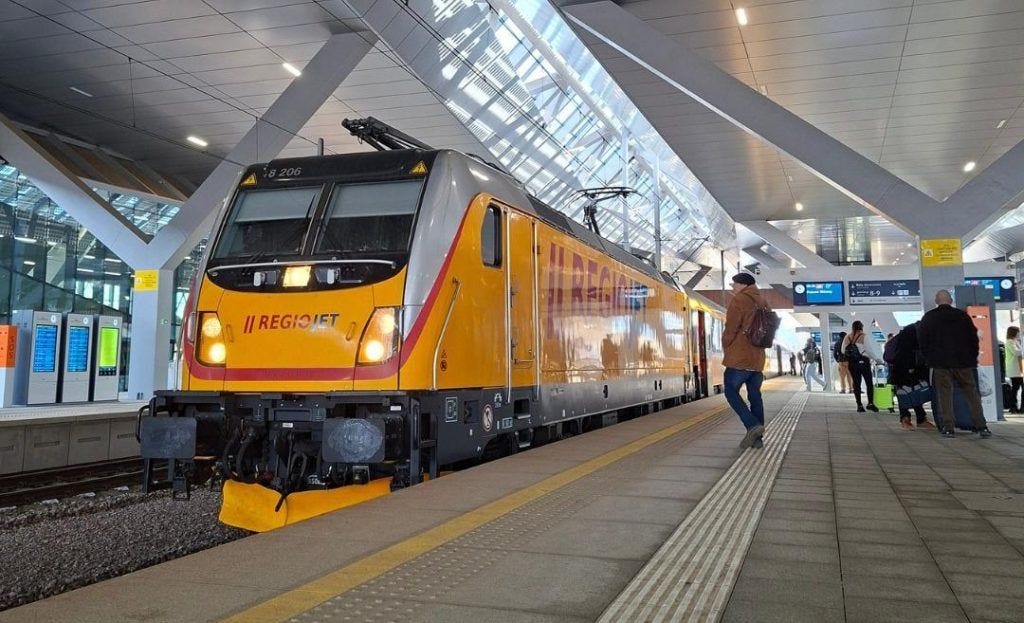
POLAND: Czech open-access operator RegioJet announced on 9 April it will end all domestic Polish services on 3 May, citing infrastructure barriers and what it described as predatory pricing by state rival PKP Intercity.
Routes on the Kraków–Warsaw–Gdynia and Poznań–Warsaw corridors will cease on 3 May, with passengers due full refunds and 100 zloty (€23.50) in compensation. International services between Warsaw and Prague and between Przemyśl and Prague via Kraków will continue.
RegioJet’s short Polish chapter
“Unfortunately, we must end our operations on the domestic market in Poland,” founder and majority owner Radim Jančura told employees in a message seen by Polish financial news site Money.pl.
RegioJet said it had lost hope of operating under current conditions and was ready to return “when the market is truly open and provides fair and transparent conditions”.
What RegioJet says went wrong
The company alleged that PKP Intercity cut ticket prices by up to 70% following RegioJet’s market entry — a practice RegioJet said competition law would classify as illegal predatory pricing aimed at eliminating a new entrant.
RegioJet also alleged that it had won an auction for a PKP Cargo depot in Warsaw’s Praga district in August 2025 but that the transaction had not been finalised, leaving the operator without adequate maintenance facilities in Poland. Without a depot, the Czech operator said it was forced to carry out repairs outdoors and conduct more serious maintenance in the Czech Republic.
The company further alleged that its marketing campaign at Polish stations had been terminated and that it had been prevented from opening ticket offices.
PKP Intercity rejected the allegations relating to competition, pricing and train path allocation in a statement issued the same day, saying it had not taken any action to limit competition and that it had no authority over infrastructure access or train path allocation, which it said rested with the independent infrastructure manager and regulator.
PKP SA separately addressed allegations relating to station marketing, ticket office access and facility arrangements, according to statements reported by Polish media.
UTK ruling adds pressure
Days before the withdrawal announcement, Poland’s rail regulator UTK issued a ruling on 7 April finding that RegioJet had engaged in unlawful practices by failing to operate 23 scheduled services in December 2025.
The affected services comprised seven on the Warsaw–Kraków route, four between Gdynia and Kraków, and 12 on the Poznań–Warsaw corridor. UTK said the cancellations violated the collective interests of rail passengers, noting that opening ticket sales created a binding obligation to operate services regardless of operational difficulties.
Under Polish rail law, UTK may now open separate proceedings to impose a fine of up to 2 % of RegioJet’s annual turnover. The Czech operator’s total revenue in 2024 was approximately €168 million, placing the potential penalty at up to EUR 3.4 million.
The ruling is not final: RegioJet has 14 days to request reconsideration by UTK or 30 days to appeal to the Provincial Administrative Court in Warsaw.
Open-access entry friction in Europe
RegioJet entered the Polish domestic market on 18 September 2025 with a single daily Kraków–Warsaw service, promising fares at half the price of PKP Intercity’s Pendolino.
A full timetable was due from December 2025 but the launch collapsed when the operator cancelled 1,080 services, affecting an estimated 250,000 seat bookings during the Christmas peak. RegioJet attributed the cancellations to staff shortages from an external driver supplier. Full timetable operation was not restored until 1 March 2026.
RegioJet said the difficulties it encountered — depot access, restricted sales points, and incumbent pricing pressure — reflected structural barriers facing open-access entrants across Europe.
The Czech operator received no public subsidy in Poland, while PKP Intercity receives state funding for approximately 90% of its connections, according to RegioJet’s statement.