

Starting today, The Rail Agenda moves from two to three weekly editions: the Monday, Wednesday and Friday Briefs.
The expansion is possible because the editorial team has grown. The Rail Agenda is now produced by a small team of business journalists, led by editor and publisher Dan Jensen — giving the newsletter the resources and flexibility to publish three times a week throughout the year.
Slow trains bring the plane back to Madrid–Barcelona
SPAIN: Vueling will fly Barcelona–Madrid again from 5 October, with tickets on sale to 29 March 2027. The airline, part of International Airlines Group (IAG), left the route in March 2025, leaving Iberia as the only operator — and returns while speed restrictions keep the fastest trains above three hours.
The flight schedule is timed to the rail restriction but not bounded by it: Adif’s works run past 13 December, while Vueling’s tickets are already on sale to March 2027.
Iberia has been the sole airline on the route since March 2025. From October, two IAG carriers will compete for the corridor’s business traffic against three rail operators.
Rail’s next battle: winning while the network is rebuilt
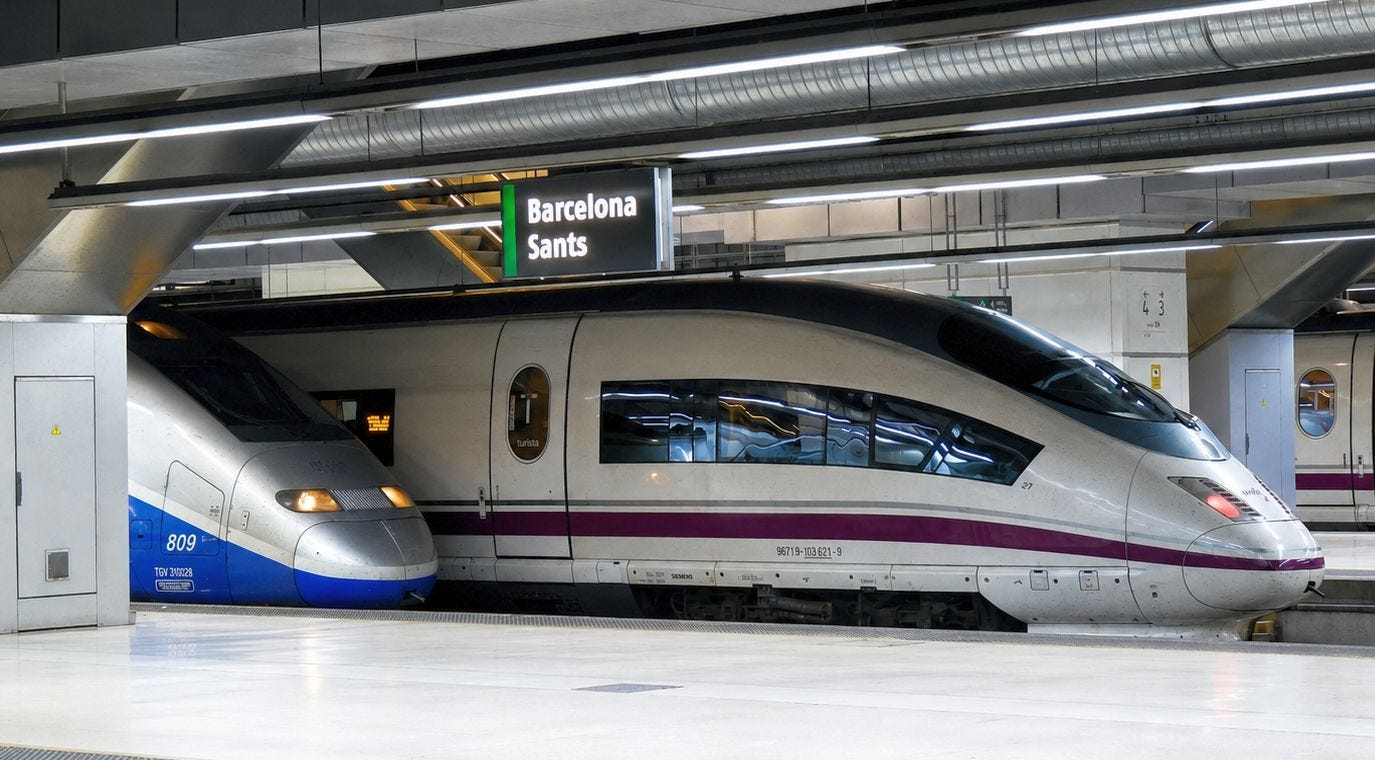
The corridor has been regarded as the showcase for how rail takes territory back from aviation. The proposition was simple: much faster city to city than flying, high comfort on board — and arrival in the centre of Madrid and Barcelona, not at an airport outside them. Within years of the line opening in 2008, the train carried the majority of the traffic.
By Dan Jensen
Spain’s markets regulator (CNMC) figures show corridor demand fell 13 per cent year on year in Q4 2025 and 17 per cent in Q1 2026, with Renfe’s share down six points to 56 per cent — while seat supply fell only 4.4 per cent.
More than 30 speed limitations remain and the agreed reduction runs to 13 December, with works extending beyond it. On 29 July the CNMC asked Adif to adjust track access charges for the duration.
Adif’s under-traffic renewal sits opposite DB’s full-closure Generalsanierung — two models for the same first-generation network, with digitalisation adding a further wave of works.
Czech Railways’ record contract cleared as rival backs down
RegioJet will not appeal the award of the largest rail contract in Czech history. The decision leaves state operator České dráhy (ČD) clear to sign 30 years of commuter operation in Prague and Central Bohemia, bid at CZK 165bn (around EUR 6.7bn).
Two approvals remain: the Central Bohemian assembly on 6 September, then Prague’s councillors. Rolling stock is a separate decision — Škoda Group offered the best terms, but no supplier has been chosen.
With Arriva out before final bids, the tender ended as a two-way price contest that ČD won by roughly CZK 18bn on a 30-year valorised basis.
Report finds serious flaw in SNCF Réseau safety system
FRANCE: The country’s land transport accident investigation bureau (BEA-TT) has concluded that SNCF Réseau lifted traffic restrictions on a flood-damaged freight line after on-site inspections failed to detect the washouts under the track, calling the failure “a very serious flaw” in the infrastructure manager’s monitoring and safety system. The first train sent down the line derailed.
The report’s weight falls on the inspection process rather than the rules: procedures were followed, yet six breaches under the track went undetected before the line reopened.
Recommendations extend beyond SNCF Réseau to two ministry directorates, with a 10 November deadline for responses on planned action and timing.
Stadler puts CHF 33 million into its Biel steel foundry
SWITZERLAND: Stadler will invest around CHF 33 million (EUR 35 million) in modernising and expanding its steel foundry in Biel. The company says the plan secures the site’s 115 jobs and will grow the foundry’s headcount by around five percent, and it adds a new dispatch hall, with the upgraded facility due to enter operation in 2028.
Biel is Stadler’s in-house source of castings, holding DB’s HPQ qualification and EN 15085-2 welding certification — a status the rebuild is designed to carry past 2028.
Beyond capacity, the plan targets roughly 15 percent lower energy use and around 80 percent less casting waste.
Railcare signs new Trafikverket framework agreement
INDUSTRY: Railcare has signed a new three-year framework agreement with infrastructure manager Trafikverket, keeping the company’s vacuum excavation machines available for maintenance call-offs across Sweden from February 2027.
The framework starts 1 February 2027 with two optional one-year extensions, and brings Railcare’s electric and battery machines into the call-off scope alongside the Railvac fleet.
It follows the February 2026 decision to wind down UK contracting, concentrating the Construction business on its largest customer.
That’s The Rail Agenda for today. If you found this newsletter useful and relevant, please forward it to someone you know.