

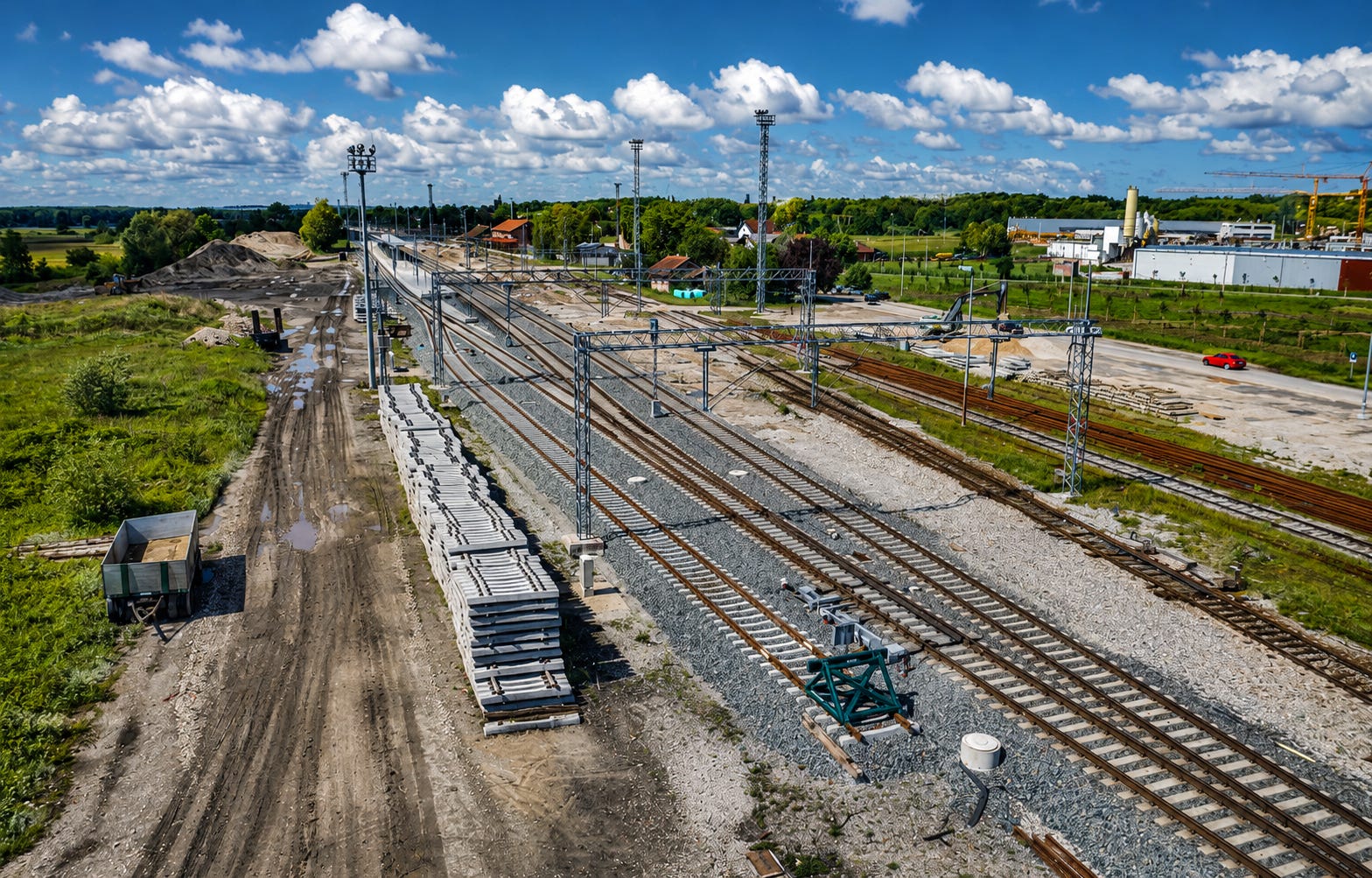
The selection of an Indian contractor for a EUR 677m railway upgrade in Croatia is not just a procurement outcome — it is the first concrete signal that Indian engineering, procurement and construction firms are moving into European rail infrastructure, and the structural conditions that produced it are not going away.
By Dan Jensen
On 11 May, Croatian infrastructure manager HŽ Infrastruktura selected Afcons Infrastructure, an Indian engineering, procurement and construction (EPC) contractor, to reconstruct and double-track 83 km of TEN-T corridor between Dugo Selo and Novska. It is Afcons’ first European contract and their largest international order to date.
The selection attracted little attention outside Croatia. It should have attracted more.
The door that opened
The European Court of Auditors confirmed in January 2026 that the EU will miss its 2030 TEN-T core network deadline. Costs on audited megaprojects have almost doubled. Rail Baltica now carries a price tag almost four times the original estimate.
Europe has the funding, but it does not have the contractors to deliver it. The gap is sharpest in central and eastern Europe, where cohesion funding is most concentrated and local EPC capacity is thinnest.
An Indian private contractor winning EU-funded infrastructure is unproblematic in ways a Chinese state-owned enterprise is not.
Why India, and why now
Afcons Infrastructure is owned by the Shapoorji Pallonji Group, one of India’s oldest private industrial conglomerates. It carries no subsidy profile of the type that has triggered FSR scrutiny in European procurement. It competed on commercial terms and won on price and capability.
Consider what happened when CRRC sought to participate in the Lisbon light metro procurement. In April 2026, the European Commission conditionally cleared the tender after finding that CRRC’s Portuguese subsidiary had received subsidies giving the consortium an unfair advantage — requiring the Mota-Engil-led consortium to replace CRRC with Polish manufacturer Pesa as a condition of approval.
CRRC’s state ownership had exposed it directly to FSR scrutiny. Afcons faces neither that barrier nor the certification wall that blocks rolling stock entrants without ERA type authorisation.
The EU-India free trade agreement, whose negotiations concluded on 27 January 2026, adds political tailwind. An Indian private contractor winning EU-funded infrastructure is unproblematic in ways a Chinese state-owned enterprise is not.
The workforce equation
42% of European rail workers are over 50, according to the European Commission’s 9th report on the rail market, published in 2025. A recruitment crisis is already visible across the sector.
Dieter Feige has run Feige Business Advisors, an executive search firm specialising in European rail, since 1985. Over four decades he has placed candidates across Asian and European markets — and watched successive waves of non-European firms attempt to enter the industry. He is direct about where Europe’s problem sits today:
“Around a third of the rail workforce is set to retire by 2030, and with them goes an enormous amount of specialized knowledge that can’t be replaced overnight. Finding the right people is the bottleneck. Not funding, not materials, not political will.”
Dieter Feige also points to what awaits Afcons: not the trackwork, but everything around it — ERTMS standards, safety certifications, procurement rules that vary country by country, union frameworks, and institutional relationships that take years to build. Croatia is where Afcons starts acquiring that experience.
Indian private conglomerates are entering with a straightforward commercial rationale: they can fill a delivery gap.
Who comes next
Larsen & Toubro, India’s largest construction organisation, has grown its international order book to almost half of total revenue, with active rail references including the Jakarta MRT. Europe is not yet a named target geography in its public statements. The structural logic points in that direction.
Poland, Romania, Bulgaria, the Baltic states — markets where cohesion funding is densest and local EPC capacity most stretched — are the logical next step. Poland amended its procurement law in September 2025 to introduce new restrictions on non-EU contractors, but systematic application is not yet the norm.
Dieter Feige is direct about the underlying dynamic:
“Indian private conglomerates are entering with a straightforward commercial rationale: they can fill a delivery gap. They don’t carry the same geopolitical baggage, and, crucially, they fall outside the Foreign Subsidies Regulation framework. That gives them a considerably smoother path in, particularly in Eastern Europe, where the supply chain is thinning fast.”
What it means
The de-risking agenda was designed to reduce European dependence on Chinese state-owned enterprises. It did not set out to open the door to Indian private contractors. It opened anyway.
A new class of competitors is entering European rail infrastructure — with different cost structures, different delivery models, and decades of large-scale project experience. The first contract is in Croatia. The funding that will attract the next ones is already committed across the continent.
Related:
Croatia picks Indian contractor for EUR 677m TEN-T upgrade

CROATIA: HŽ Infrastruktura has selected Indian contractor Afcons Infrastructure to reconstruct and double-track 83 km of TEN-T corridor between Dugo Selo and Novska, …