

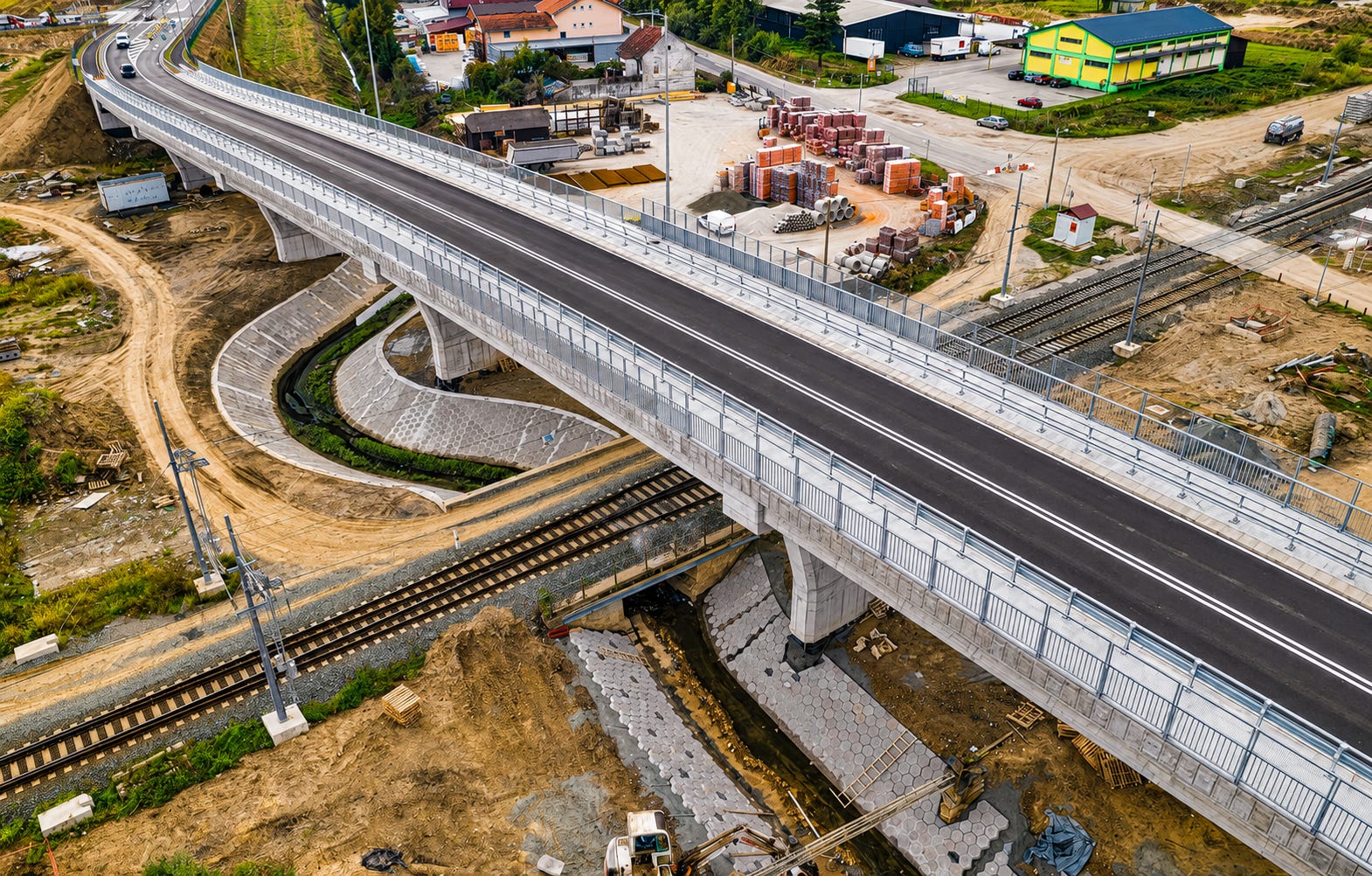
CROATIA: HŽ Infrastruktura has selected Indian contractor Afcons Infrastructure to reconstruct and double-track 83 km of TEN-T corridor between Dugo Selo and Novska, moving the project from procurement to delivery.
The contract, valued at EUR 677,055,750 excluding VAT, was announced 11 May. Contract signature follows once the selection decision becomes enforceable.
The works are scheduled to run for five years and ten months from mobilisation — placing final delivery in the early 2030s on a corridor that forms part of Pan-European Corridor X.
Scope covers track, stations and signalling
The project covers full reconstruction of the existing single track and construction of a parallel second track along the entire 83 km route. Stations at Dugo Selo, Ivanić-Grad, Popovača, Kutina and Novska will be upgraded, alongside new traffic control and signalling equipment, noise protection walls and electrical infrastructure works.
Once complete, the line will support operations at up to 160 km/h. Sections of the route are currently limited to 40–60 km/h following years of deferred maintenance.
Indian contractor’s European debut
The selection marks Afcons’ first entry into the European rail market. The Mumbai-based contractor operates globally across infrastructure sectors but has no prior European rail references.
HŽ Infrastruktura describes the project as Croatia’s largest ever railway contract.
Corridor X link between Zagreb and Belgrade
The Dugo Selo–Novska line forms part of Corridor X, which runs from Salzburg and Ljubljana toward Skopje and Thessaloniki. The section sits immediately east of Zagreb and carries both international passenger and freight traffic on a route that connects Croatia to Serbia.
Separate EU-funded upgrades are under construction on adjacent corridors toward Hungary — the Dugo Selo–Križevci and Križevci–Koprivnica sections — with both projects expected to reach completion in 2026–27.
EU funds cover 90% of project cost
The project has a total investment value of EUR 898.9m, co-financed through the EU’s Connecting Europe Facility and the Competitiveness and Cohesion Programme. The EU contribution covers approximately 90% of eligible costs across the two funding instruments.