

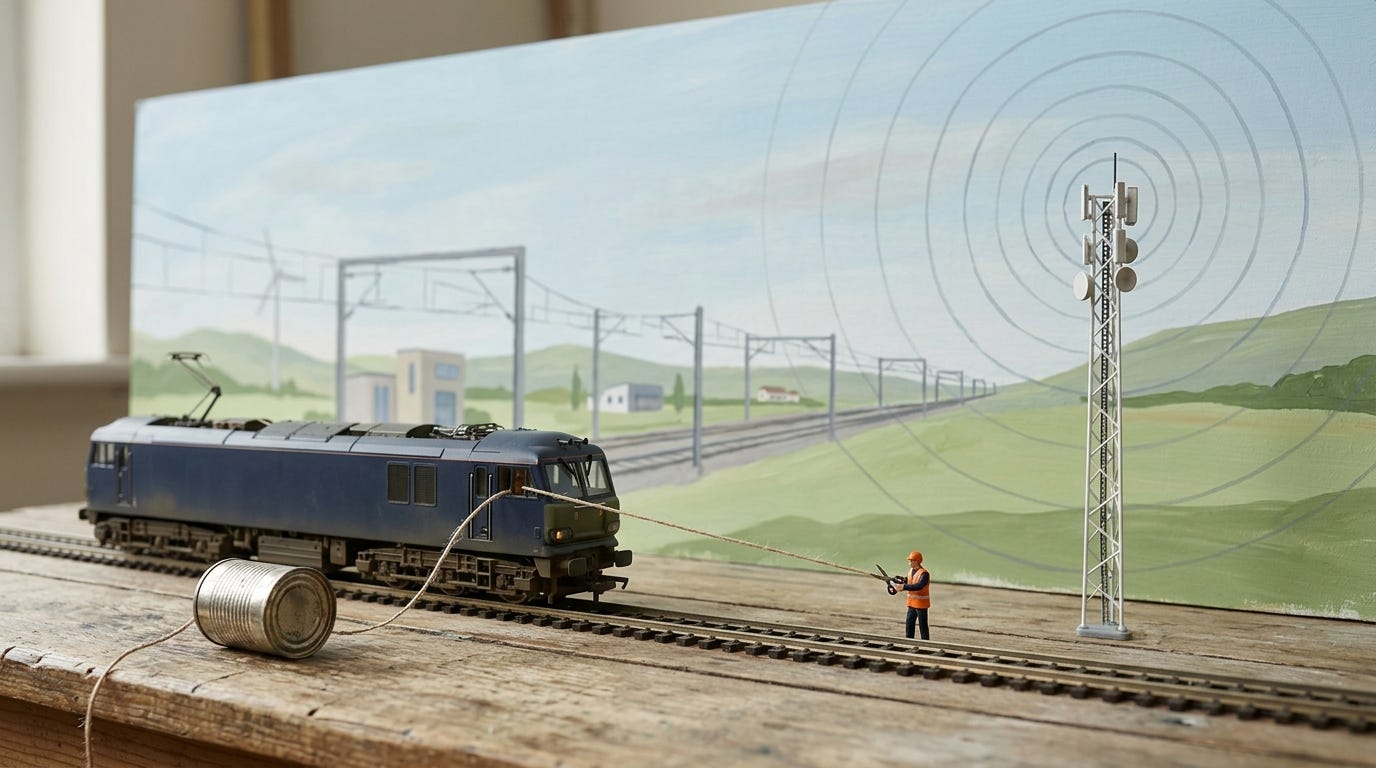
The Future Railway Mobile Communication System (FRMCS) is the 5G-based radio system that will replace GSM-R, the digital train radio that covered more than 130,000 km of European track in 2023. Industry support for GSM-R is expected to end around 2035.
GSM-R carries the voice calls between drivers and signallers and the data link for radio-based train control. Around 90,000 cab radios in Europe were connected to it in 2023, according to the International Union of Railways (UIC), which designed both systems.
FRMCS is meant to carry voice, train control and operational data on one network with far more capacity. It runs on 5G technology and on frequencies designated for railway radio across the EU. The switch affects every infrastructure manager that runs GSM-R and every train that uses it.
What GSM-R does today
GSM-R is a railway version of the 2G mobile standard, running on dedicated frequencies around 900 MHz. It is the radio layer of the European Rail Traffic Management System (ERTMS), alongside the European Train Control System (ETCS). The national networks are dedicated to the railway and linked across borders through hubs in Germany and Switzerland.
Drivers and signallers use it for voice calls, including the Railway Emergency Call. A driver who sees danger presses one button, and every train in an area set up in advance is warned at once. On lines with ETCS Level 2, it carries the exchange between train and trackside that replaces lineside signals.
GSM-R was designed for voice and a limited set of train control messages. It cannot carry the data volumes that video, remote diagnostics or automated train operation require. The European Commission warned in 2021 that industrial support for the technology was unlikely to last much beyond 2030, and by 2024 the UIC expected it to end around 2035.
How FRMCS is built
FRMCS uses the 5G standards developed by 3GPP, the body behind public mobile networks, including the mission-critical services created for police and emergency services.
The railway-specific functions, such as the emergency call, are specified by the UIC and the European Telecommunications Standards Institute (ETSI). Railway traffic can also run over public mobile networks, an option some infrastructure managers are studying for lines with less traffic.
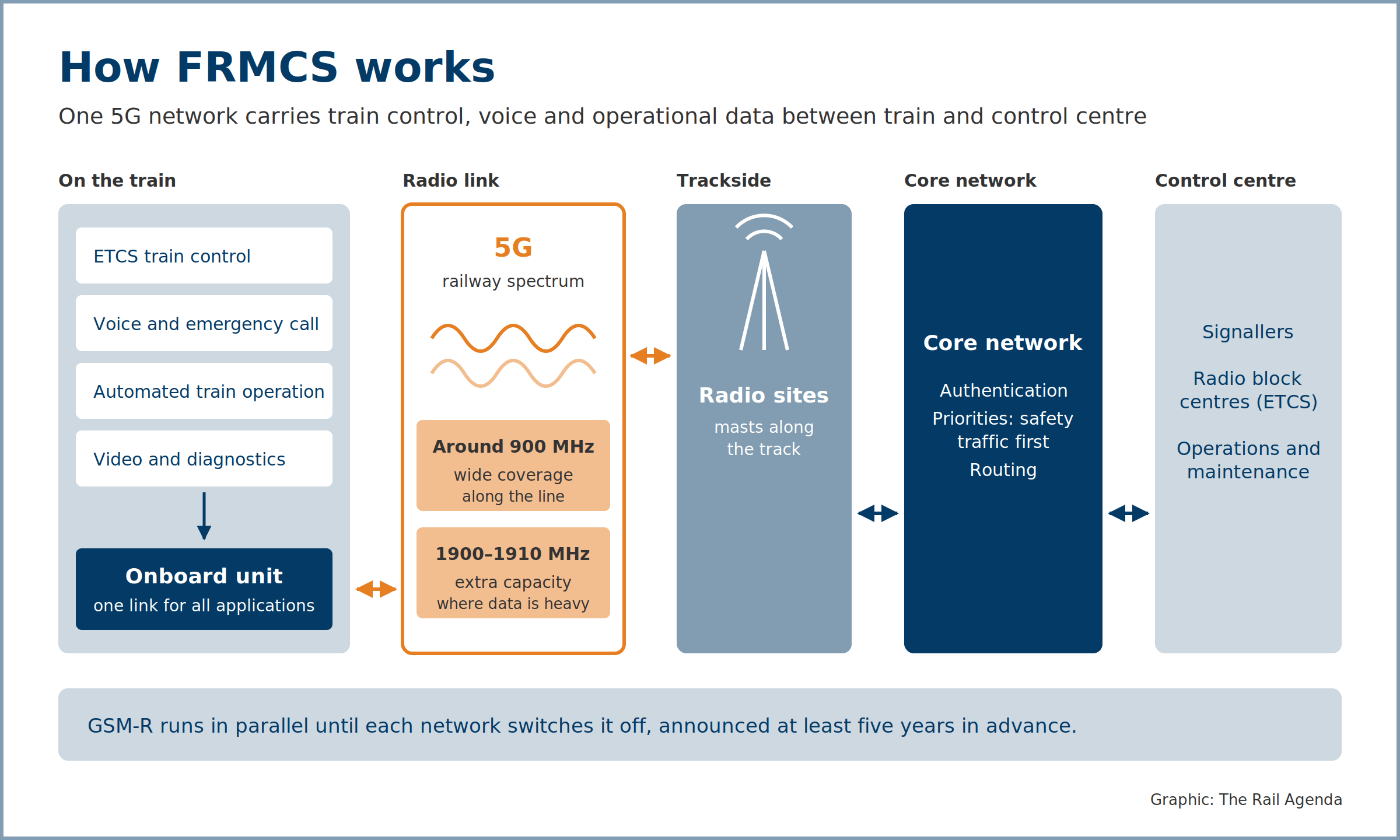
A network has three parts. Trackside radio sites connect to a core network that handles authentication, priorities and routing. On the train, an onboard unit connects ETCS, voice and other applications to the network, which gives safety-critical traffic priority when capacity is short.
The EU has designated spectrum for it in Commission Implementing Decision (EU) 2021/1730. Member states had to make the paired bands 874.4–880.0 MHz and 919.4–925.0 MHz available for railway radio by 1 January 2022, and the band 1900–1910 MHz by 1 January 2025, based on national demand. The lower bands give wide coverage along the line, and the upper band adds capacity where more data is needed.
What changes for operations
ETCS keeps its own logic for calculating movement authorities. FRMCS replaces the radio link that carries them, with more capacity and room for several data sessions per train at the same time. The ETCS software on board must support FRMCS before a train can use the new network for train control, which for many fleets means an upgrade.
The extra capacity opens uses that GSM-R cannot support: live video from level crossings and trains, continuous diagnostics from rolling stock, and the data link for automated train operation (ATO). The UIC names rail digitalisation as the second reason for FRMCS, after GSM-R’s obsolescence. When trains report the state of their equipment continuously, maintenance can move from fixed intervals towards repairs based on condition.
These applications are not part of the radio standard. Each one must be specified, procured and approved on its own terms. Voice stays, with driver–signaller calls and the Railway Emergency Call moving to the new network with the same functions.
Where the specifications stand
The EU’s rules for signalling and train radio, the Control-Command and Signalling TSI, were revised in 2023 as Regulation (EU) 2023/1695. The revision includes a first mandatory set of FRMCS specifications. A fully specified and tested system is expected only with the third version, FRMCS 1st Edition, which the UIC aims to have added to the TSI in 2027.
The EU-funded MORANE-2 project, which runs from December 2024 to September 2027, tests the specifications before that. Laboratory tests run at Ericsson, Nokia and Kontron, three suppliers of FRMCS equipment. Field trials follow on lines managed by Adif in Spain, DB in Germany, Trafikverket in Sweden and ProRail in the Netherlands.
The project, which brings together European railways, suppliers and mobile network operators, tests the second version of the specifications, FRMCS V2, which the UIC sent to the EU railway agency for review in March 2024. The trials cover equipment from different vendors working together, handovers between networks and interworking with GSM-R.
Why migration takes a decade
GSM-R and FRMCS will run side by side for years. Under the signalling TSI, an infrastructure manager must announce the switch-off of GSM-R on its network at least five years in advance, so that operators can equip their trains. A common radio is one of the conditions for rail interoperability, and trains that cross borders will need both systems until every network on their route has switched.
Every cab needs a new radio unit, and older ETCS versions must be upgraded to work with FRMCS. A 2024 working group of ÖBB, SBB, NS, DB, Network Rail and SNCF warned that fleets with earlier ETCS versions face new investment, a new approval process and shortages of products and workshop capacity.
National plans differ. In a 2024 presentation to the EU railway agency, SNCF Réseau set 2035 as its target for replacing GSM-R on the lines it covers, 97.4% of the French part of the TEN-T extended core network. By April 2026, SNCF expected FRMCS to enter service no earlier than 2034–2035, with the European specifications finalised in 2028–2029, later than the UIC’s 2027 target, and trains adapted after that.