

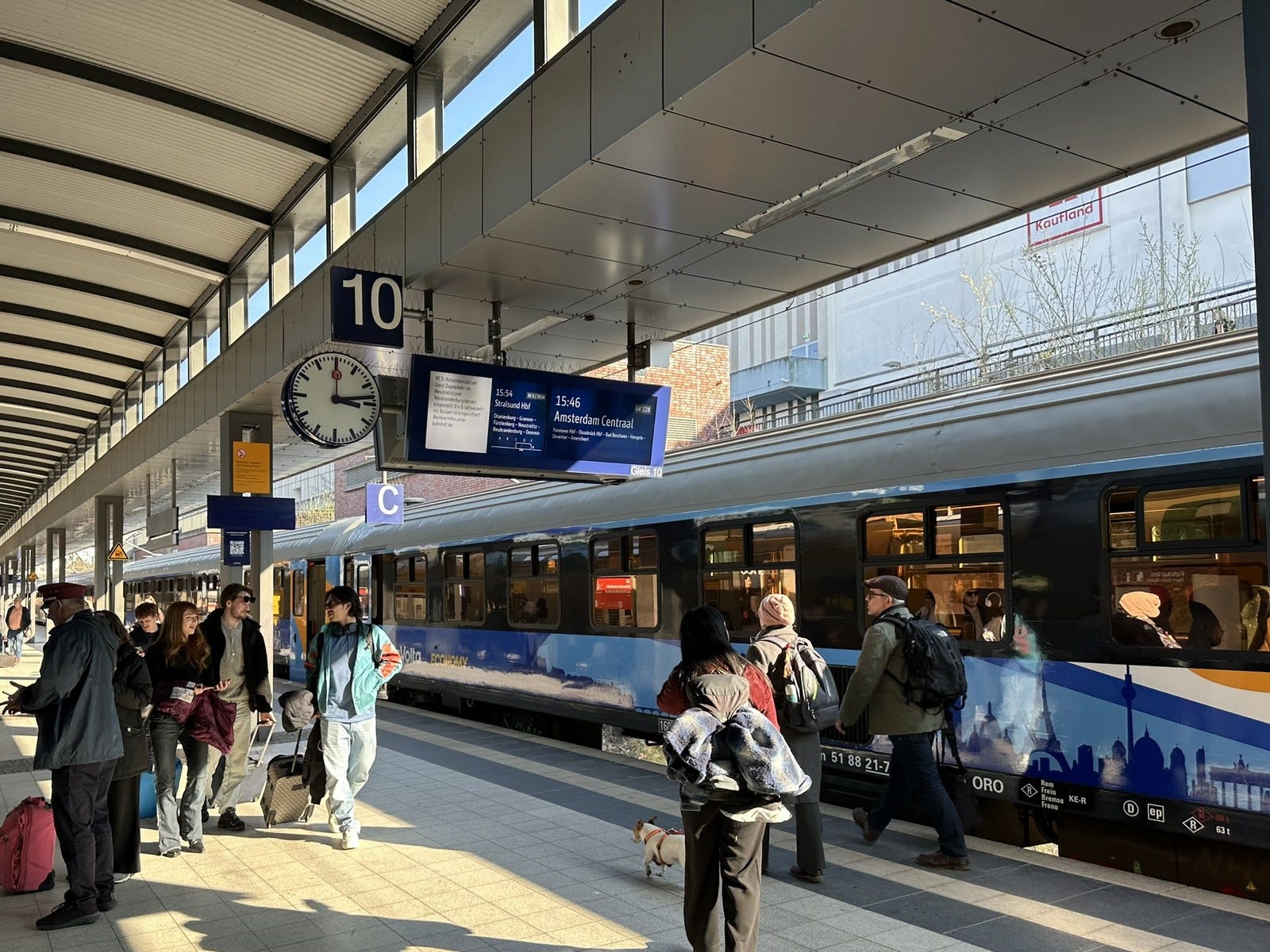
CROSS-BORDER: GoVolta has asked the Dutch and German regulators to examine whether NS and DB put new entrants at a disadvantage. A broken-down ICE blocked its locomotive at Bad Bentheim for seven hours on 8 October. NS called the accusation nonsense.
The open access operator made the request in a press release on 9 October, quoted by Dutch passenger site Treinreiziger.nl. It wants the Netherlands Authority for Consumers and Markets (ACM) and Germany’s Federal Network Agency to ensure fair access to the track, correct travel information at stations and in journey planners, and clear arrangements for looking after passengers during disruption.
GoVolta has run Amsterdam–Berlin since March in competition with the ICE that NS and DB operate jointly. Neither regulator had confirmed a complaint by 11 October.
Seven hours at the border
According to co-founder Hessel Winkelman, DB put off towing the defective train hour after hour and refused to offer GoVolta’s passengers another connection. GoVolta cancelled the run and took its passengers to Berlin by bus.
NS confirmed that an ICE run by NS and DB broke down at Bad Bentheim with a defective pantograph. A spokesperson said DB and infrastructure manager DB InfraGO handled everything on the German side, and that NS had asked Dutch infrastructure manager ProRail for a diversion and run its own trains around the blockage. GoVolta says its locomotive was boxed in and could not do the same.
“We also run our trains to Germany on open access, so like GoVolta we are simply one of the open access operators,” the NS spokesperson said.
Three cancellations in a month
GoVolta says it is the third time in a month that it could not run a service because of NS and DB, and that at least five other runs were seriously delayed. The other two cancellations were the September strike and an overhead line failure beyond Bad Bentheim at the end of September. During the strike, ProRail, together with NS and other operators, halted all trains in the Netherlands for a day, although GoVolta wanted to run.
After the overhead line failure, the co-founder says, DB claimed a diversion route without using it and released it only when GoVolta could no longer reach the Venlo border crossing before it closed for engineering work.
GoVolta now runs to Berlin via Magdeburg and Braunschweig, while journey planners show the detour via Hamburg that NS and DB use. NS says the information comes from ProRail, which told the site in the summer that it enters such changes by hand.
Passengers only by agreement
NS said it carries passengers only from operators that belong to the Community of European Railway and Infrastructure Companies (CER), whose members have an agreement on taking each other’s passengers when trains are cancelled or delayed. It could take stranded GoVolta passengers only within the Netherlands, and only under an arrangement the two have not made.
“If GoVolta wants that, we will have to make agreements about it. I warmly invite GoVolta for a talk,” the spokesperson said.
The request comes three weeks after the ACM published its finding, in a test NS had asked for, that GoVolta’s domestic services do no significant harm to NS’s concession. DB told the site it would respond after the weekend.