

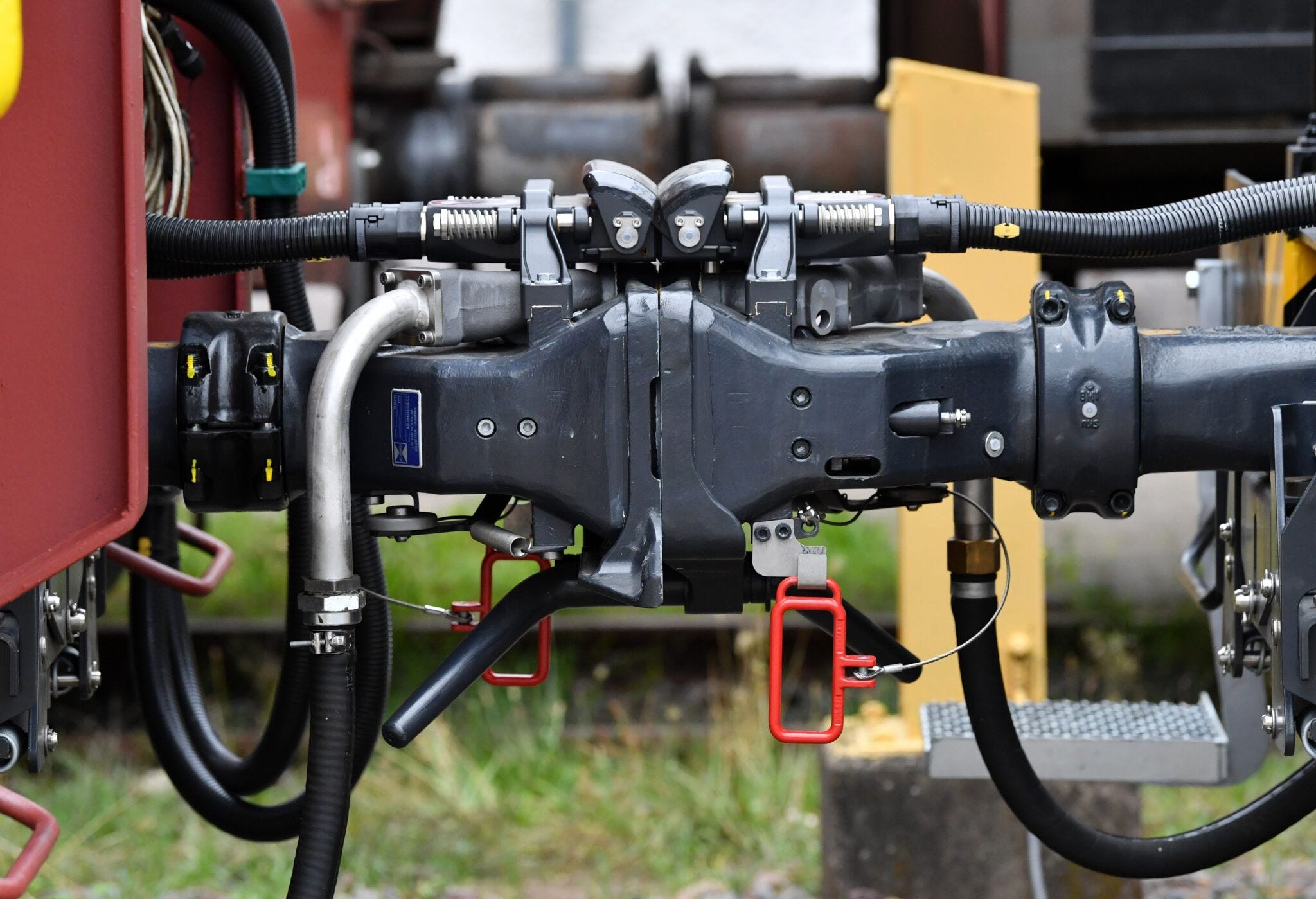
GERMANY: The Federal Ministry of Transport (BMV) has published its PioDAK funding guideline in the Bundesanzeiger, offering up to EUR 36.117m to 2029 for pioneer freight trains fitted with digital automatic couplers (DAC), research and studies. Project outlines can be submitted from 14 to 25 September.
The money sits in budget title 1210 683 51 and is split across three funding lines, prioritised in that order: pioneer trains first, research and development second, studies third. The Bundesamt für Logistik und Mobilität (BALM) runs the programme as project sponsor, applies a two-stage procedure to the pioneer trains line and hosts an online briefing for applicants on 10 September.
The ministry says the programme will fund DAC use through to commercial operation, and BALM describes the aim as testing the coupler under real conditions. Funding rates and the number of trains the budget can cover have not been published. BALM has said it will set out details of the first call at the briefing.
Three funding lines
Line 1 covers equipping and converting pioneer trains and falls under Article 16 of a new EU block exemption regulation adopted this year. Lines 2 and 3, research projects and studies, fall under Article 25 of the General Block Exemption Regulation. The submission window is common to all three lines.
Grant recipients must present their projects and interim results to the DAC Deployment Group of Europe’s Rail, the EU rail research partnership, when the granting authority requests it, with scope and timing set in each grant decision.
The ministry says cross-border projects and testing in several member states are welcome. Applicants from abroad face two conditions: the procedure runs in German, and a federal interest must be visible, for example traffic on German track.
The standard 120% overhead surcharge on personnel costs does not apply. Overheads must be calculated individually, and applicants without cost accounting must apply on an expenditure basis.
The DAC4EU demonstrator
The German-led DAC4EU demonstrator project concluded in June after six years with a verdict that the coupling works. Its partners included DB Cargo, SBB Cargo, Rail Cargo Austria and the wagon keepers Ermewa, GATX and VTG. PioDAK is intended to narrow down costs and benefits of the coupler in commercial service ahead of the EU-wide migration.
The model is the EU’s own DAC Pioneer Trains programme under the Connecting Europe Facility, which has funded 7 pilot trains on selected European routes since November 2025. Couplers from four manufacturers began mix-and-match testing in Poznań in August. The EU-wide migration is planned for the 2030s.
The ministry expects the European Union Agency for Railways to publish a first draft technical opinion in the second quarter of 2027, with a revision of the technical specifications for interoperability to follow. Applicants planning a pioneer train before that revision are advised to contact the agency first.
Two-stage procedure
BALM has been preparing the procedure since February. Outlines submitted in September are assessed against a published evaluation matrix, and selected applicants are then invited to file full applications.
“As project sponsor of the PioDAK funding programme, we will implement the two-stage application procedure for equipping and converting pioneer trains with DAC swiftly,” said BALM president Christian Hoffmann.
The ministry is separately examining a technical coordination function for the programme, covering approval support and industry alignment. The work continues from the third quarter of 2026.