

Tenders are screened. Buyers just order.
Chinese trains now run in three EU countries
ROMANIA: A Chinese-built CRRC Sifang train began carrying passengers between Bucharest and Brașov on 19 August, operated by private company Astra Trans Carpatic. It is the first Chinese-built train type authorised for commercial passenger service in Romania.
The unit runs two return trips a day on the Prahova Valley line, a journey of about two and a half hours, and is rated for 160 km/h.
The train was bought directly by Astra rather than procured through a public tender, after a joint bid with CRRC Sifang was excluded from a 2021 tender — an exclusion the Bucharest Court of Appeal annulled in a final ruling on 11 July 2025.
Full story: Chinese-built CRRC train enters service in Romania
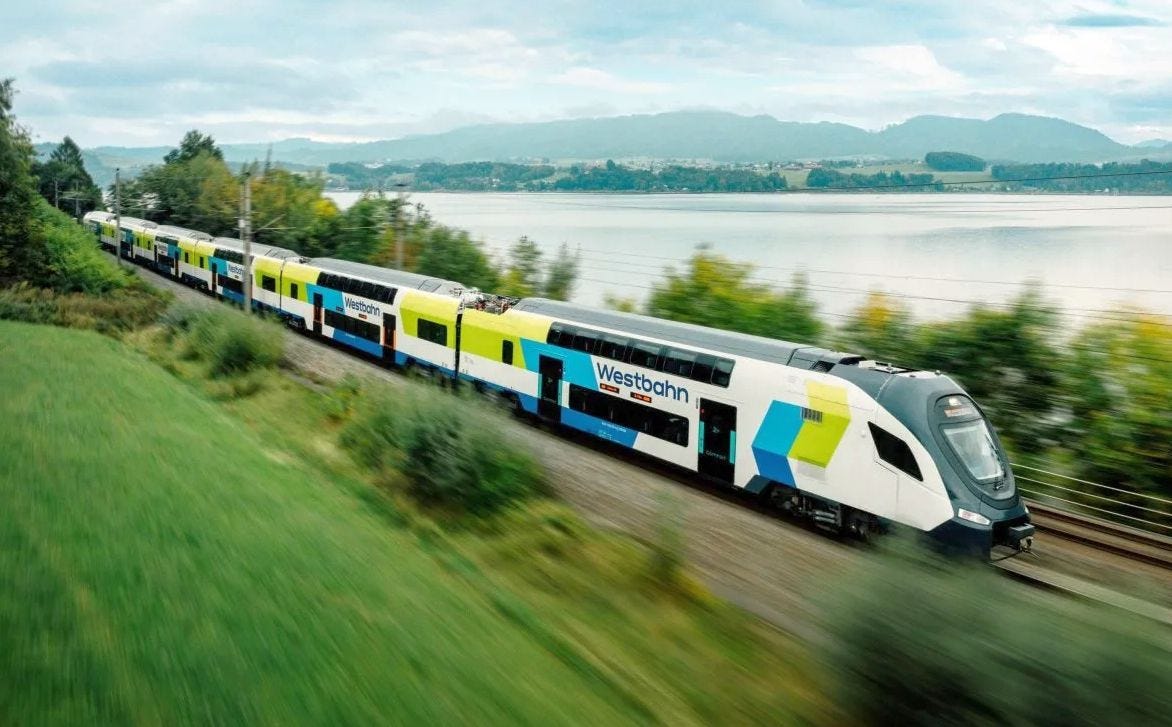
Chinese-built trains now carry fare-paying passengers on the national rail networks of Czechia, Austria and Romania — and in none of the three cases did the manufacturer win a public tender.
All three operators are private companies that needed trains, could not get them fast enough from European builders, and found that nothing in EU law stood between them and a Chinese order.
Public procurement is where the EU built its defences. The Commission’s first review of the Foreign Subsidies Regulation, published on 14 July, found the instrument fit for purpose — and every one of its tools assumes a contracting authority, a tender notice and a contract worth enough to trigger a notification.
Full story: The EU screens tenders. Chinese trains arrive by private order
20 daily trains: Virgin wins Channel access
UK: The Office of Rail and Road (ORR) has pre-approved a track access agreement giving Virgin Trains up to 20 daily return services on High Speed 1, the line from London St Pancras to the Channel Tunnel portal.
The rights run from October 2030 to the end of 2040.
The regulator rejected objections from Eurostar, Trenitalia, Gemini Trains and three continental infrastructure managers.
Full story: Virgin cleared for London–Channel line as Eurostar objection fails
DB InfraGO takes its regulator to court
GERMANY: DB InfraGO has filed a lawsuit against the Bundesnetzagentur’s 17 July ruling that limits how many long-distance paths DB Fernverkehr may hold on Germany’s busiest routes when competitors ask for the same capacity.
The infrastructure manager will ask the court to suspend the rule while the case is heard. Until a court decides otherwise, the rule stands.
The regulator issued the rule after a complaint from Italo, which plans to enter the German market in 2028. The clause first applies to the 2028 timetable, built in 2027.
Full story: DB InfraGO goes to court over Italo access rule
Stuttgart S-Bahn network goes out to competitive tender
GERMANY: Regional transport authority Verband Region Stuttgart has put the operation of the entire Stuttgart S-Bahn network out to tender, inviting operators to bid for a 15-year contract covering around 14.3 million train-km a year from December 2034.
The network was last tendered in 2006, when DB Regio was the only bidder. Requests to participate are due by 15 September 2026, with the contract award expected in early 2028.
Vossloh completes GBP 29m Cordel acquisition
INDUSTRY: Vossloh has completed its acquisition of UK laser-scanning specialist Cordel Group, three months after announcing the GBP 29m (around EUR 33m) cash offer. The transaction became effective on 13 August following court approval.
Cordel mounts LiDAR equipment on trains to produce three-dimensional scans of the track environment, analysed with artificial intelligence. Its customers include rail operators in the United Kingdom, the Middle East, North America and Australia.
That’s The Rail Agenda for today. If you found it useful, forward it to a colleague - and sign in at therailagenda.com to read every story in full.