

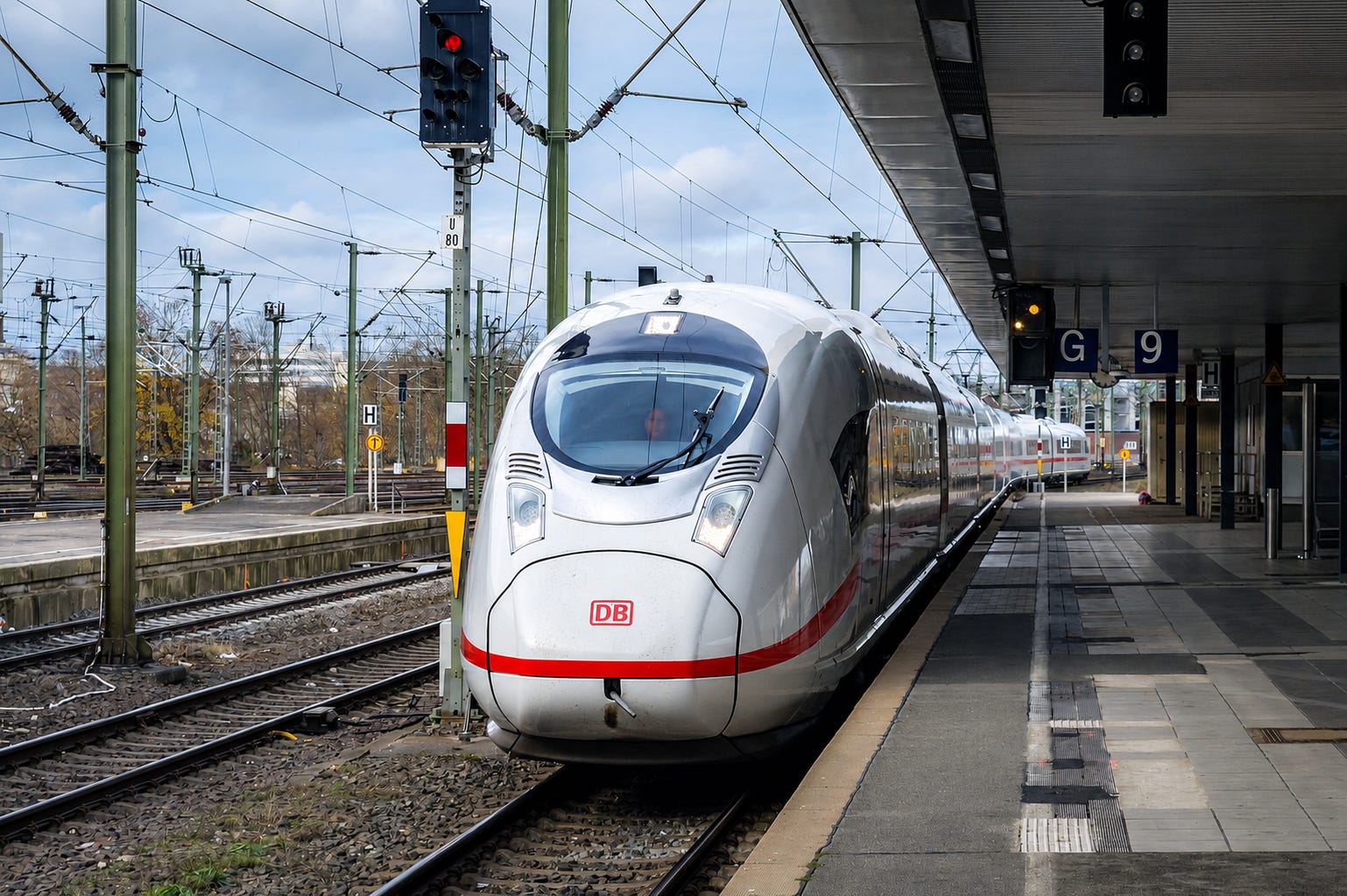
GERMANY: DB InfraGO has filed a lawsuit against the Bundesnetzagentur’s 17 July ruling that limits how many long-distance paths DB Fernverkehr may hold on Germany’s busiest routes when competitors ask for the same capacity. The infrastructure manager will ask the court to suspend the rule while the case is heard.
The regulator issued the rule after a complaint from Italo, which plans to enter the German market in 2028. DB InfraGO lodged its claim on 14 August at the Verwaltungsgericht Köln, according to Deutsche Presse-Agentur (dpa).
The company wants the courts to test the ruling’s legal basis, its proportionality and whether it can be applied in practice. Until a court decides otherwise, the rule stands.
What the rule says: DB InfraGO must write a competitor clause into its network usage conditions. It covers sections with a declared capacity limit for long-distance traffic and applies only when operators ask for more paths than are available.
In that case at least two long-distance operators must receive paths. No single company may get more than 60–75% of the capacity declared for the section. The clause first applies to the 2028 timetable, built in 2027.
What DB InfraGO objects to
The clause protects only clock-face services: at least four trains a day on the same route, no more than two hours apart, at the same minute past the hour. DB InfraGO says established services that grew without a fixed pattern get no priority in a conflict. It names Westbahn between Stuttgart, München and Salzburg, and Eurostar between the Ruhr, Brussels and Paris.
The company lists five objections:
Only clock-face services benefit; other competitors get no protection when paths conflict.
Competition on the main axes intensifies while hubs risk running short of capacity for connecting services.
Conflict resolution becomes harder. In the 2026 timetable, 5,253 of 5,605 path conflicts were settled by agreement; operators would now have less reason to give ground.
Gradual market entries are penalised: an entrant that cannot run a full clock-face service from day one gets no protection.
Station lounges are commercial floor space and should not fall under allocation rules.
DB InfraGO says companies, associations and politicians at federal and Land level have raised the same objections. Regulator and company agree on three points: no framework agreements before 2031, no legal basis for a newcomer clause, and no quota where capacity is not constrained.
From Italo’s complaint to a general rule
Italo asked for long-term guaranteed access to underpin a EUR 3.6bn German entry: 26 Siemens Velaro trains with an option on 14 more, and services from 2028 on München–Köln–Dortmund and München–Berlin–Hamburg. The regulator published its draft on 30 June and confirmed it on 17 July. The hubs München and Frankfurt are expected to be designated capacity-constrained from the 2028 timetable.
Announcing the ruling, Bundesnetzagentur president Klaus Müller said competitors such as Italo and FlixTrain must invest heavily in rolling stock without knowing whether they will get enough network access — the problem the clause is meant to solve.
DB InfraGO chief Philipp Nagl warned in June that a clause favouring one entrant risked being struck down under EU law. The final ruling names no operator; it applies to any competitor that meets the clock-face definition.
Second lawsuit: On 23 July DB InfraGO filed a claim, also with an application to suspend, against the Bundesnetzagentur’s ceiling on the cost base for 2027 track access charges — EUR 7.317bn against the EUR 7.548bn DB InfraGO had assumed.
The draft usage conditions are still due at the regulator this autumn. Path applications for the 2028 timetable open in April 2027.