

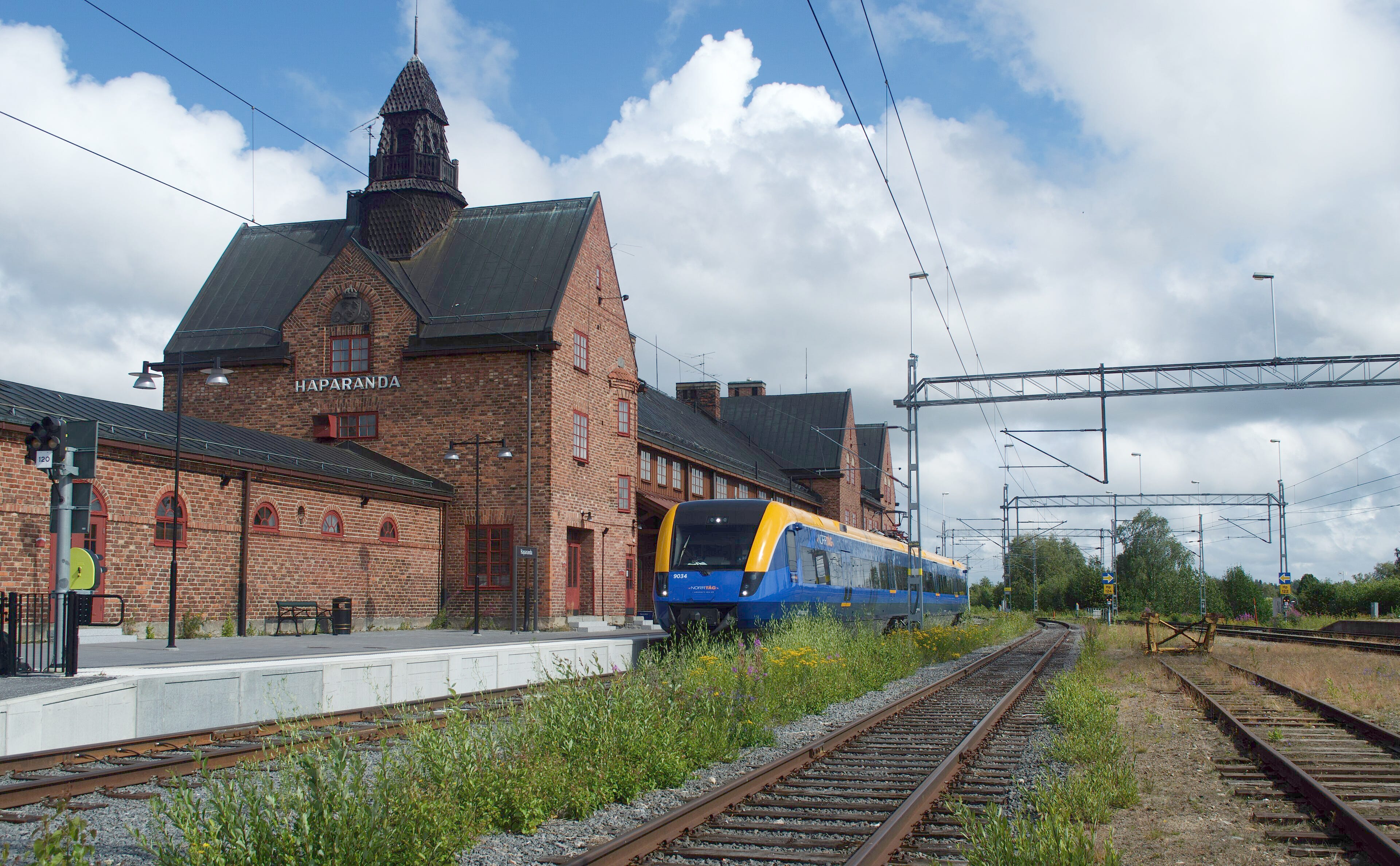
Finland and Sweden take crucial step toward cross-border rail return
CROSS-BORDER: Finland and Sweden have activated a bilateral agreement setting out how their national safety authorities will divide responsibility for rolling stock on the gauge-change crossing between Tornio and Haparanda.
The deal between Traficom and Transportstyrelsen eliminates dual-authorisation at the 1524/1435 mm gauge boundary — operators on either side run through on their home authorisation without cross-certification.
The regulatory gap is now closed. The infrastructure gap was closed earlier, when electrification of the Laurila–Tornio–Haparanda section was completed.
A service start remains contingent on VR concluding a contract with Traficom. No timetable has been confirmed.
Portugal contracts Hitachi Rail to extend ERTMS train compatibility
PORTUGAL: Infraestruturas de Portugal has contracted Hitachi Rail to develop and certify a new onboard module that allows ETCS-equipped trains to operate on lines still running Portugal’s older signalling system.
The contract covers a Specific Transmission Module (STM) bridging ETCS and Portugal’s national CONVEL system — the component that keeps cross-network operations running until full ERTMS migration is complete. Infraestruturas de Portugal has required FRAND terms, meaning the certified module must be made available to all operators and rolling stock manufacturers on equal terms.
No contract value or certification timeline has been disclosed.
ERTMS trackbot enters permanent service on Dutch rail
NETHERLANDS: The Netherlands has deployed what is believed to be the first ERTMS installation robot in permanent commercial service, mounting balises and axle counters on the Leeuwarden–Harlingen Haven line automatically and at scale.
The Trackbot, developed by a consortium of Strukton, AMT and No Man Trackwork, removes one of the most labour-intensive bottlenecks in ERTMS deployment. The Dutch national rollout requires around 50,000 balises and more than 20,000 axle counters — the scale of the task that drove the case for automation.
Six consortia bid for Poland’s first high-speed rail section
POLAND: Poland’s CPK authority has received six consortium bids for the country’s first dedicated high-speed rail section, the opening segment of the Warsaw–Łódź corridor.
Seventeen companies across the six consortia have entered a competitive dialogue phase for a 13-kilometre section near the planned CPK airport at Baranów, designed for 350 km/h operation. Contract signature is targeted for the fourth quarter of 2027.
The Y-line will also introduce a new electrification standard for Poland: 25 kV AC, replacing the 3 kV DC system that has defined the national network for decades.
Belgian state takes full control of country’s largest freight operator
BELGIUM: Belgium’s sovereign wealth fund SFPIM has secured European Commission clearance to acquire full ownership of Lineas, ending the freight operator’s decade-long experiment as a majority-private company.
The Commission cleared the transaction on 15 April under EU merger control rules. SFPIM moves to 100% ownership after private equity fund Argos Wityu withdrew, having been unable to continue providing financial support. An additional EUR 40m in public financing from federal and regional budgets remains pending alongside the EUR 61m rescue loan approved in January.
Lineas handles around 60% of Belgium’s rail freight and has set breakeven as its target for 2026.
Oxford and Cambridge to get direct rail link under new plan
UK: Britain’s East West Rail project has opened its final public consultation on a new direct line connecting Oxford and Cambridge, with full services targeted for the mid-to-late 2030s.
Services between Oxford and Bedford are targeted by 2030, with the full Cambridge connection following in the mid-to-late 2030s. A formal planning application is expected in 2027, with construction potentially beginning in the late 2020s.
The consultation runs until 9 June and is the last major public engagement before that application is submitted.
RegioJet was right about Poland — and still failed its passengers
COMMENTARY: The barriers RegioJet described when it left Poland were real. They were also known before a single ticket was sold.
Poland’s rail regulator UTK ruled on 7 April that RegioJet had violated collective passenger interests by failing to operate 23 scheduled services in December 2025. Two days later, RegioJet announced its exit from the Polish market.
The question the Polish episode leaves open is not whether the barriers were real. They were.
The question is what is required of an open-access entrant that wants to survive on a hostile market — and whether systemic criticism, however justified, is a substitute for the operational foundations that protect passengers when things go wrong.
It is not.
That’s The Rail Agenda for today. If someone in your network should be reading this, send it their way.