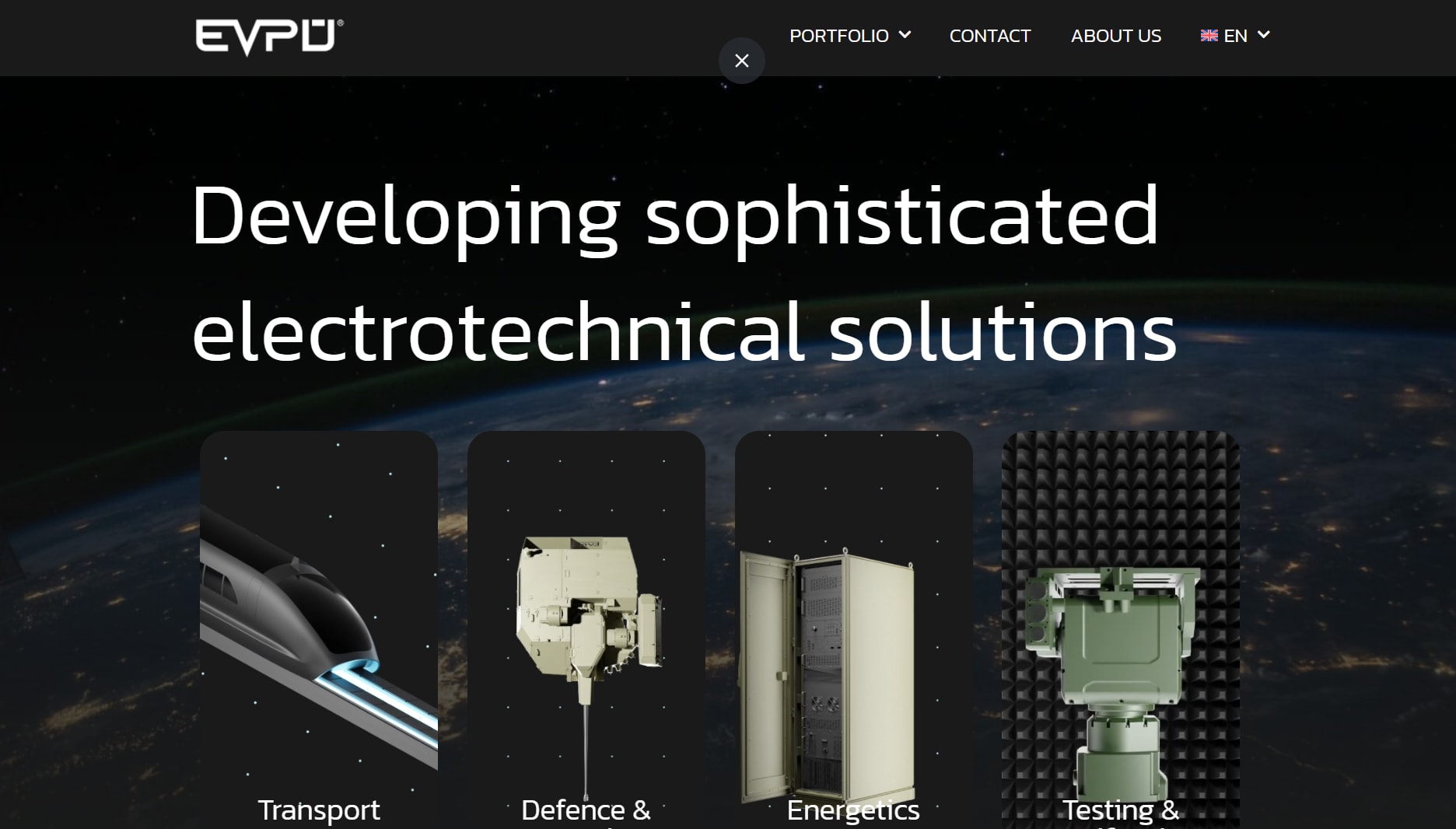
EVPÚ is a Slovak developer and manufacturer of power electronics for rail and urban transport vehicles, based in Nová Dubnica, where its research, production and accredited test laboratories share one site.
EVPÚ traces its origins to Elektrotechnický výskumný ústav, an electrotechnical research institute that grew out of in-house development work at the machine works in Dubnica nad Váhom and became an independent state research organisation on 1 October 1968 within the Závody ťažkého strojárstva (ZŤS) heavy-engineering group. Traction equipment for electric locomotives was among its early development areas, alongside drives for rolling mills and machine tools.
The break-up of ZŤS in 1990 left the research and development core as a state enterprise under the name Elektrotechnický výskumný a projektový ústav. EVPÚ a.s. has been entered in the Trenčín commercial register as a joint-stock company since May 1992, and the company dates its coupon privatisation to 1994. Michal Pavlík is chief executive.
EVPÚ ZVS in Dubnica nad Váhom followed in 1996 and the Czech sales representation EVPÚ ČR in 1998. The Czech sister company EVPÚ Defence, based in Uherské Hradiště, was founded in 2001.
Traction and auxiliary converters
EVPÚ’s rail business sits almost entirely in traction and propulsion. The company develops and manufactures traction inverters and converters, static converters for auxiliary drives, electrodynamic brakes and vehicle control systems, including integration with the traction motors.
For passenger coaches, EVPÚ lists multi-system static converters covering input voltages of 1,000 V AC at 16⅔, 22 and 50 Hz, 1,500 V AC and DC, and 3,000 V AC and DC. They feed air-conditioning motors, heating elements, battery charging and onboard socket circuits, and are built as modular units on insulated-gate bipolar transistor (IGBT) technology.
Completed vehicle projects include a full traction and auxiliary package for a tram — traction converter container, auxiliary converter container, asynchronous traction motor and vehicle control and diagnostic system — together with main and auxiliary converter containers for electric buses and for mining locomotives, and auxiliary converters for metro vehicles.
Drives are controlled from the vehicle control system over a Controller Area Network (CAN) bus. The traction system has several levels of fallback operation, allowing a vehicle to reach a depot after a fault in one traction group, and the auxiliary converter can run several units in parallel so that auxiliary supply continues if one unit fails.
EVPÚ also supplies static converters for railway infrastructure, including point-heating supplies, compensating converters and high-voltage sources for test purposes. In 2023 its engineers published a comparison of silicon carbide (SiC) MOSFET and silicon IGBT three-phase inverter modules for railway auxiliary converters, written with the Faculty of Electrical Engineering and Information Technology at the University of Žilina.
Certification and business areas
EVPÚ holds ISO 9001, ISO 14001 and International Railway Industry Standard (IRIS) certification, EN 15085-2 for railway welding, and Allied Quality Assurance Publication (AQAP) 2110. The company also holds an Entity in Charge of Maintenance (ECM) certificate.
Beyond rail, EVPÚ supplies defence electro-optics and stabilised current sources, and runs accredited test and certification laboratories that are also used by external customers.
Current activity
EVPÚ’s own trade fair calendar lists InnoTrans 2026 in Berlin among the events the company plans to attend. The organiser has scheduled the fair for 22–25 September 2026; as of July 2026 no stand number had been published.