

European railways run on electricity where the infrastructure allows, and on diesel where it does not - a split that defines both the engineering of the fleet and the policy challenge of decarbonising it.
How a train is propelled determines its energy use, its emissions and, increasingly, its procurement politics. Four supply voltages coexist across the European network, and a substantial share of EU lines still carries no overhead wire.
Decarbonisation has made traction one of the most active technology fields in rail. Battery and hydrogen propulsion are moving from pilots to fleet orders, while diesel remains indispensable on the lines electrification has not reached.
The traction chain
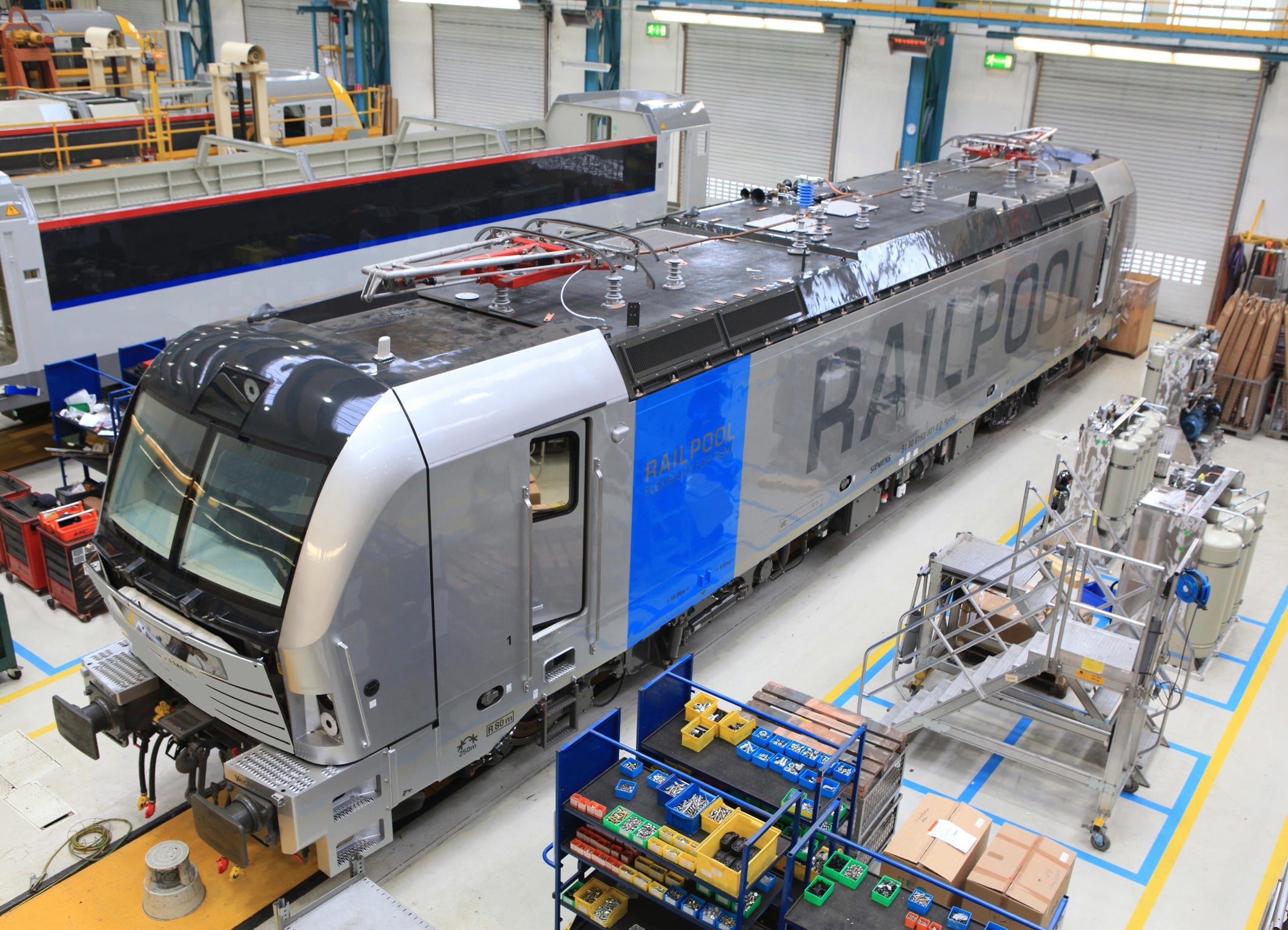
A train operating under alternating current draws power from the overhead contact system through a roof-mounted pantograph, raised pneumatically against the contact wire. In standard 25 kV AC systems, the traction transformer steps the voltage down and feeds a traction converter, which rectifies and re-inverts the current into three-phase AC at variable frequency and voltage.
This output drives the traction motors, which transmit torque to the wheelsets through a gearbox. The complete sequence — pantograph, transformer, converter, motor, gearbox, wheelset — is the traction chain.
In DC systems, operating at 750 V, 1,500 V or 3,000 V depending on the national network, the transformer stage is absent. Power electronics handle conversion directly, using insulated-gate bipolar transistors (IGBTs) or, in newer designs, silicon carbide (SiC) semiconductors, which cut switching losses and component size.
Traction motors and regeneration
Virtually all modern electric rolling stock uses three-phase asynchronous motors or permanent magnet synchronous motors (PMSMs). Asynchronous motors are robust and well understood; PMSMs offer higher power density and better efficiency at partial load.
Both types support regenerative braking. When a train decelerates, the motors act as generators and return electrical energy to the overhead system, where accelerating trains on the same section can draw it — or a reversible substation can feed it back to the grid.
Regeneration is built into three-phase drive architecture, not added to it. It cuts net energy consumption and is a primary reason electric railways use significantly less energy per passenger-kilometre than road or air transport.
Diesel and non-electrified operation
Just over 42% of EU railway lines remained non-electrified in 2024, according to Eurostat. Diesel traction predominates on these routes.
In diesel-electric multiple units, a diesel engine drives a generator that feeds the traction motors electrically — the same motor and control architecture as electric traction, with an onboard combustion engine as the primary source. The arrangement removes the mechanical gearbox and gives operators precise torque control.
UNIFE data indicate that around 80% of European rail traffic by train-kilometres runs under electric traction. The remainder depends on diesel or alternative fuels.
The transition to alternative traction
European operators are replacing diesel on regional and secondary lines through two parallel approaches. Battery-electric multiple units (BEMUs) carry lithium-ion battery packs sized for 80–120 km of non-electrified operation, charging from the overhead system on electrified sections and through regenerative braking.
Germany has led deployment: Stadler, Siemens and Alstom have all delivered BEMU fleets to regional transport authorities from 2023. Denmark’s Lokaltog ordered 14 FLIRT Akku units from Stadler in 2024 for routes on Zealand and Lolland-Falster, with delivery planned from August 2028.
Hydrogen fuel cell trains generate electricity onboard by combining stored hydrogen with oxygen, emitting only water vapour. Alstom’s Coradia iLint entered commercial service in Lower Saxony on 17 September 2018 — the first hydrogen fuel cell train in revenue operation.
Orders for hydrogen trains in Germany, Italy and France are placed or under contract, but deployment outside Germany remains at procurement or trial stage. Fuel cell trains carry a significant price premium over equivalent diesel or battery units, and refuelling infrastructure is sparse outside pilot regions.
Four voltages, one network
European electric railways operate under four distinct voltage systems: 25 kV AC 50 Hz, 15 kV AC 16.7 Hz in Germany, Austria and Switzerland, 3 kV DC in Belgium, Italy, Poland and the Czech Republic, and 1.5 kV DC in France and the Netherlands.
Multi-system locomotives and multiple units carry additional converter stages to handle more than one supply voltage, enabling cross-border operation without locomotive change. The complexity and cost of multi-system traction equipment are persistent factors in European rolling stock tendering.
Standards and policy
The rolling stock energy subsystem is governed by EU Technical Specifications for Interoperability (TSIs), which set the electrical and performance requirements determining how a train interacts with the supply network.
Funding for zero-emission propulsion development and infrastructure electrification flows primarily through the Connecting Europe Facility (CEF) and the Horizon Europe research programmes.