

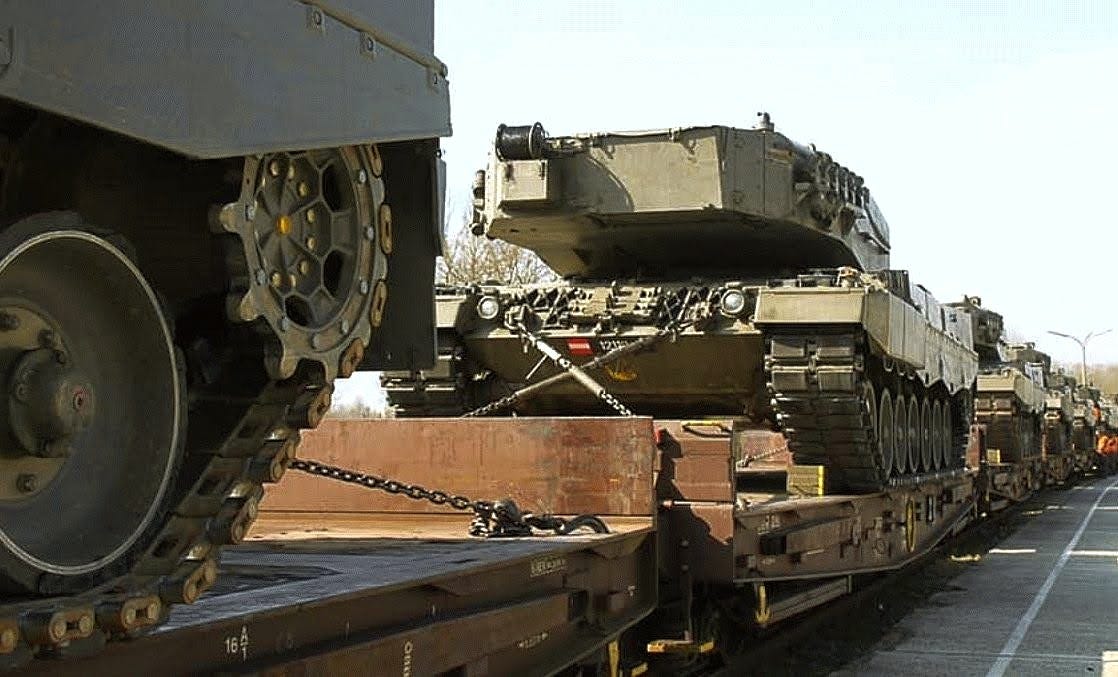
Europe is rebuilding its railways for war the way it last did before the First World War. Four years of war in Ukraine point to a different measure: how fast a network can be repaired once it is hit.
The EU’s rebuilding, now taking shape in a new regulation on military mobility, follows the mobilisation list. Bridges that carry tanks, tunnels wide enough for them, border-crossing permits for military convoys processed in days rather than weeks, priority for the army over the timetable. It is a railway for the opening weeks of a crisis, when units have to reach the right places, and for moving them along a front afterwards.
In Ukraine the front has been the whole country for four years, and the railway has kept the country working: power, grain, evacuation, supply. That is the role the mobilisation list leaves out, and in northern Sweden a third answer is being cleared out of the forest without anyone yet having decided what to do with it.
A line closed since 2012
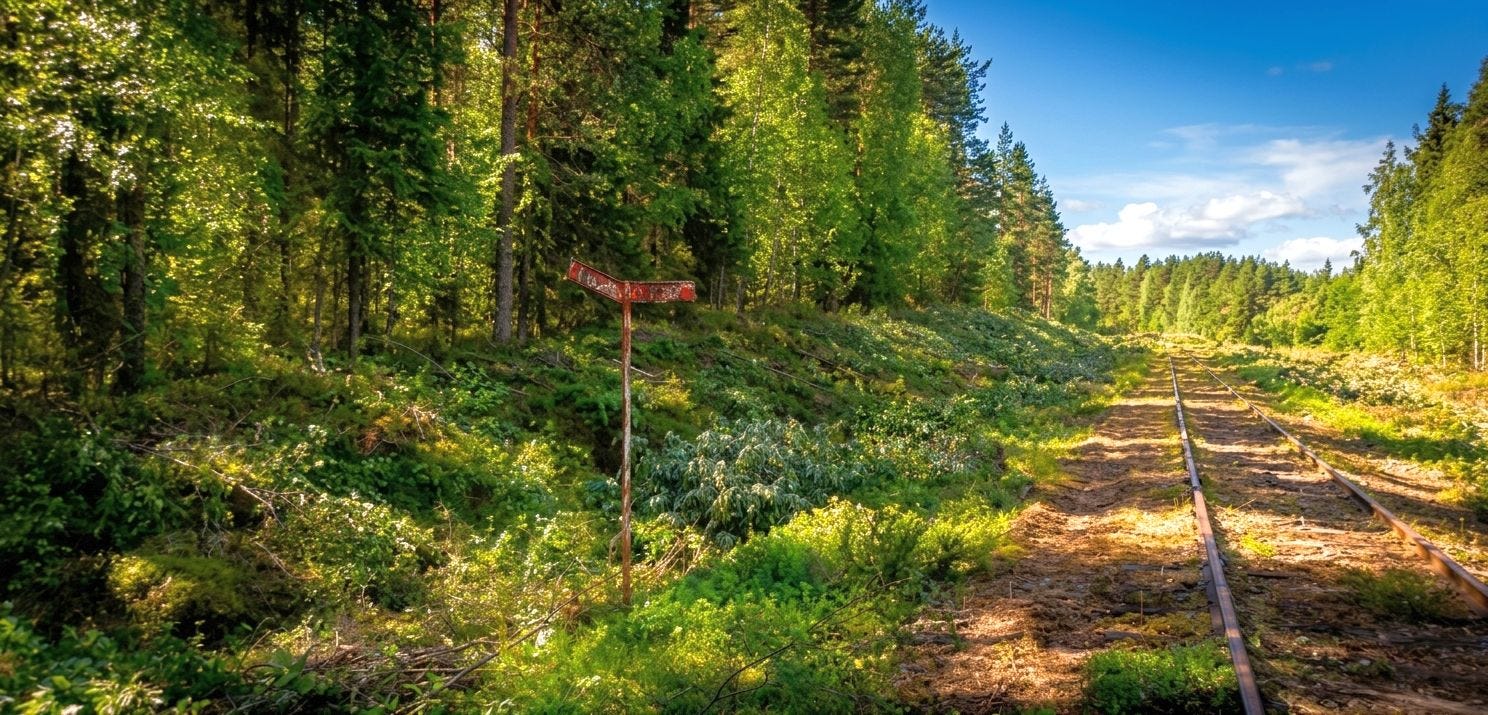
The photograph released in late August by Trafikverket, the Swedish infrastructure manager, shows a single track running into the forest, grass between the rails, cut birch piled along the embankment and a rusted marker post still standing beside the line. It is the Morjärv–Karungi–Haparanda line, 91 km towards the Finnish border, without a train since 2012.
Clearing started this summer, the precondition for surveying culverts, drainage and level crossings. On a second closed line, Arvidsjaur–Jörn, out of use since the 1990s, the Swedish infrastructure manager starts replacing sleepers and rail this month on two test sections of about 4 km each, to learn what it takes to bring a dead railway back.
Helena Eriksson, Trafikverket’s regional director, says Sweden’s railways are being rebuilt for citizens, business and total defence, and that Norrbotten is central to that defence. The test sections, she adds, will provide the basis for planning further work on long-closed lines, “if decisions are made”.
Sweden is clearing dead railway to get redundancy back with saws and ballast. The decision to use it has not been taken.
A railway that stays open
In June, the Community of European Railway and Infrastructure Companies (CER) and Ukrzaliznytsia (UZ) published a joint report on what European railways can learn from Ukraine. Its subject is a railway that has stayed open for four years under attack, for the army and for everyone else.
“UZ has evacuated more than 4 million people since 2022 and carries 63% of the country’s freight …”
According to the report, UZ has evacuated more than 4 million people since 2022 and carries 63% of the country’s freight. In August the company was still running its passenger timetable under drone attack. The military moves on the same network, and the network keeps running for the country. That is the experience the report is built on.
The report sets out three threat levels, from peacetime cyber attacks and natural disasters, through hybrid warfare with sabotage, drone incursions and coordinated cyber attacks, “as some EU countries have already experienced”, to full-scale war. Each level has its own measures. Resilience is a standing condition of operation.
The report asks the EU to make recovery capacity eligible for infrastructure funding in the next budget period, and to tie railway resilience to the EU’s existing rules on critical entities and cybersecurity.
How the network is kept alive
The report’s principles are operational. Protection is layered, and the report calls full protection of everything “very expensive and rather useless”. Repair capacity is a resilience tool: the aim is to restore function within hours.
Spare parts are dispersed and stockpiled. Locomotives and wagons are pre-positioned after a fleet redundancy analysis. Electric traction remains the preference even in war, with diesel traction kept as the last resort.
Recovery is organised for it. Self-sufficient repair brigades with fire trains and cranes are stationed alongside the stockpiles. Modular catenary and modular bridges replace what is destroyed.
Communication runs on fibre with radio as fallback, and regional managers have the authority to decide without waiting for headquarters. The report gives no table of recovery times. It says function comes back within hours, and four years of traffic say the same.
The report’s fourth principle sits awkwardly with EU rail policy. UZ is 100% state-owned and vertically integrated, and the report calls a single, unified chain of command a strategic advantage.
Hunting the locomotive
Russian strikes have damaged 492 locomotives since 2022, Ukraine’s Minister for Recovery, Infrastructure and Transport, Mykola Kalashnyk, said in late August, with more than 1,500 attacks on the railway this year alone. Ukrainian officials counted 128 damaged locomotives in 2025. By mid-August 2026, UZ put the number damaged in the preceding six months at more than 250.
A damaged locomotive takes years to replace, and UZ puts the average age of its fleet at 46 years.
“Russia now uses drones with cameras and remote control, flown against rolling stock in real time …”
UZ’s chairman Oleksandr Pertsovskyi told Reuters in June that Russia now uses drones with cameras and remote control, flown against rolling stock in real time. A locomotive is a slow, hot, predictable object on a line the attacker can read from a map. Russia is flying the weapon against that target.
UZ describes the defence as a chain of measures. Detection and electronic warfare (EW) come first, jamming and spoofing drones before they reach the line, coordinated with the army’s air defence. Locomotives and wagons get splinter shields and counter-EW equipment after a vulnerability analysis. Crews get helmets and vests.
Trains are stopped ahead of a known threat and evacuation begins before impact, a procedure UZ has used repeatedly this year. The company has built and deployed more than 800 mobile shelters at junctions and depots so that staff can stay on duty during alerts.
UZ plans to repair 70% of the damaged fleet, to keep spare locomotives pre-positioned across the network so that no single strike removes traction from a region, and to ask partners for more. The first of 55 new Alstom locomotives, ordered in November 2025, arrives in 2027. Until then every locomotive lost is a locomotive fewer.
What Europe is ordering
The EU’s military mobility regulation, now in negotiation between Parliament and Council, does three things: permits within days, an emergency regime that gives military transport priority over civilian traffic, and upgrades of four corridors to carry military loads. Agreement is targeted before the end of the year.
The list is about arrival. Reserve locomotives, dispersed stockpiles and repair brigades are not what the file is built to pay for. Money sits outside it, as Roberts Zīle, one of Parliament’s two rapporteurs, said in July: “Here we didn’t touch money issues.”
“Europe has to assemble forces from Spain to the Baltics across 27 sets of rules, three track gauges and separated operators and infrastructure managers …”
The list answers a problem of Europe’s own. Ukraine runs one network under one command, while Europe has to assemble forces from Spain to the Baltics across 27 sets of rules, three track gauges and separated operators and infrastructure managers, and Andrius Kubilius, the EU’s defence commissioner, said in July that a movement from Spain to the Baltic states can take about 45 days. The regulation is built for that job, and it needs to be.
The regulation treats the civilian railway as something that gives way when the army needs the track. It has no view on how that railway is kept open the day after, or in the years of pressure that Ukraine’s report describes as the normal condition.
The infrastructure managers’ own position points the same way. The European Rail Infrastructure Managers (EIM) told legislators in April that the main challenges are primarily organisational and operational, and asked for pre-defined routes, cross-border coordination and mandatory compensation for lost revenue.
EIM also asks for rapid-access funding to repair infrastructure after intensive or emergency use, for protection of dual-use assets and for crisis exercises. Those requests sit lower in the paper and carry no obligation. Coordination and compensation are where the paper puts its weight.
Ukraine’s railway asks for repair capacity, reserves and dispersal. Europe’s legislators and infrastructure managers ask for coordination, compensation and priority, and nothing in the file yet covers the second list. The CER and UZ request on recovery capacity is the test.
What the defence debate leaves out
The heaviest military loads move by rail, which rarely features in the public debate on defence alongside aircraft, tanks and drones. In Ukraine, 63% of freight moves by rail, and the network has been repaired faster than it has been hit. The corridors the EU regulation covers are multimodal, and rail carries the heavy loads on them.
The 1914 scenario ends when the units are in place. In the modern one, society as a whole has to keep functioning, and Ukraine has shown that the railway is the system that carries it. That understanding exists in Norrbotten and in Kyiv. It is missing from the argument about what Europe is building.