

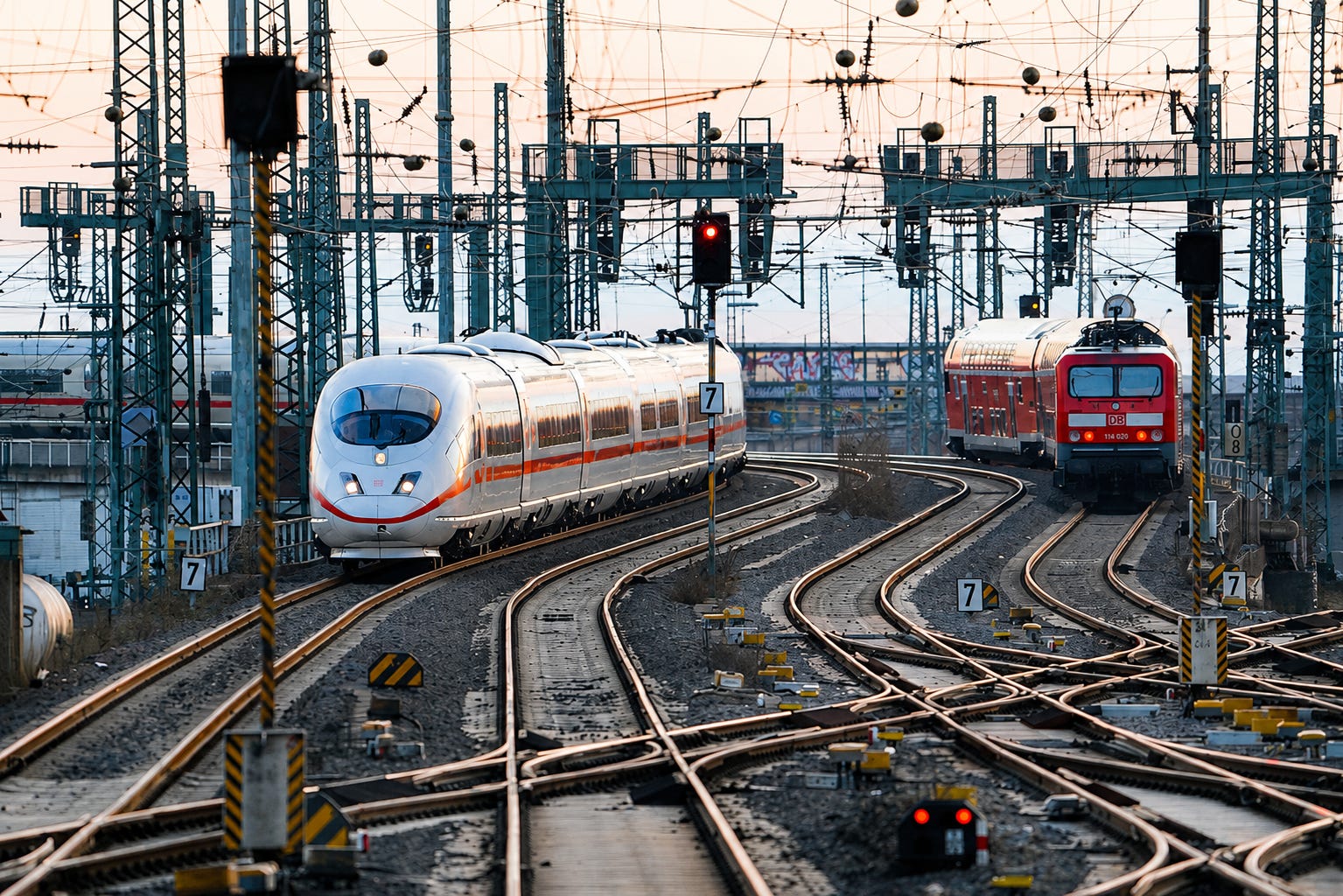
GERMANY: The Bundesnetzagentur will reserve 25–40% of capacity on congested long-distance corridors for competitors to Deutsche Bahn — the access guarantee Italo demanded before its 2028 market entry.
The regulator published its draft decision on 30 June. DB InfraGO may allocate no more than 60–75% of capacity on heavily used routes to a single operator, with the exact share left to the infrastructure manager. A final decision is expected within two weeks, after consultation of the rail infrastructure advisory council.
The rules apply from the capacity allocation for 2028 — the year Italo plans to launch German services. Deutsche Bahn, which runs about 95% of German long-distance traffic, warns that losing paths on profitable corridors would force cuts elsewhere on its network.
How the competition clause works
The clause covers only designated congested corridors, not the network as a whole. Nodes such as Munich and Frankfurt are set to fall under the capacity ceilings where the rule applies.
The quota applies only to regular-interval services — at least four daily departures at two-hour intervals to the same minute — and only where demand for paths exceeds capacity. Within the 60–75% band, DB InfraGO sets the exact ceiling itself; in practice, at least one competitor to DB Fernverkehr must receive usable paths on every corridor covered.
“Competitors of DB Fernverkehr such as Italo or FlixTrain have to invest heavily in new rolling stock,” said Bundesnetzagentur president Klaus Müller. “Until now, they could not reliably assess whether they would receive sufficient access rights.”
The clause, he said, guarantees a minimum level of access for competitors in scheduled long-distance services without blocking capacity for other types of traffic.
The demand behind the draft
Italo has pressed the regulator for reserved capacity since announcing its German entry programme: EUR 3.6bn in total, including 26 Siemens Velaro trains with an option for 14 more, operated through its German subsidiary Atrium SE from 2028.
Long-term framework agreements — the instrument Italo first asked for — were abolished in Germany in 2017. Without them, an entrant orders trains years before knowing whether it will get paths to run them.
DB InfraGO chief Philipp Nagl warned in June that a special access clause favouring Italo risked being struck down as contrary to EU law. The draft answers with a general rule open to any competitor, not a deal for one.
The incumbent’s objections
Deutsche Bahn argues that earnings from the busiest corridors finance long-distance services in thinner markets, and that lost paths would mean cuts elsewhere. The Eisenbahn- und Verkehrsgewerkschaft (EVG) rail union shares that concern.
DB InfraGO notes that the rule would guarantee paths for at least two long-distance operators on every congested corridor — and says it would aggravate the structural problem of nodes and capacity.
The draft now goes to the rail infrastructure advisory council. If confirmed, the clause takes effect with the path allocation for the 2028 timetable — the first year Italo trains could run.