Anglo Belgian Corporation (ABC) is a Belgian manufacturer of medium-speed diesel and dual-fuel engines for rail, marine and power generation applications, headquartered in Ghent.
ABC was founded in Ghent in 1912, shortly after the first licensed Rudolf Diesel engines entered production. The original company went bankrupt in 1979 and was restarted under new ownership; engine production has continued in the same city since, and the company now operates as part of the OGEPAR group.
Since the 1980s, ABC has focused on medium-speed, four-stroke engines for marine propulsion, locomotive traction and stationary power generation. The company states that its power range spans from 600 kW to 10,400 kW per engine.
Marine remains the largest market. According to the company, rail has been a continuous business line since 1960, covering both diesel and alternative engines for locomotive applications.
Rail engines and repowering
ABC supplies engines for shunting and mainline locomotives in both diesel-electric and diesel-hydraulic configurations. The medium-speed design, running at 600–1,000 rpm, trades power density for lower fuel and lube oil consumption and longer maintenance intervals — ABC’s central argument against high-speed alternatives.
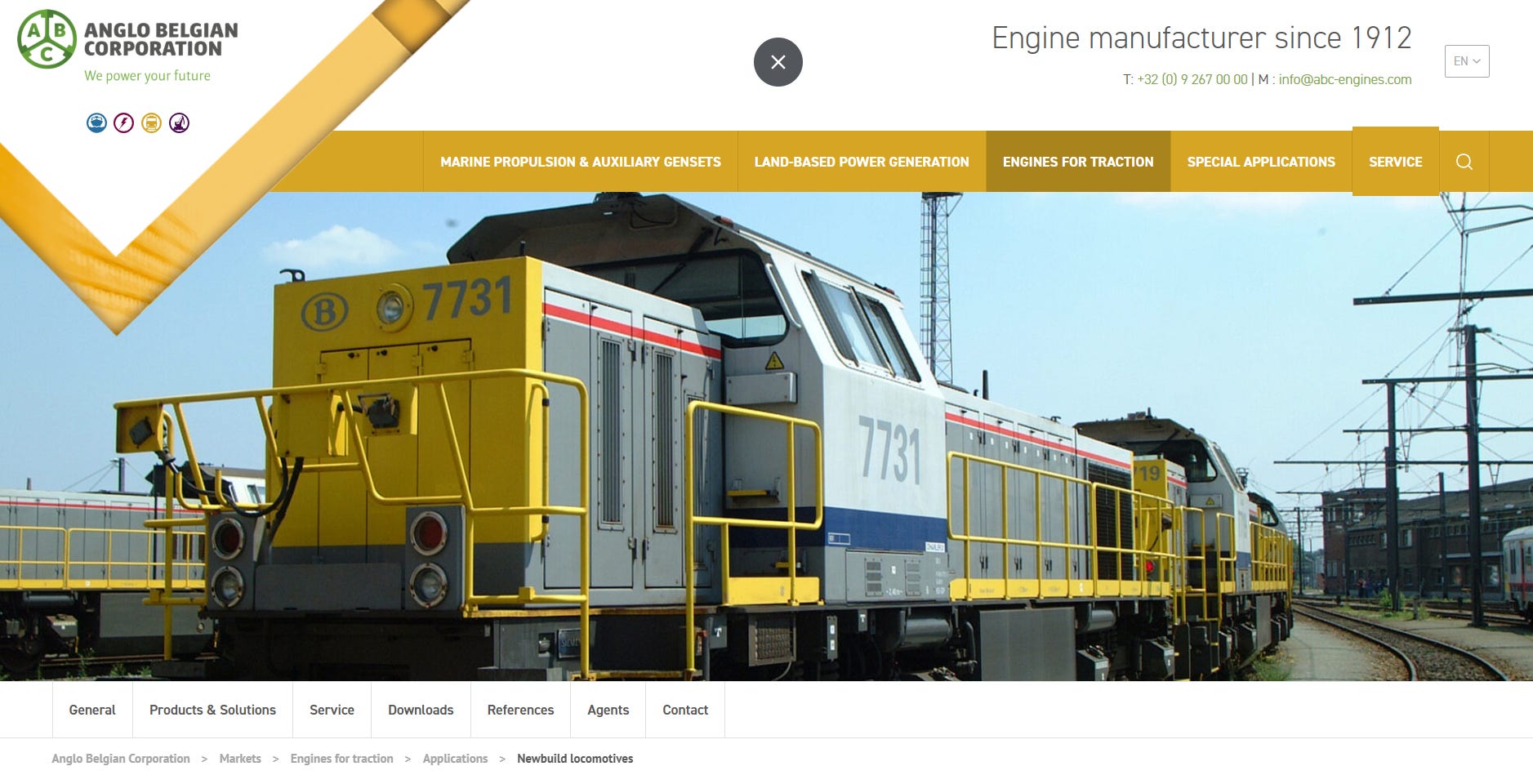
ABC’s largest European locomotive traction reference is the SNCB/NMBS Class 77 shunting and freight locomotive. All 170 units, delivered between 1999 and 2005, are powered by ABC’s 6DZC engine delivering 1,150 kW.
Repowering is the second leg of the rail business, applied to locomotives operated in Ukraine. ABC’s 6DZC engine replaced a V12 unit in a TEM7 shunting locomotive, increasing traction power by 8 percent, and its 8DZC engine replaced the original 10D100 engine in a 2TE10 mainline locomotive, increasing traction power by 15 percent. The 2TE10 rebuild was carried out at the Daugavpils Locomotive Repair Plant in Latvia.
Hydrogen through BeHydro
ABC develops hydrogen combustion engines through BeHydro, a joint venture with the Belgian shipping group CMB.TECH. The dual-fuel engines run on up to 85 percent hydrogen with a 15 percent diesel or biofuel pilot injection, and a 100 percent hydrogen version was launched in 2022.
For rail, the dual-fuel hydrogen engine is a development of the same 6DZC platform installed in the Class 77. In 2021, BeHydro proposed converting existing Belgian HLD 77 locomotives to hydrogen operation, presenting the concept to Infrabel’s CEO and the federal mobility minister at the time; no further public update has followed since.
In May 2026, a BeHydro dual-fuel hydrogen engine was installed in a heavy-duty freight locomotive at Traxtion’s facilities in South Africa, which the company describes as the first railway application of the engine. The locomotive, with hydrogen stored in swappable 20-foot containers on a dedicated fuel wagon, is planned to operate on the Walvis Bay–Windhoek corridor in Namibia.
Market position and current activity
ABC holds an EU Stage V certificate for its DZC engines in the IWP/IWA categories, which cover inland waterway propulsion rather than rail. The company’s own history states an installed base in more than 120 countries; a service network spanning more than 70 countries has been reported by third-party sources but is not confirmed on the company’s own channels.
Customers in rail include national operators, locomotive builders and repair plants handling repowering programmes. The company’s Ghent plant also produces generating sets and turnkey power plants.
In 2026, ABC opened the ABC Academy, a training centre next to the Ghent production site, covering service training on diesel, Hydrotreated Vegetable Oil (HVO), methanol and hydrogen engine variants.