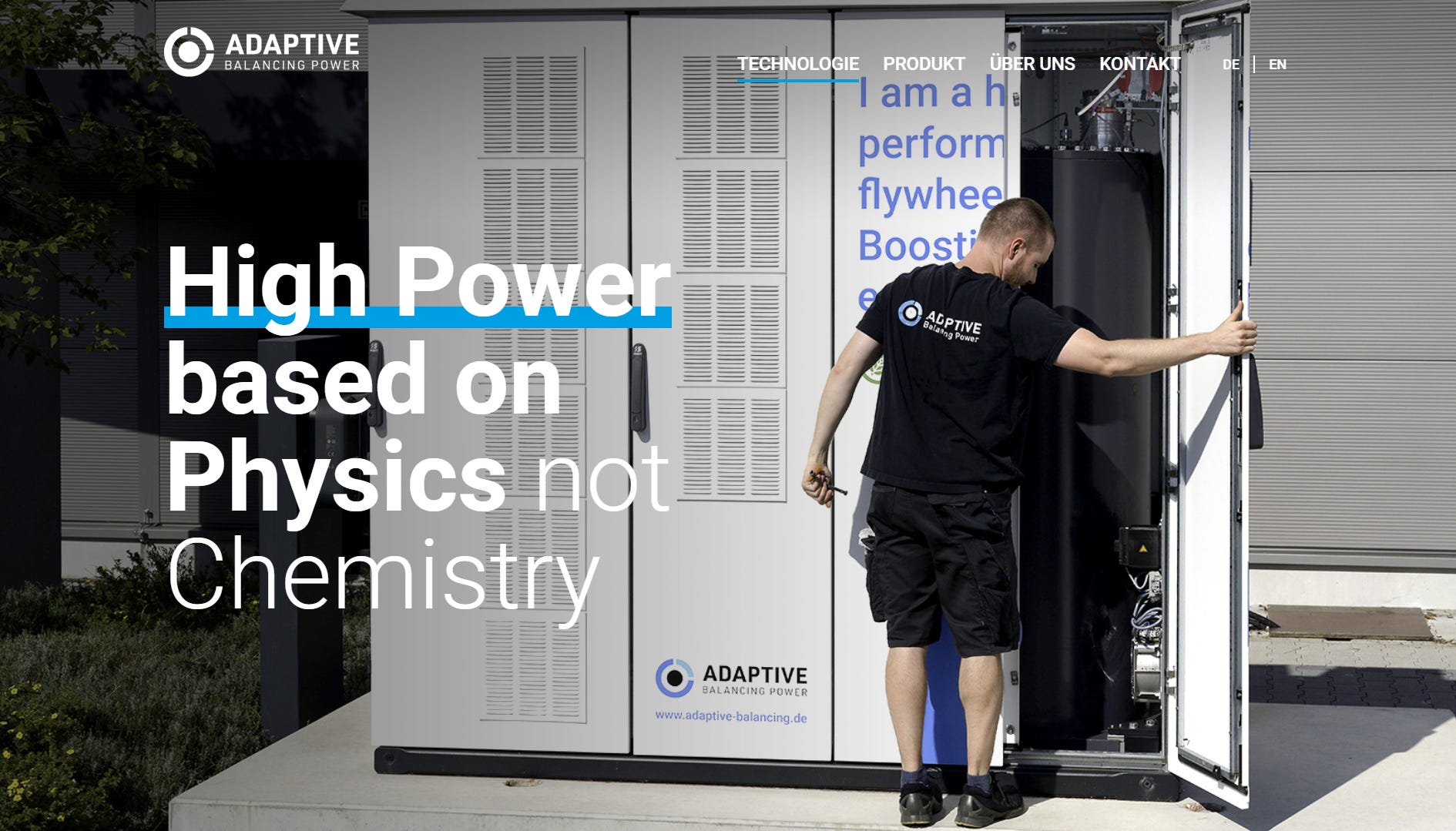
Adaptive Balancing Power is a German developer and manufacturer of flywheel-based energy storage systems for railway and grid infrastructure, founded in 2016 as a spin-off from the Technical University of Darmstadt.
Adaptive Balancing Power GmbH is headquartered in Pfungstadt, just south of Darmstadt, where it relocated from Darmstadt in 2022 and doubled its production floor space to around 800 square metres. The company was founded by Hendrik Schaede-Bodenschatz and Nicolai Meder, whose university research into magnetically suspended rotating masses forms the technical basis of the product.
Technology
The core of the system is a carbon-fibre flywheel shaped as a hollow cylinder, rotating at up to 16,000 revolutions per minute on contact-free magnetic bearings inside a vacuum housing. An external-rotor synchronous machine accelerates the flywheel to charge the store and decelerates it as a generator to discharge.
Power flow reverses in under 30 milliseconds even at full load. Because the storage principle is mechanical rather than chemical, the company states the system can be charged and discharged without cycle limits over a service life it puts at more than 20 years.
Rail applications
In the rail sector, the systems address recuperation of braking energy and peak-load management in DC networks, a form of energy storage for infrastructure aimed at the trackside rather than the vehicle.
The company names operators of energy and railway networks among its target customers, alongside industrial DC grids and high-power EV charging providers.
Current activity
In April 2026 the company announced PEAK_S, a pilot project with DB Energie to test flywheel storage in the DC power supply and electrification of the Berlin S-Bahn network. Its Amperage system delivers up to 350 kW of total power for DC rail and e-mobility applications.