

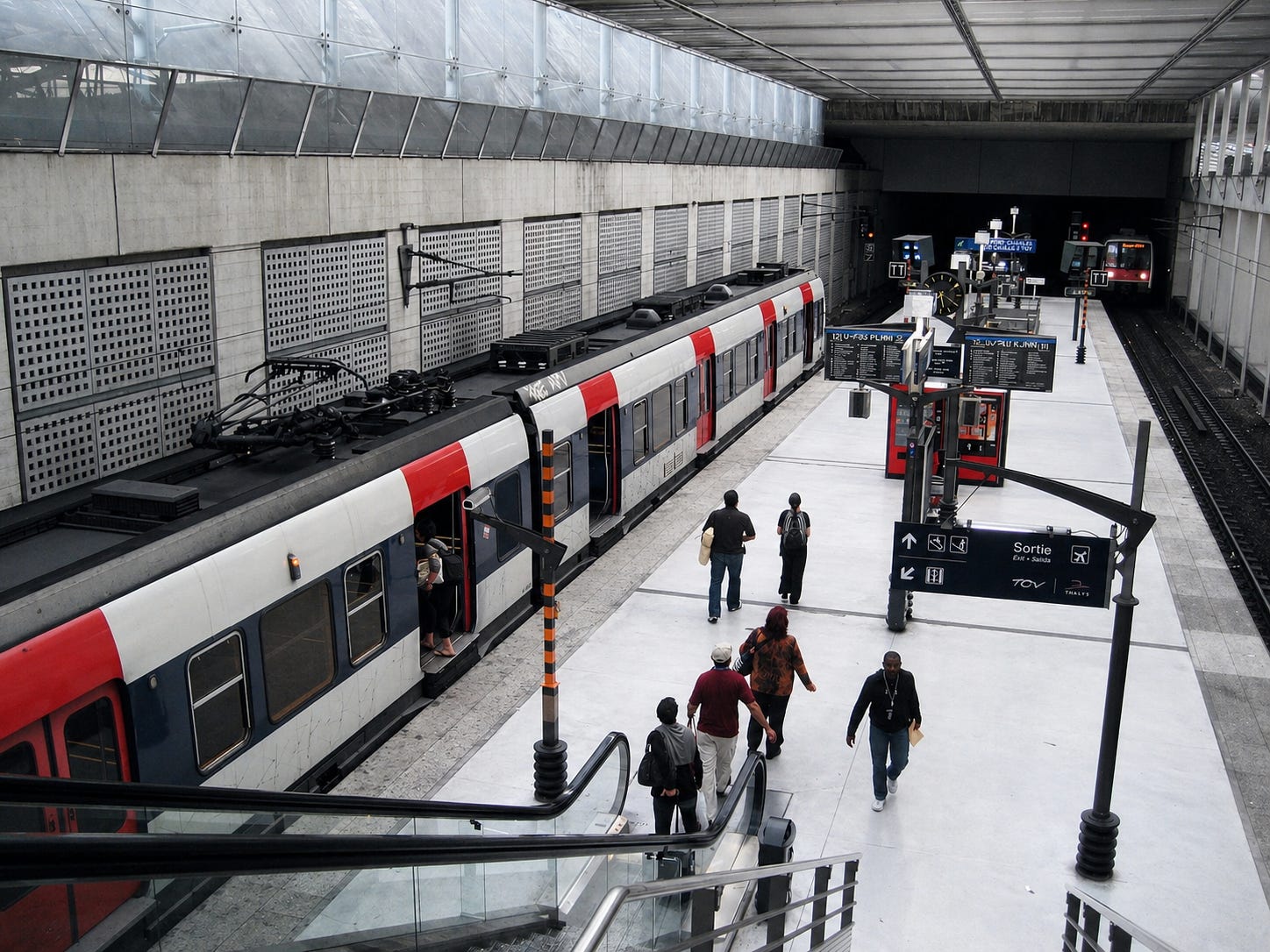
The MI79 trainsets on Paris’s RER B were purpose-built for a line that runs under two separate operators, two voltage systems and a nineteenth-century tunnel — constraints that have made replacing them far harder than retiring any ordinary commuter fleet.
The MI79 entered service in 1980 as the first rolling stock capable of running across both the RATP and SNCF sections of RER B, switching between 1.5 kV DC and 25 kV AC as it crossed Gare du Nord.
The MI84, a derivative built for RER A and transferred to RER B from 2017, added further capacity but not a solution to the underlying problem: a line carrying more than one million daily passengers on single-deck trains designed for a different era of demand.
Both fleets were refurbished — the MI79 between 2010 and 2015, the MI84 from 2017 — but neither renovation added capacity. Paris commuter authority Île-de-France Mobilités commissioned 146 double-deck MI20 trainsets in February 2021 under a EUR 2.56 billion contract with an Alstom–CAF consortium to replace them.
A line that could not take a standard train
The MI79 was not an adaptation of existing equipment. It was designed from the ground up to solve a specific technical problem: how to run a single train across two networks with different power supplies and different operating organisations.
North of Gare du Nord, SNCF operates RER B under 25 kV AC. South of that station, RATP takes over under 1.5 kV DC. The train must switch between the two mid-journey, without interruption to passengers. No existing rolling stock in the French fleet could do this when the MI79 was ordered in 1979.
The line’s physical constraints compounded the challenge. The southern section follows the route of the Ligne de Sceaux, a nineteenth-century suburban railway whose tunnel clearances were never built for modern double-deck rolling stock.
When planners later considered replacing the MI79 with longer trainsets — as used on RER A — the tunnel geometry ruled it out. Platform lengths, signalling positions and catenary heights set further limits. Any replacement fleet had to be engineered around these constraints, not selected from a catalogue.
The MI84: a transfer, not an upgrade
The MI84 arrived on RER B not as a planned fleet renewal but as a consequence of decisions made elsewhere. Built between 1985 and 1990 for RER A, the MI84 was progressively displaced as that line introduced double-deck MI09 trainsets from 2011 — a transition that was not complete until the last sets transferred to RER B in 2017. By that point, the trains had already spent three decades in intensive service on one of Europe’s busiest lines.
RATP refurbished 33 of the 45 MI84 sets under a EUR 75 million contract with Alstom signed in 2017 — new interiors, LED lighting, updated ventilation. The result was a more comfortable train. It did not increase capacity. The MI84, like the MI79, remained a single-deck four-car set carrying 788 passengers per trainset.
What refurbishment could and could not do
The MI79 refurbishment, completed between 2010 and 2015 at a cost of EUR 275 million, extended the fleet’s operational life by an estimated 15 to 20 years. It updated interiors, installed refrigerated ventilation and improved passenger information systems.
It did not change the fundamental constraint: a single-deck train on a line whose passenger numbers had grown far beyond the assumptions of the 1970s design brief.
Refurbishment bought time. It did not solve the capacity problem, and it could not address the structural bottleneck at the core of the network — the shared two-track tunnel between Gare du Nord and Châtelet–Les Halles, where RER B and RER D run together at peak times.
Why the MI20 had to be built for this line
The MI20 is not a shelf product applied to RER B. Like the MI79 before it, it was specified around the line’s constraints. The southern tunnel clearances that ruled out 112-metre trainsets on RER A apply equally to MI20: the new fleet matches the 104-metre length of the MI79 and MI84 sets it replaces.
The dual-voltage requirement remains — the MI20 must switch between RATP and SNCF power systems at Gare du Nord, as the MI79 has done since 1980.
What changes is the cross-section. The MI20 is a seven-car hybrid trainset combining single and double-deck carriages, carrying 1,070 passengers per set against 788 for the current fleet. Full-length intercirculation and level boarding are designed to cut dwell times at the busiest central Paris stations. Each set is air-conditioned — a basic feature absent from the original MI79.
Assembly is split between the two consortium members. CAF produces the end cars at its Reichshoffen plant in Alsace. Alstom manufactures the central cars and carries out final assembly at its Crespin site in northern France.
The first end car left Reichshoffen on 29 January 2026. No complete trainset has yet been built. The current target is late 2028 for first passenger service, with full delivery of all 146 units not expected before 2030.
The capacity gain that depends on a second system
The MI20 will add capacity. But the deeper operational change on RER B depends on something the rolling stock alone cannot deliver.
NExTEO, a communications-based train control system being deployed across RER B and D, will allow headways in the shared central tunnel to be reduced substantially — increasing the number of trains that can run through the core of the network per hour.
Each MI20 trainset will carry the onboard NExTEO equipment under a separate EUR 239 million contract. The central tunnel section is scheduled to go live with NExTEO in 2031, with full deployment across the RER B perimeter by 2033.
Until the MI20 fleet and NExTEO are both in place, the capacity of the shared tunnel remains the binding constraint on what RER B can deliver. The trains being replaced were built to connect two networks that had never been designed to share one.
The trains replacing them must do the same — and enable a signalling system the line could not run without the new fleet.