

A derailment in Switzerland’s Gotthard Base Tunnel in August 2023 has triggered a Europe-wide operational start date for new freight wagon wheel safety measures: 1 February 2026.
The Joint Network Secretariat (JNS), coordinated by the EU Agency for Railways (ERA), has finalised “risk control measures 2026” covering seven wheel types. These include the BA 390 type involved in the Gotthard derailment.
The package tightens three things at once: how wheels are identified in operations, how they are inspected, and what diameter thresholds are allowed in service.
The measures are targeted at freight operations. Passenger rolling stock typically uses different wheel types and maintenance regimes, and is therefore not directly covered by this specific JNS package.
What changes from 1 February 2026
From 1 February 2026, the measures are mandatory in day-to-day operations. In practice, they tighten responsibilities across maintenance, train preparation and post-incident handling.
For the wagon maintenance organisation responsible for the vehicle, the change is straightforward: maintenance organisations must add wheel checks to routine workshop tasks, including:
Brake block changes
Axle inspections
Off-wagon maintenance (with wheelsets removed)
Wagon technical inspections
For infrastructure managers and railway undertakings, the measures require reinforced checks at key operational moments:
Train preparation
Brake block changes
After suspected thermal overload
A second, highly visible element is the phase-out of “white stripe” markings — a paint mark used in operations to indicate wheels previously classified as “thermostable” for operational purposes (i.e., cleared for higher thermal loads).
Under the new measures, the affected wheel types are treated as non-thermostable, so the marking is no longer considered a reliable operational signal. The phase-out follows a fixed timetable:
Traceable programme due: 1 February 2026
Markings removed by: 1 July 2027
New technical thresholds and transition dates
The package also introduces tighter technical thresholds for some wagons, particularly where axle loads are higher. For wheels on wagons with a nominal axle load above 20 tonnes, the new diameter rules are:
Minimum in-service wheel diameter: 864 mm
Minimum wheel diameter after last reprofiling: 880 mm
Reinstallation ban: wheels at 864 mm or below must not be reinstalled
Implementation is phased. General compliance runs to 1 January 2029. However, shorter timelines apply for higher-risk operating regimes, including mountain routes and regions with harsher winter operating conditions.
During the transition, wheels below 864 mm may continue to run only under tighter controls defined in the JNS/ERA package — including more frequent checks and—under specified operating regimes—a 50,000 km visual inspection interval.
Switzerland’s national approach
Switzerland had already pushed for stricter national rules after the Gotthard derailment. The European package now sets a shared baseline, while debate continues over whether tougher, faster national timelines are justified for alpine freight operations.
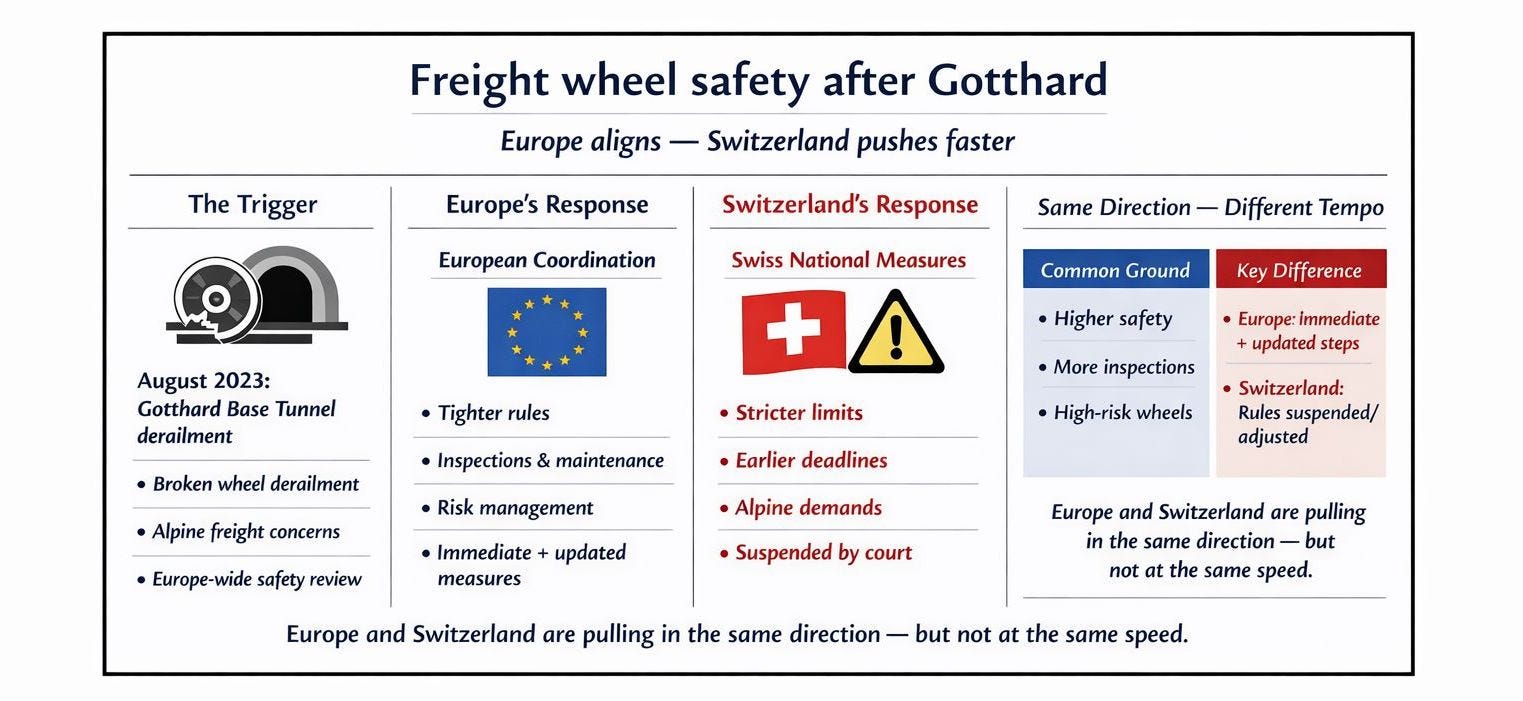
The “national rules” question matters beyond this case: Switzerland has historically moved earlier with stricter requirements than parts of the EU, which can create immediate compliance pressure for freight operators and wagon owners running cross-border services.
Why it matters: This turns a safety investigation into an operational regime with fixed dates — affecting maintenance planning, wagon availability and departure checks across Europe’s freight market.