

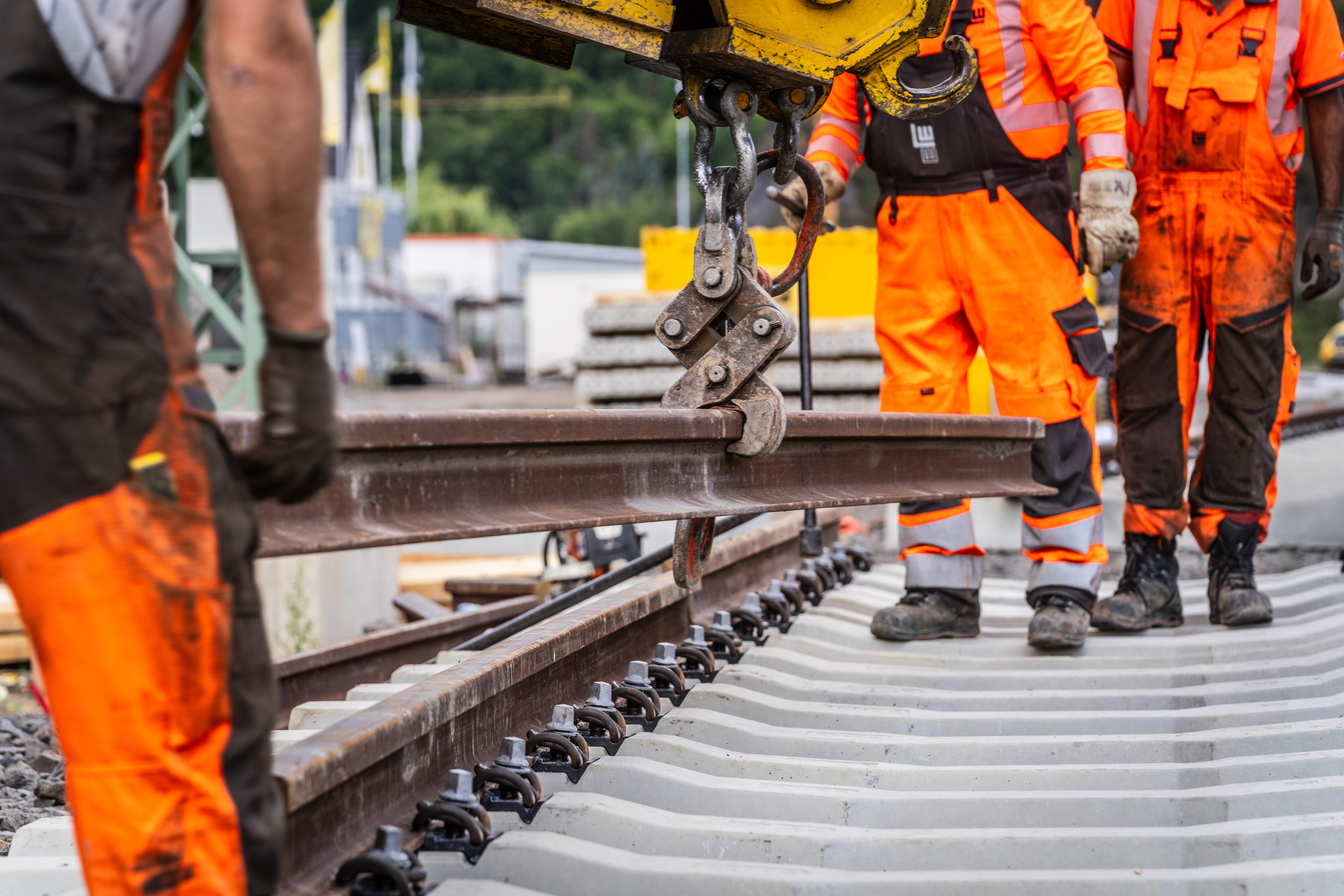
Every train movement in Europe rests on the permanent way — the assembly of rails, sleepers, fastening systems, ballast and supporting structures that forms the railway’s physical foundation and transfers every traction and braking force to the ground.
The term dates from the earliest railways, but the engineering does not stand still. Rail metallurgy, sleeper materials, fastening design and inspection regimes have each been redefined over the past half-century.
What has not changed is the division of labour: every component either carries load, holds geometry, or both.
Rail and continuous welding
The rail is a precisely profiled steel beam, typically 60 kg/m on main lines and 54 kg/m on secondary and freight routes. It is rolled in lengths of 100–120 metres and joined by thermite welding into continuous welded rail (CWR).
CWR eliminates rail joints, and with them the dynamic impact loads and maintenance burden that discrete joints create. Thermal expansion is managed not by physical gaps but by designed-in longitudinal stress.
Rail is laid and welded at a neutral temperature — typically 17–30°C depending on regional climate — that balances summer compression against winter tension.
Sleepers and slab track
Beneath the rail, sleepers hold the correct gauge and transfer vertical and lateral loads into the ballast bed. Prestressed monoblock concrete sleepers are standard on European main lines, having displaced the timber that dominated track construction until the 1970s.
Concrete imposes consistent gauge tolerance and lasts longer: 40–50 years on a main line, against 25–30 for timber.
On high-speed lines and in tunnels, ballastless slab track mounts the fastening systems on a concrete or polymer base without loose stone — used where settlement control and maintenance access are critical.
Fastening and load transfer
The fastening system connects rail to sleeper, and its job goes beyond fixing position. A correctly designed fastening provides controlled vertical elasticity to absorb dynamic wheel loads, electrical insulation between rail and sleeper to support track circuit signalling, and enough downward toe load to resist longitudinal rail creep and rollover under lateral force.
European systems — including the Pandrol e-clip family and the Vossloh SKL series — achieve this with spring steel clips that hold a continuous clamping force without bolts, removing the need for periodic retightening.
Switches and crossings
Turnouts let trains move between tracks by guiding wheels across a junction where the running rail itself is briefly interrupted. The point where two diverging rails meet is a mechanical compromise: geometry that works for one route inevitably imposes a gap or an angled crossing on the other.
Manganese steel frogs and movable point frogs are used where speed or frequency of use makes that gap behaviour critical.
Actuation, locking and detection of the moving parts are integrated into signalling systems, making the physical turnout inseparable from the signalling layer in terms of safety assurance.
Overhead contact line
On electrified lines — 57.6% of the EU network by length in 2024, according to Eurostat — the permanent way also carries the overhead contact system (OCS), the wire and mast infrastructure that delivers power to the pantograph.
Its supports and foundations follow the track’s own geometry rather than an independent alignment. On high-speed lines above 250 km/h, OCS tolerances become as demanding as the track’s own, and the two must be maintained jointly.
Monitoring and inspection
Under Directive 2016/798, infrastructure managers are obliged to maintain track in a condition that does not endanger safe train operation. In practice this means systematic measurement of gauge, cant, twist, alignment and longitudinal level, on cycles set by line category, traffic volume and speed limit.
European track geometry standards are governed by EN 13848, which defines quality levels for each parameter and the threshold values that trigger maintenance intervention.
Cracking that starts inside the rail head is invisible from the surface and is instead found by ultrasonic testing, run from dedicated measurement vehicles or road-rail inspection vehicles that operate on both track and road. Beneath the sleeper, ground-penetrating radar reveals ballast condition and subgrade settlement without any need to dig.
Network and investment
The EU rail network totalled 201,314 km in 2024 — a decrease of 8.7% from 220,420 km in 1990. The reduction reflects closures of lightly used secondary routes, not deterioration of the main network.
Track renewal and maintenance are recurring, capital-intensive obligations for every European infrastructure manager. France and Germany operate the two largest national networks in the EU; both have shrunk since 1990 while their electrification share has risen.
None of this is visible to a passenger. That is, in a sense, the point: the permanent way is judged almost entirely by the absence of anything going wrong.