

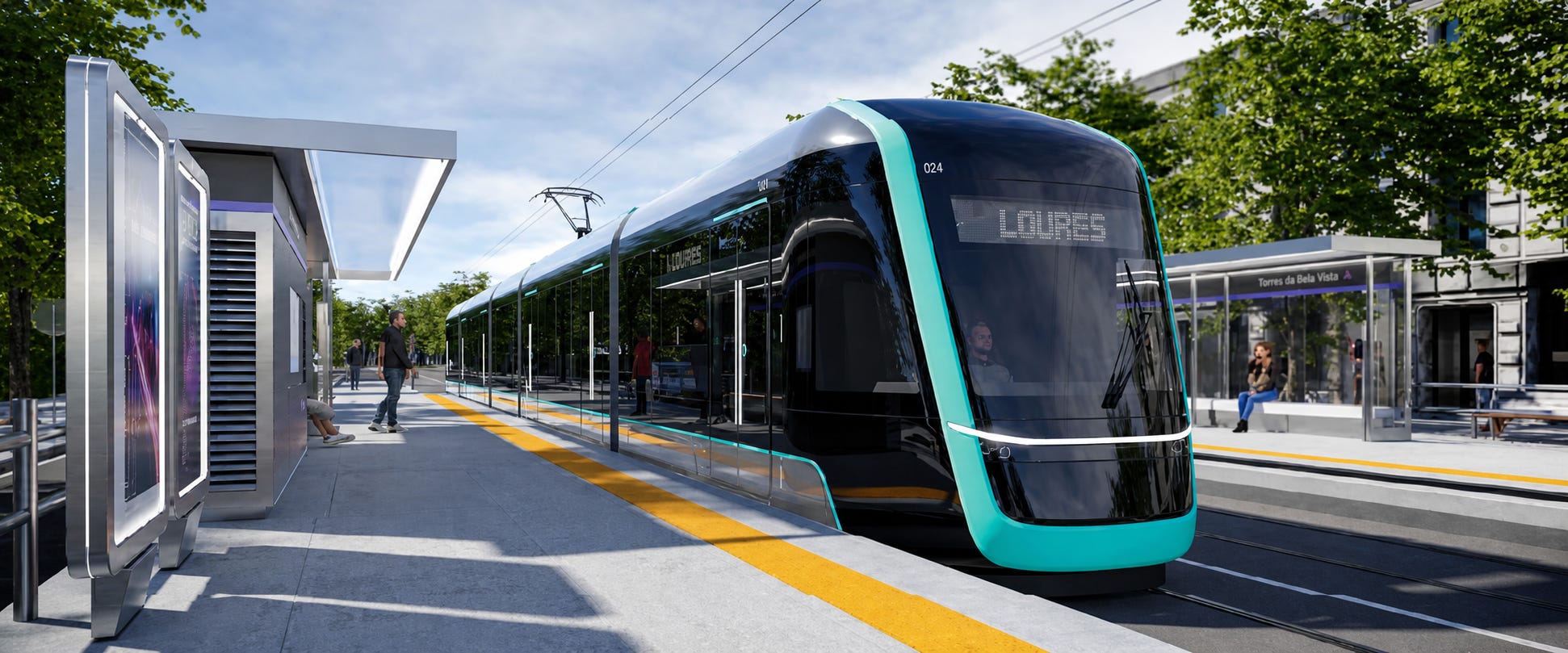
The European Commission's ruling that Chinese supplier CRRC had to leave the Lisbon metro consortium settled the question of fair competition — or at least, a specific version of it. It said nothing about whether the price was right, whether European suppliers could have matched it, or whether China's rail industry has simply become better than Europe's.
By Dan Jensen
The consortium’s bid remained at EUR 598.8 million after CRRC was removed and Pesa substituted. The Commission accepted the swap as sufficient.
If the case had been about price level, that outcome would make no sense. What changed was not the number — it was the traceability of the state support behind it.
FSR is not a price instrument
The Foreign Subsidies Regulation (FSR) is not a price instrument. It does not ask whether a bid is low. It asks whether state support from outside the EU gave a company an advantage that cannot be traced or assessed
In Lisbon, the Commission identified three distinct forms of state support to the CRRC group:
The Chinese state awarded CRRC contracts in China exceeding EUR 36 billion over three years — at a scale that raises questions about whether the company operates as a market actor or a state instrument
Approximately EUR 471 million in direct state transfers
A preferential corporate tax rate of 15 percent against a standard 25 percent
The question was not whether CRRC was the strongest competitor. It was whether the competition had been fair.
“Distortive foreign subsidies”
The obvious challenge to this logic arrived quickly in the debate that followed. Pesa, the Polish manufacturer brought in as replacement, is itself extensively state-backed. Poland’s state development fund PFR controls the company.
In December 2025 Pesa signed a financing agreement of up to PLN 6.8 billion (approximately EUR 1.6 billion) with a consortium of more than 20 Polish and international financial institutions, covering long-term investment, working capital and performance guarantees for existing and future contracts.
The Commission’s response to this is precise. It cleared Pesa on the grounds that the Polish manufacturer had not received “distortive foreign subsidies.” The operative word is foreign, not the absence of state support.
Pesa’s backing falls within the EU state aid framework:
Member states must notify aid plans to the Commission before implementing them
Awards above EUR 100,000 are published in a public register
Competitors can challenge decisions before the General Court.
None of those mechanisms applied to state support from outside the EU. The FSR was designed precisely to close that gap.
This is not a claim that EU state aid rules produce perfectly equal outcomes. It is a structural point: One form of state support operates within a framework of defined rules — compliance can be monitored and challenged. The other can take any form, at any scale, with no mechanism for scrutiny or challenge.
European industrial weakness?
There is a separate argument in the Lisbon debate that deserves to be taken seriously on its own terms. It goes like this: CRRC would have won even without the subsidies. European suppliers are too expensive, too slow and too protected. The real problem is not Chinese state support — it is European industrial weakness.
The procurement record gives that argument some force. Lisbon’s first tender collapsed — every bid averaged 46 percent above the ceiling. After the budget was raised by EUR 150 million, four consortia bid again. Only one came in below the new EUR 600 million ceiling — the consortium with CRRC as rolling-stock subcontractor. The next cheapest option matched the ceiling exactly.
The FSR ruling does not address that record. It establishes whether a specific distortion occurred. Whether European suppliers could have matched the price without it is a different question entirely.
The Westbahn case
Westbahn, the Austrian open-access operator that brought CRRC double-deck units into scheduled service on the Vienna–Salzburg corridor in November 2025, made its position explicit: the European rolling-stock market is an oligopoly — too few suppliers, too little competition, rising costs and long delivery queues.
That assessment stands regardless of the FSR ruling in Lisbon.
Straightforward protectionism?
The Lisbon decision is the first time the FSR has been run to a final substantive outcome in a public procurement case.
Any EU tender above EUR 250 million where participants have received foreign financial contributions of at least EUR 4 million per non-EU country over the preceding three years is subject to mandatory notification and potential investigation.
What the decision does not do is fix European supplier capacity, compress delivery timelines or address the pricing dynamics that produced a collapsed first tender. Those are industrial policy questions. The FSR is a competition instrument.
CRRC is not formally banned from EU tenders. But the subsidy structure the Commission documented in Lisbon is structural — it does not change between bids.
The next time CRRC bids above the threshold, the Commission will be starting from a position it has already investigated. That makes a second exclusion significantly easier to reach.
Many saw the ruling as straightforward protectionism. FSR rules require a simpler test: could the state support behind the bids be mapped and assessed?
For the lowest bid, the Commission found it could not.
Sources:
The Lisbon case — primary sources
European Commission, 21 April 2026 — IP/26/853: Commission clears Lisbon railway line bid under FSR, subject to conditions https://ec.europa.eu/commission/presscorner/detail/en/ip_26_853
Official Journal of the EU, 27 November 2025 — OJ C/2025/6441: Summary notice of in-depth investigation (FSP.103117)
https://eur-lex.europa.eu/legal-content/EN/TXT/HTML/?uri=OJ:C_202506441
Metropolitano de Lisboa, 21 July 2025 — Bids submitted for the Violet Line https://projetos.metrolisboa.pt/expansao/linha-violeta/
FSR framework and precedent
Regulation (EU) 2022/2560 — Foreign Subsidies Regulation
https://eur-lex.europa.eu/legal-content/EN/TXT/?uri=CELEX:32022R2560
Related:
EU orders CRRC out of Lisbon metro contract

EU: The European Commission has ordered a Lisbon metro consortium to drop Chinese supplier CRRC after finding it received subsidies that distorted competition — the consortium has committed to replacing …
China-built trains are coming — because Europe can’t keep up

Austria’s Westbahn will deploy four Chinese-built trains within weeks — not as a geopolitical statement, but because Europe’s established manufacturers can’t deliver fast enough.