

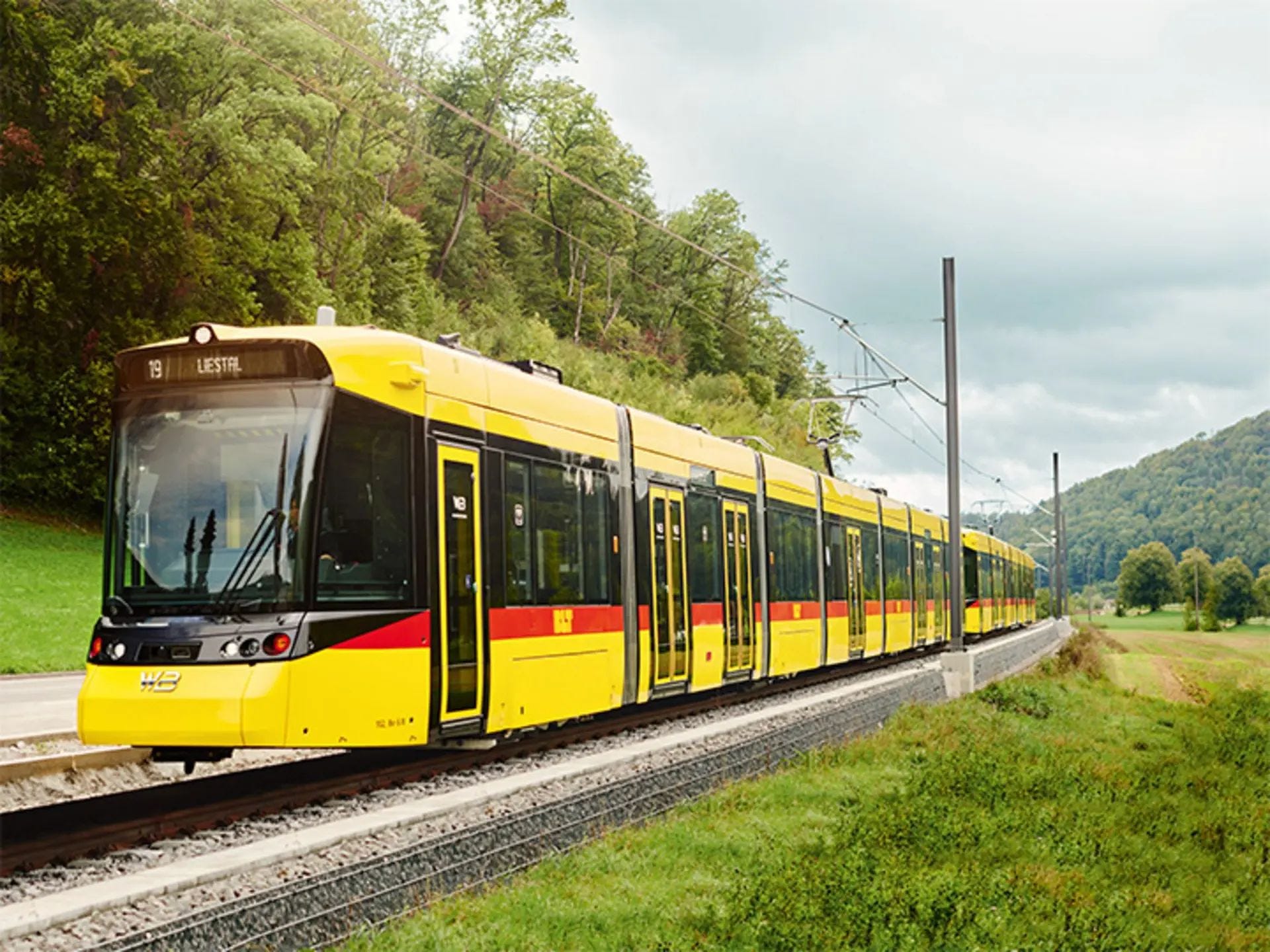
A Swiss regional railway has begun semi-automated (GoA2) operation in regular passenger service. It’s deployed on an open line with level crossings — not a fully segregated urban system.
The start of operation follows approval by Switzerland’s federal transport authority and the commissioning of new signalling and train control systems supplied by Stadler.
The service is operated by Baselland Transport on the Waldenburg Railway in Basel-Landschaft, a narrow-gauge light rail line. The signalling and train control system was supplied by Stadler and approved for regular operation by the Swiss Federal Office of Transpor
A driver-supervised operating model
In this setup, the driver remains on board and authorises departure, while the control system executes the driving profile once doors are closed — including compliance with speed limits, level crossing management and precise stopping at stations. The driver monitors the run and can intervene if required.
The setup is based on Stadler Signalling’s NOVA Pro train protection system, redeveloped as a communications-based train control (CBTC) system.
Operator, supplier and approval
Within the approved operating concept, the system supervises speed and braking, enforces line-specific speed limits, manages movements through level crossings and supports accurate station stopping after driver authorisation.
As a follow-on phase, automated depot movements are planned from the end of 2026, extending automation beyond the main line into yard and stabling operations.
Why it matters: It shows a path to incremental automation on existing regional lines with level crossings, without full segregation. For other networks, the question is which parts of the driving task can be standardised and certified under driver supervision — and what that means for operations.