

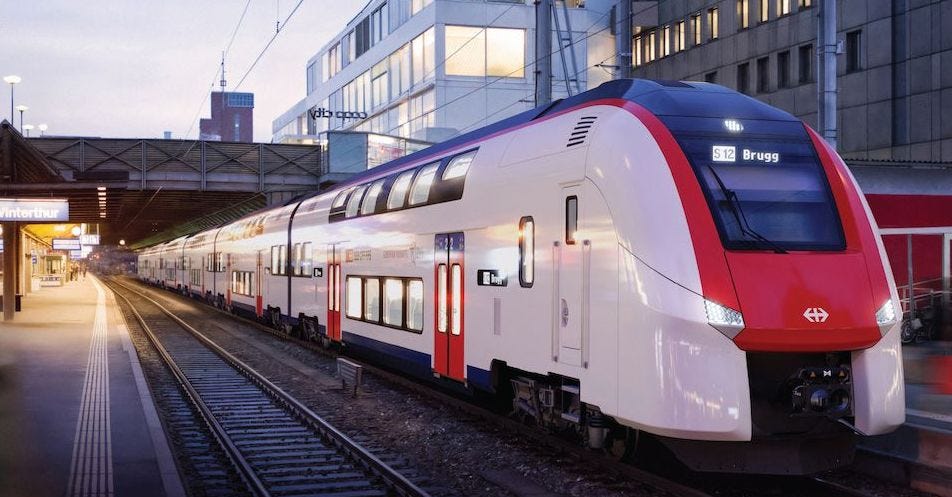
Stadler has taken SBB to court over its 7 November decision to award the EUR 2.1 billion double-deck order to Siemens. The company says key parts of the evaluation “cannot be understood” — even after reviewing the scoring in detail.
The case asks the Federal Administrative Court to review how Siemens outscored Stadler on operating costs, maintenance, quality and long-term service, despite proposing a double-deck configuration still in development. Stadler argues its proven platform was undervalued in several criteria. SBB maintains that Siemens submitted the most advantageous bid under procurement law.
What this case is — and why it matters
This is not a challenge to a previous ruling, but directly to SBB’s procurement decision. The court will check whether SBB applied its criteria properly and whether the scoring is supported by the documentation.
At stake is one of the largest rolling-stock orders in recent Swiss history: 116 six-car double-deck trains, with options for 84 more. Siemens’ fleet is due to enter service from 2031. SBB ranked the German bid highest on lifecycle costs, deployment risk and operational compatibility.
Stadler disputes several of those points. It argues that its existing double-deck platform has years of service experience, while Siemens’ configuration is still in development. According to Stadler, this should have carried more weight in categories linked to long-term reliability and cost.
The court will not reassess the trains themselves. Its task is to determine whether SBB followed procurement rules, applied criteria consistently and justified its scoring.
What could happen next
Three outcomes are realistic. The court may uphold SBB’s decision — the most common result.
It may require SBB to correct parts of the scoring and reassess specific criteria.
In rarer cases, it can order a broader re-evaluation if the scoring method is deemed inconsistent or insufficiently supported.
Why it matters: For Europe’s rail sector, the case shows how detailed scoring of lifecycle costs and risk is becoming more open to challenge when the margin between bidders is narrow. The case tests how major rolling-stock awards hold up under legal scrutiny.
What’s next: The court will assess whether SBB applied its criteria correctly. A re-evaluation could unsettle long-term fleet planning.