

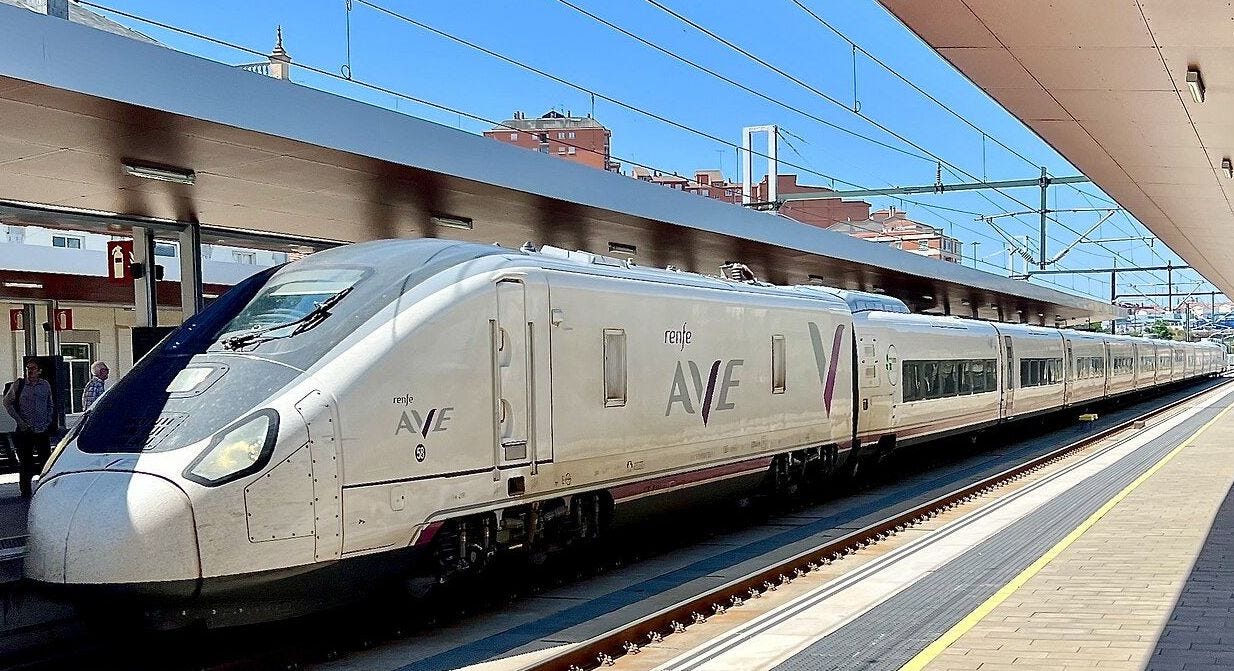
SPAIN: Renfe has withdrawn two fixed-gauge Talgo Avril trains from the Madrid–Valencia line. The operator says some of its own drivers have cut the trains’ speed on their own initiative.
The two Talgo Avril sets covered six departures on the corridor and have been replaced with S112 sets from the same manufacturer. Renfe says the decision is about operations and service quality and that there is no safety reason behind it.
Renfe put the figure at two in a statement answering the Spanish Railway Drivers’ Union (SEMAF), which had said five of the 11 available sets had been taken out of commercial service. Each replacement set has 142–143 fewer seats per departure, on a corridor where Iryo and Ouigo compete with Renfe for the same passengers.
The speed dispute
Some drivers have been limiting the fixed-gauge Avril sets, Renfe’s Class 106, to 200 km/h, the ceiling SEMAF has demanded, according to Spanish press reports. Renfe says the reductions go against the assessment of its own engineers and of the Agencia Estatal de Seguridad Ferroviaria (AESF), Spain’s rail safety authority.
AESF has confirmed that there is no technical basis for a general speed restriction and that Renfe’s measures are sufficient, Renfe says. The authority’s position is so far known only through the operator’s account of it.
SEMAF called the withdrawal a positive step and demanded openness from Renfe. The trains were taken out, the union said, so that the operator could meet its own service guarantees.
Seats lost on a contested corridor
The rotation affects seven services, three Avlo and four AVE. Renfe’s low-cost Avlo service drops from 581 seats to 438 per departure and its AVE service from 507 to 365. El Economista calculates the loss across the seven services at more than 97,500 seats by the end of the year if the rotation stands.
Cadena SER reported that Renfe planned to put S102 sets on some of the departures from 14 September. Renfe did not confirm the plan.
Cracks, inspections and a rebuild
Magnetic-particle tests in the last week of August found new signs of early-stage damage on the bogies of two fixed-gauge sets, which Renfe took out of service as a precaution. Renfe chairman Álvaro Fernández Heredia met SEMAF on 4 September and raised the inspection frequency to every three to four days.
After that meeting Renfe pointed to the contract it signed with Talgo in July 2026, worth around EUR 132m, to rebuild all 15 fixed-gauge sets to variable gauge with new, more robust bogies, a step the operator calls the definitive solution.
Industry reports put the start of that work in mid-2027. Renfe says its analyses with Talgo show that a train with a visible crack would have to run around 38,000 km before the crack reached a potentially dangerous size.