

Rail freight is set to grow globally through 2035, driven by intermodal demand and new long-distance corridors. But the strongest momentum is outside Europe’s mature markets — with Poland standing out as one of the few European countries where volumes continue to rise.
Forecasts from Future Market Insights point to expanding container traffic, cross-border corridors and more intermodal capacity worldwide. Europe remains largely flat, held back by congested infrastructure, passenger prioritisation and slow progress on road-charging reform. Poland is the exception: intermodal volumes increased in the first half of the year, and operators such as ORLEN Kolej are expanding fleets to meet rising demand.
Poland stands out in an otherwise stagnant region
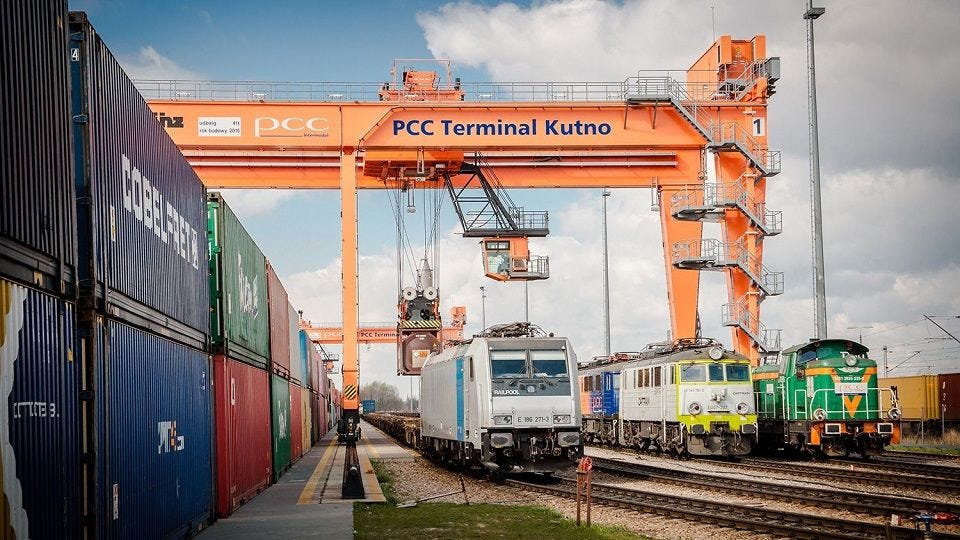
Poland’s resilience reflects a mix of factors. Strong east–west container flows through hubs like Małaszewicze support intermodal traffic, and domestic industry provides stable baseline volumes. Infrastructure bottlenecks exist but remain less limiting than in Western Europe.
Operators are responding. Growth in the first half of the year added pressure on existing fleets, prompting accelerated renewal programmes. ORLEN Kolej’s recent order for 40 new freight locomotives — a major Polish acquisition — underlines confidence in continued volume growth. Domestic manufacturers PESA and Newag supply the new units.
Global growth contrasts with European stagnation
Future Market Insights expects global rail freight to reach EUR 567.3 billion by 2035, driven by containerisation and long-distance corridors linking production regions with ports. Asia–Pacific and emerging markets account for most of the expansion, supported by electrified lines and high-capacity intermodal hubs.
Europe is not part of this acceleration. The network is mature, heavily shared with dense passenger traffic and restricted by bottlenecks in key terminals and nodes. Even when operators want to run more freight, train paths are limited. Road transport still fails to reflect full external costs, weakening rail’s competitiveness despite lower emissions.
Where the growth goes next
Poland shows that freight grows where new terminals open, where electrified lines link ports with inland hubs, and where operators can run longer, heavier trains with reliable access. In Europe, this depends on relieving capacity constraints and modernising road charges so rail can compete fairly.
Without those changes, Poland risks remaining an outlier rather than a model for wider European growth.
Big picture: Global rail freight continues to expand, but Europe risks falling behind as capacity and pricing constraints persist.
Quick take: Poland’s intermodal-driven growth stands out in a region where most markets remain flat.
What’s next: Corridor upgrades and modernised road charging will determine whether European freight can reconnect with global growth trends.
Source: Future Market Insights report