

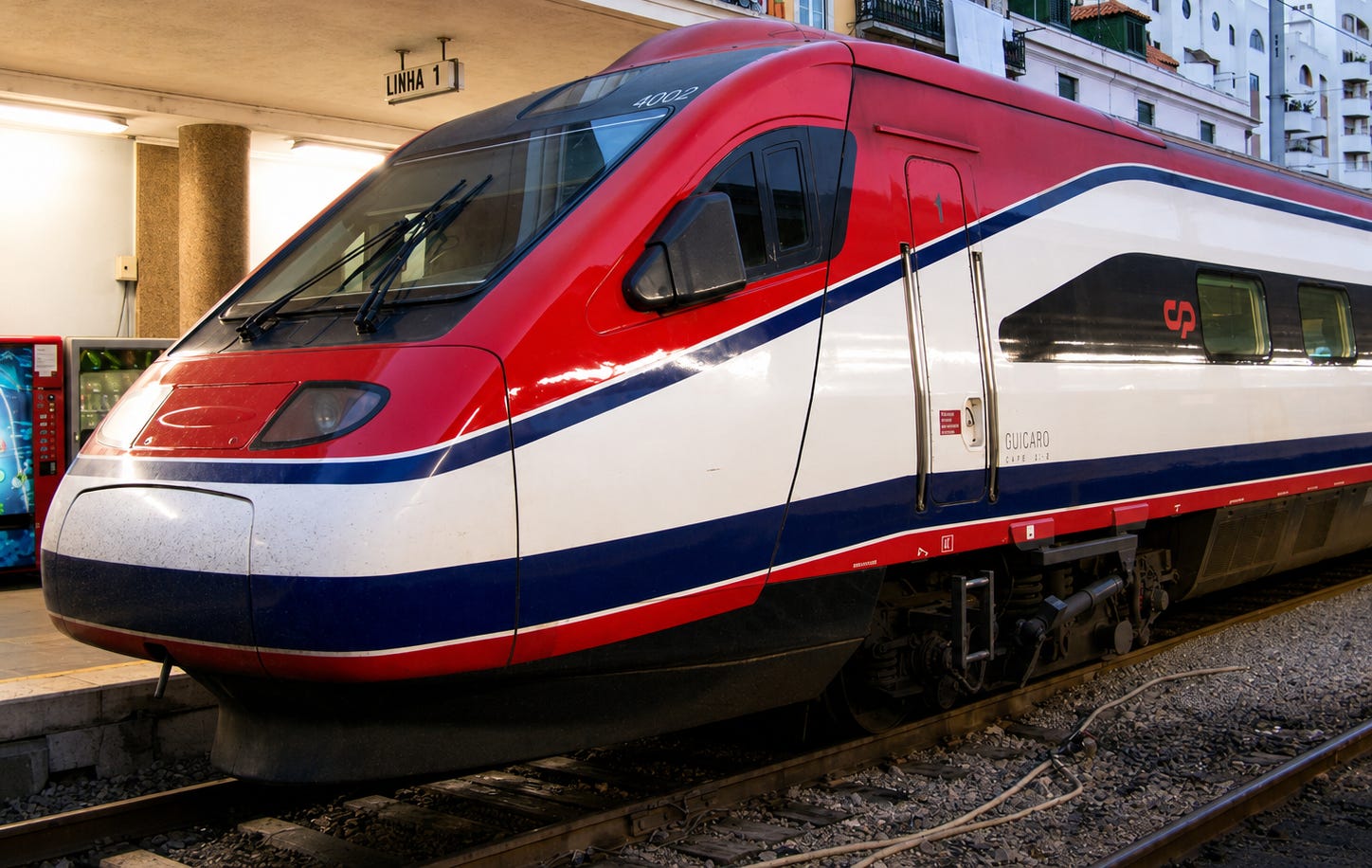
CP has opened a EUR 584m tender for 12 high-speed trainsets — Portugal’s first dedicated high-speed fleet — and the field breaks down into two competing arguments: Alstom has the local case, Siemens has the risk case.
By Dan Jensen
The procurement, launched 20 May, sets a bid deadline of 2 July and targets contract award in Q1 2027. The firm order covers 12 trainsets, with an option for eight more. First delivery is due Q1 2031, aligned with the scheduled start of commercial operations on the first Porto–Lisbon section.
Iberian gauge is mandatory — and that single requirement does most of the filtering.
Why gauge decides the field
Portugal’s new high-speed line is being built to Iberian gauge — the same specification as the existing national network. Spain built its high-speed network from 1992 in standard gauge despite its existing network also running on Iberian gauge.
Portugal has gone the other way, arguing that Iberian gauge trains can run beyond the dedicated line onto the conventional network, reaching cities like Braga and Faro without a gauge change.
The European Commission has asked Portugal to justify the decision. A derogation from the EU’s standard-gauge requirement has been granted until 2040, with dual-fit sleepers installed to keep the conversion option open.
Some manufacturers can bid from an existing Iberian gauge relationship. Others face a more fundamental engineering challenge: building a train that does not yet exist in the required specification.
The field
CP's EUR 584m programme covers 12 trainsets, spare parts and maintenance. The rolling stock base price is EUR 504m.
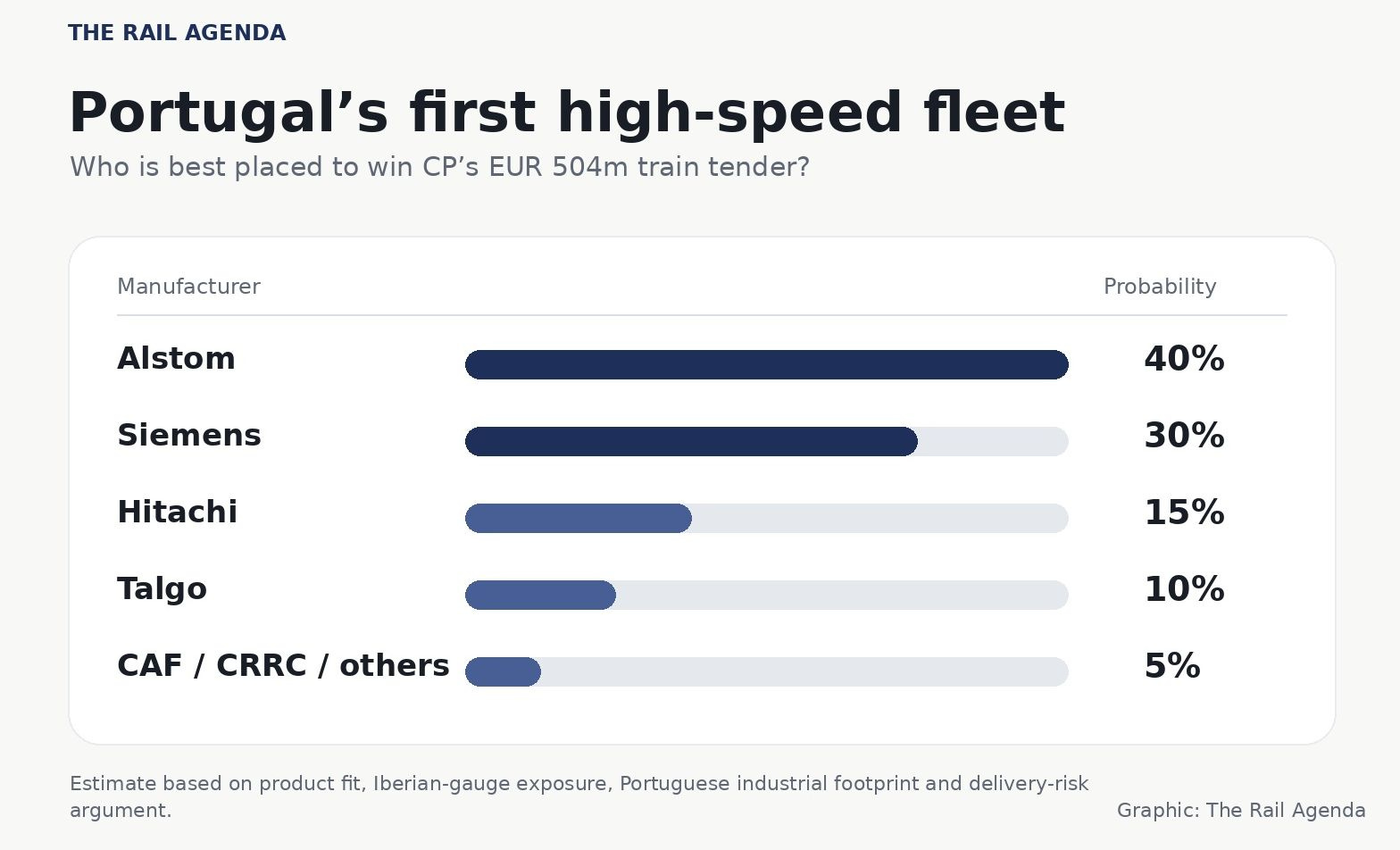
The probabilities reflect product fit, Portuguese industrial footprint and delivery certainty — and one core question: does CP reward local-industrial continuity, or the cleanest delivery-risk case?
No manufacturer is bidding off the shelf. The specification requires Iberian gauge at 300+ km/h — a combination that does not exist in any current certified product. Every bid will involve platform adaptation, gauge engineering, or both. That is why delivery certainty weighs as heavily as it does in this evaluation.
The gauge requirement gives Alstom a clear starting advantage.
Alstom: the local case
The Alfa Pendular has run Lisbon–Porto since 1999. Built by Fiat Ferroviaria — now part of Alstom — for Iberian gauge and Portuguese infrastructure, it has carried almost 41 million passengers. According to Alstom, two out of three trains currently operating in Portugal were manufactured by Alstom or incorporate Alstom technology.
In March 2026, CP awarded Alstom a EUR 1.03bn contract for 153 regional and suburban trainsets — the largest rolling stock procurement in Portuguese history. As part of that contract, Alstom is building a factory in Matosinhos, Porto region, covering more than 20,000 square metres and creating around 300 jobs.
That factory is not yet open. But the message to CP’s evaluation committee is clear: Alstom is not a supplier visiting Portugal. It is becoming part of Portugal’s rail industrial base.
Alstom’s open question
Alstom’s current high-speed platform — the Avelia Horizon — is built for standard gauge. There is no Iberian gauge version in service.
Alstom also has a visible delivery problem. Its order book is growing faster than its delivery machine. That gives CP one hard question: is the strongest local case also the safest delivery case?
Siemens: the risk case
No manufacturer has a stronger delivery-risk case than Siemens.
The Velaro platform has operated on Spanish high-speed infrastructure since 2007. The S-103 fleet — 26 trainsets certified for 350 km/h on the Madrid–Barcelona corridor — is the most mature Siemens high-speed reference in Iberia.
Siemens does not have Alstom’s local position in Portugal. But it does not carry the same visible delivery strain either. For CP, that combination — proven platform, no backlog problem — is the whole Siemens argument.
Siemens’ open question
The Velaro has never been built for Iberian gauge. The Velaro Novo has no European operational reference and no ERA authorisation. Siemens would be bidding an adaptation — technically plausible, but not a certified product that exists today.
If CP weights delivery certainty above industrial continuity, Siemens can win.
The rest of the field
Talgo is the genuine outsider. The Spanish manufacturer has built Iberian gauge trains for decades, and its variable-gauge technology allows operation on both 1,435 mm and 1,668 mm infrastructure — a deeper gauge relationship than any other manufacturer in the field.
The problem is the product. Talgo’s 350 km/h successor to the Avril does not yet exist. The Avril entered service in May 2024 after a three-year delay, and its first year brought reliability problems serious enough to put delivery back into the procurement conversation.
Hitachi, CAF, CRRC
The Frecciarossa 1000 — Hitachi’s high-speed platform, operating in Italy and in Spain through Iryo — is a strong certified product. But Iryo runs on Spain’s standard-gauge network, not Iberian gauge infrastructure, and the Frecciarossa has no Iberian gauge variant. Without a gauge adaptation, Hitachi’s case is weaker than its headline credentials suggest.
Spanish manufacturer CAF has deep Iberian industrial credentials but no certified 300+ km/h platform. Chinese CRRC has no ERA-certified high-speed train and faces FSR exposure after being removed from the Lisbon metro consortium earlier this year. Both sit outside the realistic field.
What to watch before 2 July
The full tender documents are available to registered bidders but have not been published openly. What is known is that evaluation criteria will favour the best relationship between lifecycle cost and technical capacity — a weighting that benefits Siemens’ delivery-risk argument as much as Alstom’s local case.
Three further points will clarify the competitive picture when the documents emerge:
Whether variable-gauge capability is required
Whether ERA authorisation for cross-border Spain operations is required
How CP weights technical risk against industrial footprint
It is a contest between a local-industrial argument and a delivery-risk argument — and CP has not yet shown which one it finds more persuasive.
Contract award is expected in Q1 2027. The answer will say as much about how Portugal procures strategic infrastructure as it does about which train wins.
Related:
CP launches EUR 584m tender for 12 high-speed trains

PORTUGAL: Portugal’s national rail operator Comboios de Portugal (CP) has launched a EUR 584m tender for 12 high-speed trainsets as the country prepares to open the upgraded Lisbon–Porto c…
Status of July 2 bid?