

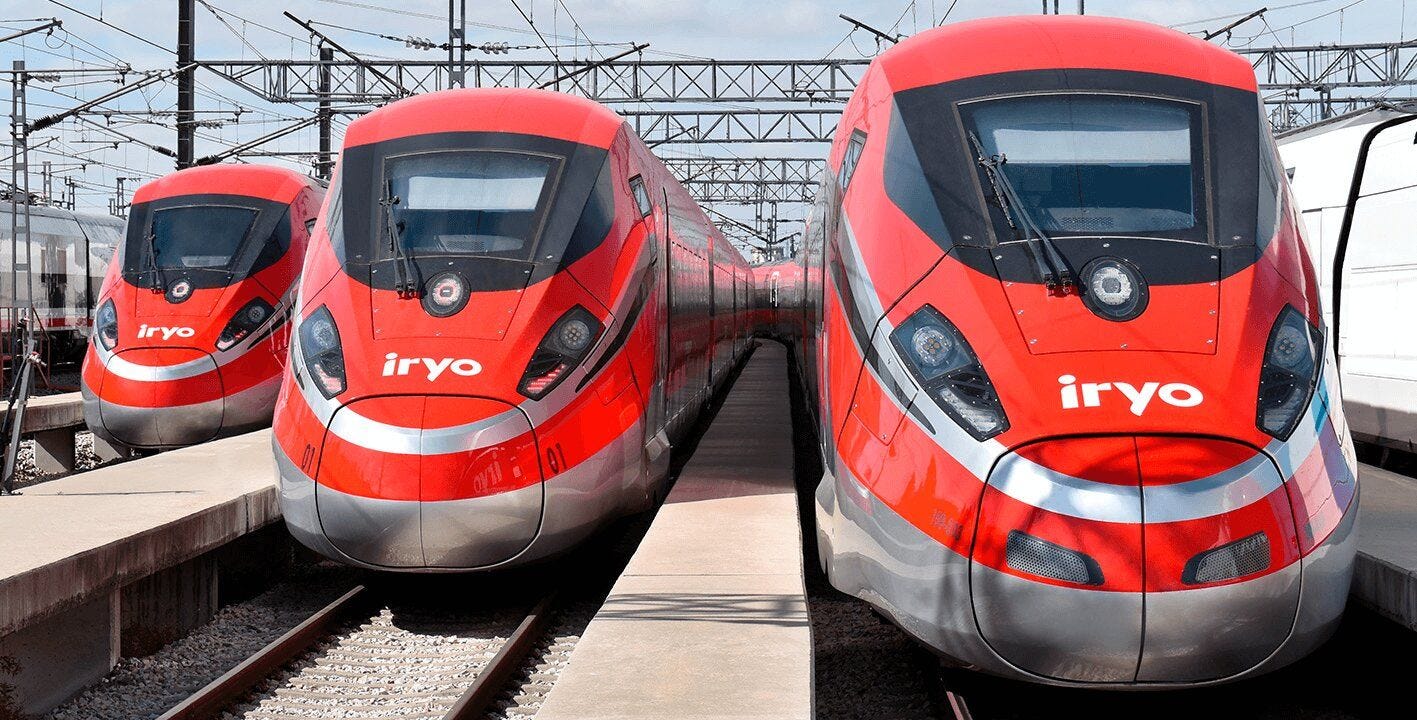
SPAIN: Spain’s competition regulator has found that the country’s mixed gauge network gives incumbent Renfe a structural advantage over open-access competitors Ouigo and Iryo.
The National Commission on Markets and Competition (CNMC) published the report on 23 March, drawing on submissions from Renfe, Ouigo, Iryo, rolling stock manufacturers and other market participants.
The findings come as Spain prepares a second phase of rail liberalisation that will open corridors including mixed-gauge sections — routes where the gauge constraint Ouigo and Iryo have flagged will apply directly.
Gauge coexistence complicates second-phase liberalisation
Spain operates standard gauge (1,435 mm) on its high-speed network and Iberian gauge (1,668 mm) on conventional lines. Where the two coexist, trains must be equipped with variable-gauge technology — and the number of manufacturers producing such rolling stock remains limited.
The CNMC found that this constraint reduces fleet availability for open-access operators in a way that does not apply equally to Renfe, whose fleet and operational model were built around Spain’s existing gauge infrastructure before the market was opened to competition.
Ouigo and Iryo told the CNMC that operating across both gauges adds technical complexity and reduces available train capacity. The regulator accepted that assessment.
Ministry to deliver gauge analysis by July 2026
The CNMC has stopped short of prescribing an infrastructure remedy. Migrating to a single gauge standard would require investment on a scale that neither the regulator nor the ministry has quantified.
The Spanish transport ministry has committed to delivering a cost-benefit analysis on gauge migration by 19 July 2026. The CNMC has recommended that any decision on gauge substitution be preceded by a thorough assessment of its impact on both passenger and freight competitiveness.
The July deadline gives the industry its first formal timeline for a question that open-access operators have raised since liberalisation began.