

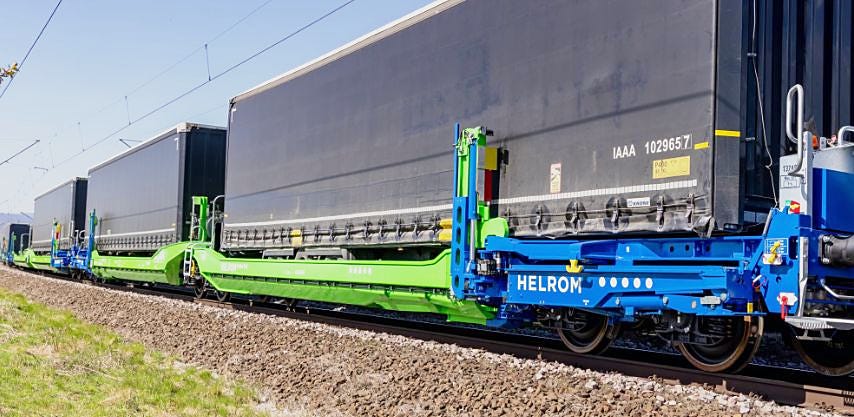
The MegaSwing wagon — the only commercially validated system in Europe capable of loading standard semitrailers onto rail without cranes or terminal infrastructure — is getting a third attempt at commercial viability under new owner Greenbrier, after two consecutive failures in twelve months left 250 employees without jobs.
By Dan Jensen
Between 80 and 95 percent of all semitrailers on Europe’s roads cannot be loaded onto a conventional rail wagon from above. They have no crane fittings, no lifting points, no intermodal compatibility. The existing terminal infrastructure — cranes, reach stackers, dedicated loading facilities — was built for containers and the minority of trailers designed to work with them.
The wagon opens to the side
The MegaSwing wagon solves the problem differently. The wagon opens to the side. A standard trailer is reversed in by a terminal tractor on any flat surface next to a track. The process takes around two minutes per wagon. No crane. No fixed terminal. No specialised infrastructure.
The two established alternatives solve the same problem via the terminal. Modalohr, in commercial operation since 2003, has moved trailers on routes across France and into southern Europe for more than two decades. CargoBeamer can load an entire train in around 20 minutes.
In both cases, the capital cost of the terminal is borne by the infrastructure investor or the state. With MegaSwing, all the complexity — and all the capital — sits in the wagon. The operator carries it alone.
A technology with many friends
The reaction across the freight industry to Helrom’s liquidation was consistent across the board. People who worked on the project, operators who ran the routes, logistics professionals who followed the company from its earliest days — most expressed genuine regret.
Dieter Feige, a rail industry recruiter who followed Helrom from its startup phase, sees applications that have barely been explored.
Germany’s federal programme to fund private siding tracks — Gleisanschlussförderung — has seen the number of active sidings fall from around 11,000 to just 2,000–3,000 over the past three decades.
Land is no longer available and regulatory requirements have tightened. A flexible terminal-free system that needs nothing more than a flat surface next to a track fits precisely where fixed infrastructure cannot.
Feige also points to military mobility and construction logistics as natural market entry points:
“A revival of this business model would certainly be interesting for entering the market or expanding the scope of business,” he told The Rail Agenda.
Flagship proof of concept
Those who worked directly with the wagons were consistent on the technology’s commercial credentials. Routes to Lébény, Vienna and Trento ran at strong utilisation. The Audi block train between Regensburg and Hungary operated as the system’s flagship proof of concept.
A former Helrom maintenance specialist told The Rail Agenda the system had real design weaknesses that complicated winter operations — none of them insurmountable, but persistent enough to make maintenance demanding. Greenbrier has said its engineers will work to improve the technology.
Two attempts, two failures
The first commercial structure collapsed in July 2025, when a planned equity round failed to materialise. Chief executive Roman Noack told Deutsche Verkehrs-Zeitung (DVZ) the company had encountered a shortfall in shareholder equity. The wagon financing — EUR 67.4m in asset-backed loans from Greenbrier, Deutsche Anlagen-Leasing and Société Générale — was in place. The equity was not.
The restructuring that followed was thorough. PwC led the investor process. The insolvency plan was confirmed by the Frankfurt am Main Local Court on 20 January 2026, with all three financing partners continuing their support under new majority owner HRG.
It lasted five months. The second insolvency came without public warning. Trains had reportedly stood idle for at least a week before employees were informed on 29 May. The financial position did not allow for continuation of operations, DVZ reported. For 250 employees, the news was abrupt.
Greenbrier’s third attempt
On 2 June, Greenbrier Europe announced that MegaSwing wagons are now available for lease or sale across Europe. A scalable leasing platform is in place, the company said, with active engagement underway with operators, logistics providers and shippers.
As part of the January 2026 restructuring agreement, Greenbrier — which manufactured the wagons — took ownership of around 190 of the approximately 220-wagon fleet, along with the intellectual property and patents.
From January to May, Helrom operated under a leasing arrangement, renting the wagons back from Greenbrier. The terms of the arrangement were confirmed by William Glenn, Greenbrier Europe’s head, in a separate exchange with The Rail Agenda.
Two differences
In an interview with DVZ, Glenn points to two differences: Greenbrier's engineers will improve the technology, and customer demand — Amazon among them — signals a broader market than Helrom ever reached.
Greenbrier’s model appears to distribute risk across multiple operators on different corridors rather than relying on a single lessee.
That spreads the exposure — but does not change the underlying economics for each operator, who still carries track access charges, staffing costs and operational risk against a fixed leasing payment to Greenbrier.
The Rail Agenda asked Glenn what is structurally different about the new leasing model — and what gives Greenbrier confidence that it can succeed where two operating structures could not. He had not responded at the time of publication.
The structural question
The industry’s reaction to Greenbrier’s announcement has been overwhelmingly positive. More than a hundred responses on LinkedIn welcomed the news that the technology survives.
The applications identified by industry observers — military mobility, construction logistics, the Gleisanschlussförderung angle — suggest the addressable market is broader than Helrom's corridor-by-corridor approach ever reached. Amazon's interest in shifting trailers to rail points in the same direction.
The question is whether the new leasing model resolves the structural problem that defeated its predecessors.
The third attempt is underway. The structural question remains.
