

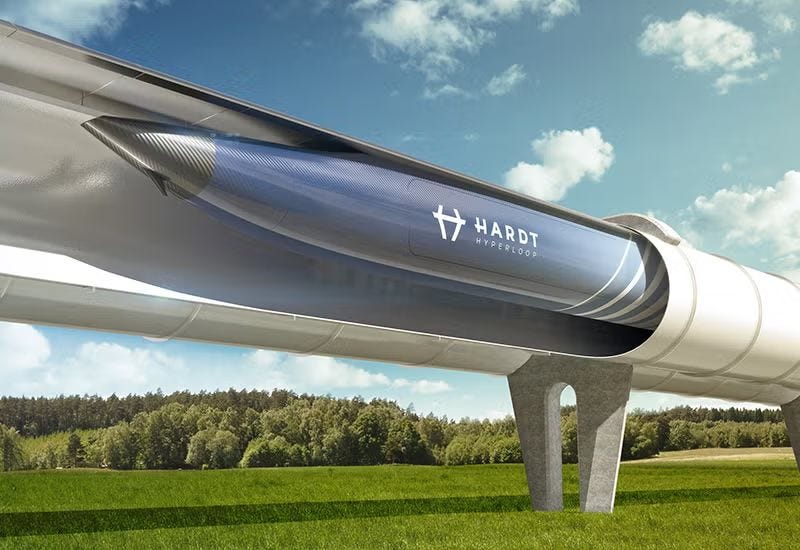
NETHERLANDS: Dutch hyperloop developer Hardt has been declared bankrupt by the court in The Hague. The bankruptcy was registered on 4 March 2026 in the Dutch Central Insolvency Register.
The Rotterdam-based company had become one of Europe’s most visible developers of vacuum-tube transport systems and was closely associated with the European Hyperloop Center test facility in the northern Netherlands.
The bankruptcy highlights a wider challenge facing developers working on the technology: moving from prototype tests to infrastructure projects that would require large-scale investment and regulatory frameworks that do not yet exist.
European hyperloop developer collapses
Hardt emerged from a student hyperloop team at Delft University of Technology and later developed technologies intended for future vacuum-tube transport systems, including propulsion concepts, switching systems and infrastructure designs.
The European Hyperloop Center in Veendam is a 420-metre test facility created through a public-private partnership involving Dutch ministries, the Province of Groningen, private investors and European research programmes.
In 2025 Hardt announced at the centre in which a prototype capsule reached around 85 km/h inside a low-pressure tube while demonstrating stable levitation and a lane-switch system designed to allow capsules to move between routes within a future network.
The trial represented a significant increase from earlier trials at about 30 km/h and was intended to validate core system components rather than achieve the high speeds often associated with the concept.
From Musk proposal to global experiments
Interest in the hyperloop concept accelerated after Elon Musk published a proposal in 2013 outlining high-speed transport using capsules travelling through low-pressure tubes.
The idea suggested that reducing air resistance and friction inside sealed tubes could allow passenger or freight pods to travel at very high speeds.
The proposal prompted a number of engineering initiatives and startups exploring the approach in Europe, North America and Asia.
Virgin Hyperloop and projects explored worldwide
In the United States, Virgin Hyperloop conducted a manned prototype test in Nevada in 2020, one of the most visible demonstrations of the system.
The company later shifted its strategy away from passenger transport toward freight applications, reflecting the technical and regulatory challenges associated with certifying passenger systems.
China has also explored vacuum-tube transport through state-backed research programmes investigating ultra-high-speed transport technologies.
Proposed corridors have appeared in the Middle East, including plans linking Dubai and Abu Dhabi, while India has examined potential routes between major cities such as Mumbai and Pune.
Despite more than a decade of experiments, prototypes and feasibility studies, no system based on the technology has yet entered commercial passenger or freight service anywhere in the world.
Infrastructure economics remain the core challenge
A central challenge for developers has been the cost and complexity of building entirely new transport infrastructure.
Unlike conventional rail or road systems, such systems would require long sealed tubes, specialised stations and dedicated control systems constructed from scratch.
The scale of investment required would be comparable to major rail infrastructure projects, while regulatory frameworks, safety standards and operating models remain largely undeveloped.
This combination has made it difficult for companies working on the technology to secure the large-scale financing needed to move from prototype tests to real transport corridors.
Setback for European research efforts
Hardt had become a central participant in European research on vacuum-tube transport, working with universities, engineering firms and research programmes exploring next-generation mobility concepts.
The European Hyperloop Center had been intended to function as a development hub where multiple companies and research groups could test technologies related to the concept.
The bankruptcy of one of the sector’s most visible developers therefore represents a setback for efforts to move the technology beyond demonstrations and early research.