

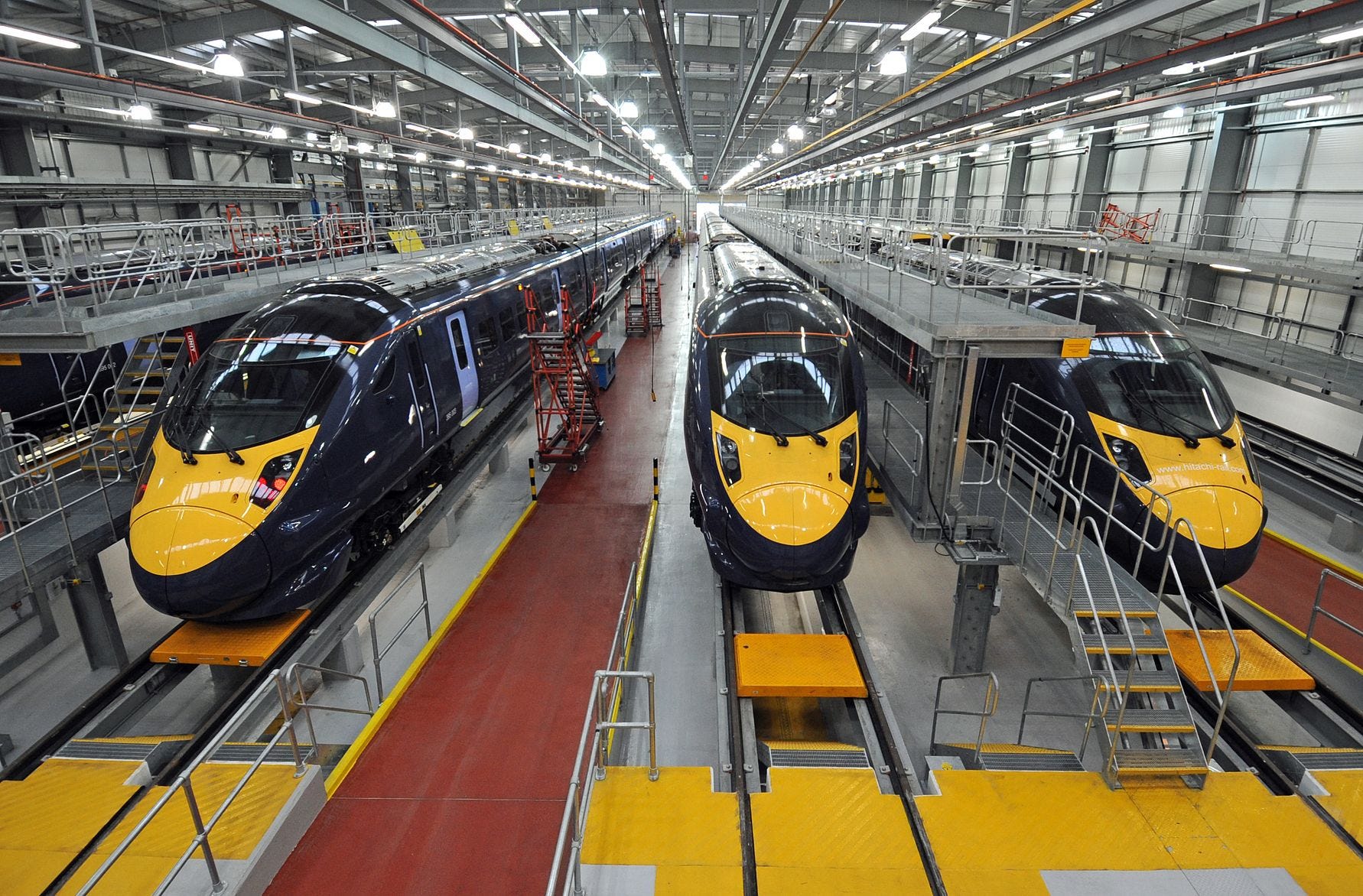
A train only earns its place on the timetable between overhauls — behind every scheduled service sits a workshop deciding what still meets tolerance and what has to come off.
The equipment behind that work spans machine tools for precision metalworking, lifting and handling systems for heavy component exchange, and test facilities that verify restored components before a vehicle returns to traffic.
What gets done, when, and by whom is not left to the operator’s discretion. European regulation assigns the responsibility explicitly.
The maintenance obligation
Every railway vehicle on public infrastructure in Europe must have a designated Entity in Charge of Maintenance (ECM). Directive (EU) 2016/798 defines the ECM as the organisation responsible for keeping the vehicle in a safe condition, and Commission Implementing Regulation (EU) 2019/779 sets out the certification system built on that definition.
The ECM function covers four areas: management, maintenance development, fleet maintenance management, and maintenance delivery. The last three may be outsourced to certified workshop operators, creating a market for independent maintenance providers alongside the in-house workshops of major operators and original equipment manufacturers (OEMs).
ECM certificates are issued for a maximum of five years by accredited certification bodies and require surveillance audits at least every 12 months. The regulation covers all vehicle categories — passenger coaches, multiple units, locomotives, and freight wagons — after 2019/779 replaced the freight-only scope of Regulation 445/2011.
Workshop functions and their equipment
Maintenance work falls into three broad categories. Light maintenance is daily or weekly servicing: cleaning, fluid checks, brake pad inspections, and minor component replacements.
Intermediate maintenance addresses components with defined service intervals measured in kilometres or calendar periods — wheelset reprofiling, brake disc replacement, bogie inspections. Heavy maintenance is full vehicle overhaul at multi-year intervals, including bogie removal, traction motor exchange, and structural inspections.
Each category needs different equipment. Light maintenance bays require access pits and basic tooling; intermediate facilities add underfloor wheel lathes, bogie drops, and lifting jacks; heavy maintenance workshops add traction motor test stands, non-destructive testing (NDT) equipment, and component cleaning systems.
Wheelset maintenance
Wheels wear out of their conical profile in service — flange thickness reduces, braking events create flats, and surface fatigue cracking develops. An out-of-profile wheelset increases track forces, reduces ride quality, and eventually poses a derailment risk.
Reprofiling on an underfloor wheel lathe restores the correct geometry without removing the wheelset from the vehicle. EN 15313 governs in-service wheelset requirements, defining the dimensional limits that trigger reprofiling or replacement.
The standard applies to wheelsets meeting the product requirements of EN 13262 (wheels), EN 13261 (axles), and EN 13260 (assembled wheelsets). Wheels have a minimum diameter below which they must be scrapped — set in the vehicle’s maintenance plan, this boundary determines how many reprofiling cycles are available before replacement.
Bogie and undercarriage maintenance
Bogies are removed at defined overhaul intervals for frame inspection, suspension element replacement, and wheelset exchange. EN 13749:2021 specifies structural requirements for bogie frames, including fatigue assessment methods used both in original design and in evaluating frames after damage or extended service.
Non-destructive testing of bogie frames during overhaul typically uses magnetic particle or ultrasonic methods to detect cracks in the steel structure. Overhaul intervals for an electric multiple unit (EMU) or other vehicle type depend heavily on service intensity, and are set by each operator’s own maintenance plan rather than a fixed European figure.
Traction motor maintenance
Traction motors in service since the 1980s and 1990s are approaching or have passed their original design lives. Remanufacturing — disassembly, inspection, rewinding of stator windings, bearing replacement, and full functional testing — extends motor service life without requiring a new unit.
Remanufactured motors must meet the same performance specifications as the original, verified against IEC 60349-2 for converter-fed AC motors or IEC 60349-4 for permanent magnet synchronous motors.
Condition-based maintenance
Traditional maintenance schedules run on fixed distance or time intervals regardless of actual component condition. Condition-based maintenance (CBM) uses onboard sensor data — vibration signatures, temperature readings, acoustic emission — to detect deterioration before it reaches the intervention threshold.
This extends effective maintenance intervals and reduces unplanned failures. The shift from time-based to condition-based regimes is influencing workshop equipment design, as facilities must process sensor data alongside physical inspection results.
Go deeper:
Bogie and undercarriage maintenance