

SWITZERLAND: Railway operator BLS has submitted the plan changes for the Lötschberg base tunnel, which the Federal Office of Transport (BAV) has put out to public objection until 15 September. The 35 km link under the Bernese Alps opened in 2007 with double track on only 14 km. Finishing it will cost about CHF 1.7bn (EUR 1.8bn) and run into the mid-2030s.
BAV opened the consultation on 17 August. Most of the project was approved years ago and that approval is final, so only the changes required to complete the second tube can still be objected to.
BLS is Switzerland’s second largest railway after the federal SBB, and the Lötschberg has been its route since the mountain line opened in 1913.
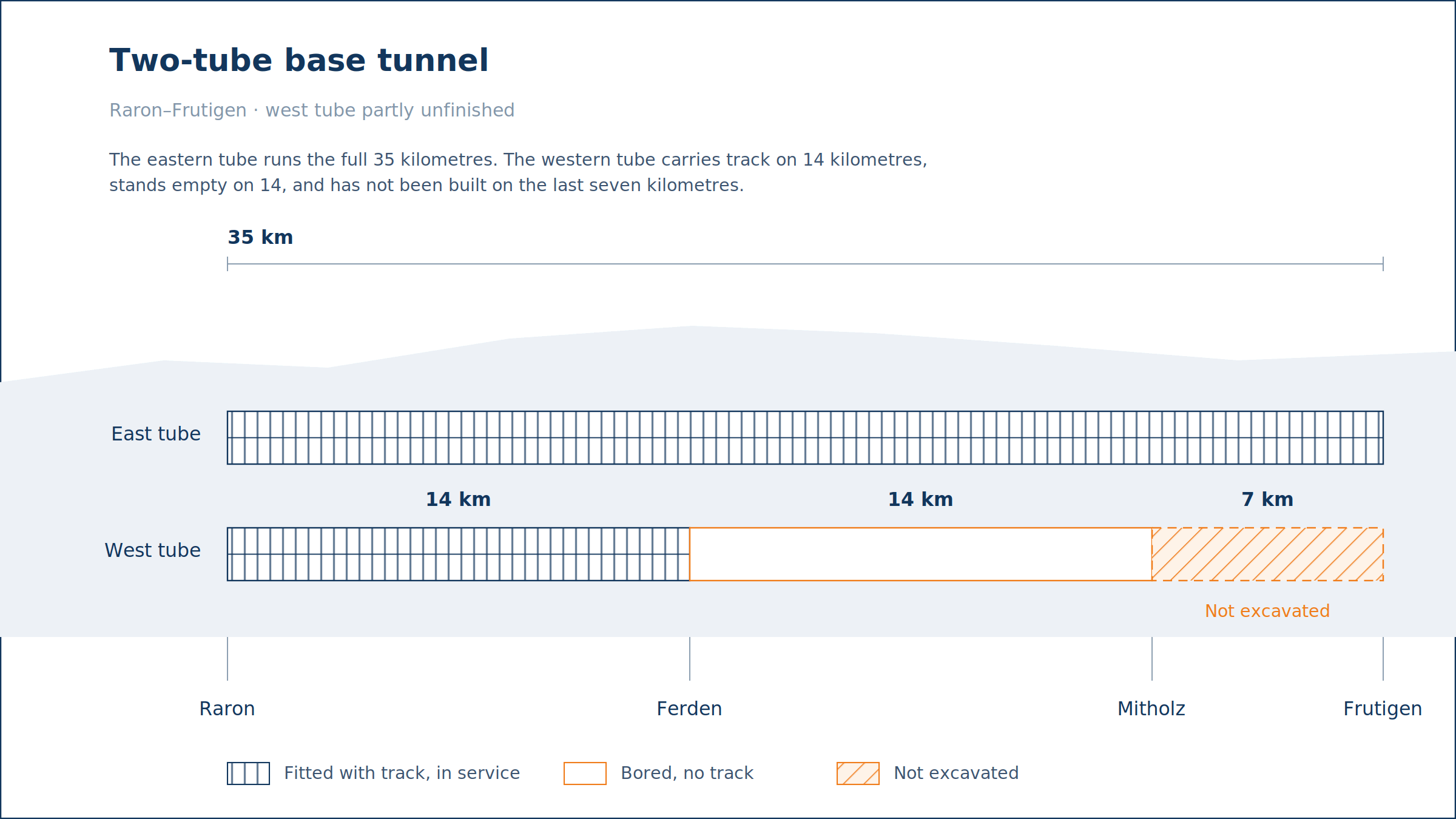
The Lötschberg was designed as two parallel single-track tubes. Only the eastern one runs the full length. Of the western tube, 14 km between Raron and Ferden carry track. A further 14 km to Mitholz is an empty tunnel with no track, power or signalling. The last 7 km to Frutigen was never built at all.
Trains change tubes inside the mountain. A crossover at Ferden feeds them into one tube or the other for the 14 km down to Raron, and gathers them back into the eastern tube for the 21 km north to Frutigen. On that stretch trains in both directions share one track, so a train entering from either end waits until an oncoming one has cleared it.
BLS built the base tunnel as contractor to the federal government, which put up the money and required the infrastructure to be held in a company it controls. The canton of Bern owns 55.75 per cent of BLS itself.
What the consultation covers
The changes on display are the 7 km still to be built at the Frutigen portal, a new emergency stop at Mitholz and a revised construction sequence. The additional work takes place inside the mountain, BLS said.
Main works are scheduled to start in 2028. BLS puts the construction period at about ten years. Marco Ceriani, its head of Alptransit and overall project manager, told a public meeting in Frutigen on 18 August that trains should run on two tracks throughout from December 2035, and that financing is secured by contract with the federal government.
What the second track buys
BLS describes the single-track section as the bottleneck in the mountain. The Lötschberg–Simplon axis is one of Switzerland’s two transalpine rail routes, and traffic on it ran at about 110 freight and passenger trains a day, Dirk Stahl, chief executive of BLS Cargo, said in an interview with Neue Zürcher Zeitung in August 2023.
The same interview put the figure after completion at 270 trains a day. A finished tunnel also allows a continuous half-hourly inter-city service between Bern and Valais.
How the money was voted
The Federal Council proposed CHF 900m (EUR 970m) in October 2018 to lay track in the empty 14 km between Ferden and Mitholz, and parliament approved it in June 2019.
The Federal Council returned in August 2023 with a request for CHF 640m (EUR 690m) more to build the remaining 7 km as well, and parliament gave final approval in early 2024. The two credits come to CHF 1.54bn (EUR 1.65bn), against BLS’s current estimate of about CHF 1.7bn for the finished project.
The western tube was deferred when the Federal Council scaled back the Neue Eisenbahn-Alpentransversale, the federal programme that built the Alpine base tunnels, in 1996. BAV decides on the plan changes once the objection period closes.
