

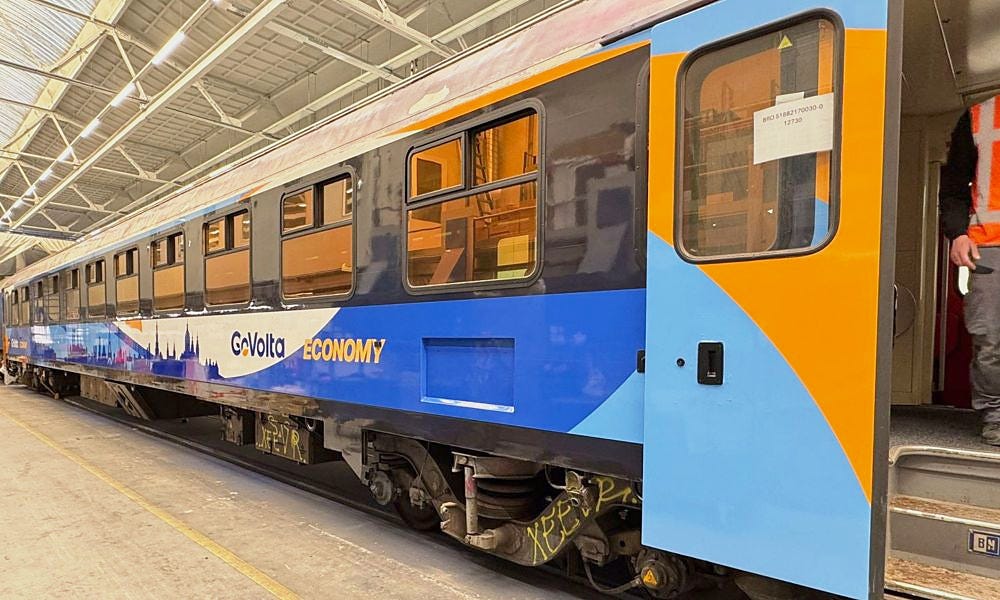
CROSS-BORDER: Dutch budget operator GoVolta has opened ticket sales for a daily Amsterdam–Paris service launching 14 December, with fares from EUR 19 — the first classic rail link between the two cities since the Etoile du Nord ended in 1996.
The service runs via Antwerp and Ghent rather than Brussels, taking just over seven hours and positioning GoVolta against Eurostar on the corridor’s most price-sensitive segment.
GoVolta simultaneously launched a EUR 1.5m bond offering to fund the expansion.
First Amsterdam–Paris classic rail link since 1996
The daily service departs Amsterdam Centraal at 07:46, arriving at Paris-Nord at 14:54. The return leaves Paris at 15:49, reaching Amsterdam at 23:29. Fares start at EUR 19, against Eurostar’s entry point of around EUR 35 for a journey that takes three hours and twenty minutes — less than half the time.
GoVolta routes via Antwerp and Ghent rather than Brussels, which the company says is already well served by high-speed connections to both cities. For Ghent, it is the first direct international rail service in years.
Budget product, crowd bonds
The EUR 1.5m bond offering runs via crowdfunding platform Eyevestor, with a minimum investment of EUR 1,000, a 10% annual return and a 30-month maturity. GoVolta will use 50% of the proceeds for additional coaches and 35% for Paris launch costs. An investor meeting is scheduled for 4 June in Breda.
The company operates the Amsterdam–Paris route with refurbished Belgian I10 coaches leased from Assetoro and maintained by Brouwer Technology in Blerick. The Paris configuration covers 11 coaches — nine economy, one comfort and one restaurant car — with plans to expand to 22 by 2028.
Hamburg in seven weeks
GoVolta pulled its Amsterdam–Hamburg route in May after seven weeks of operation, citing low passenger numbers. Amsterdam–Berlin, launched 19 March, runs six times weekly from July with occupancy above 70%. The company has carried 90,000 passengers to date and plans to double Berlin frequency by 2028.