

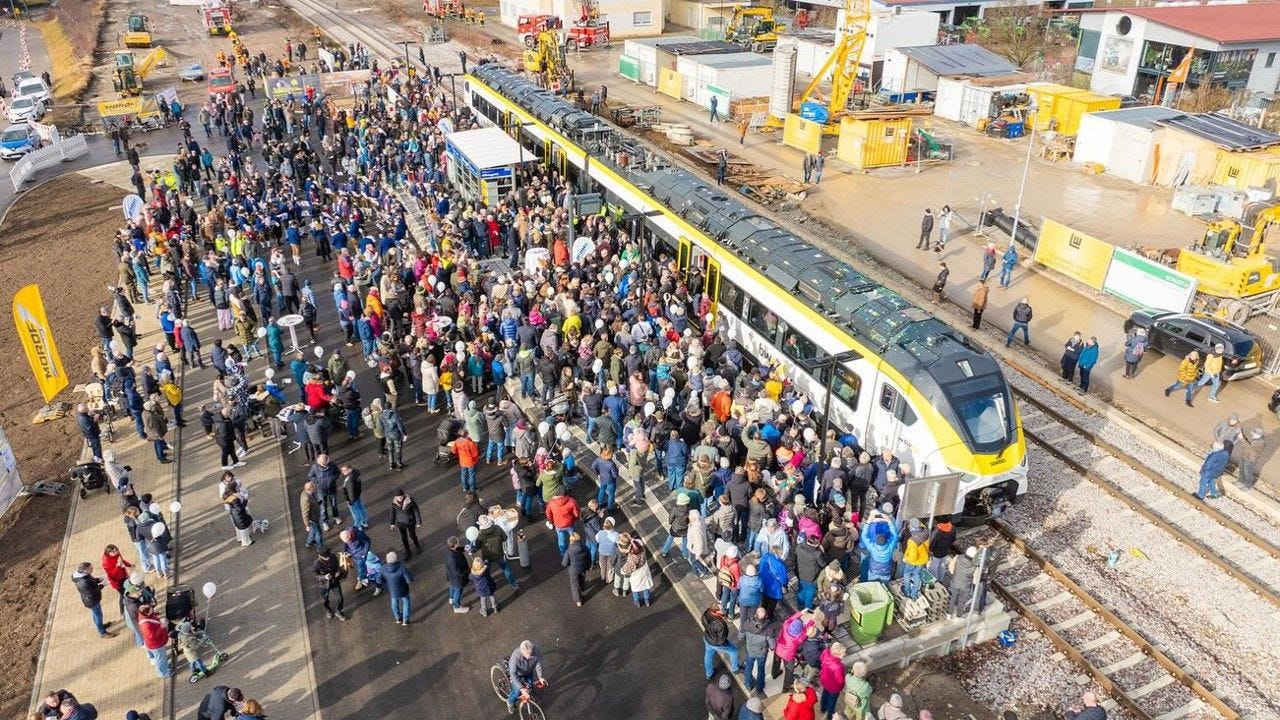
The Hermann Hesse line linking Calw and Weil der Stadt in Baden-Württemberg has reopened, restoring regular passenger services on a regional route where passenger services last ran in 1983.
Backed by the state, the 23 km reactivation reconnects the northern Black Forest area to Stuttgart’s regional rail network via interchange at Weil der Stadt.
Battery operation, phased timetable
Services are being launched with Siemens Mireo Plus B battery-electric multiple units, enabling operation without continuous electrification as the line returns to regular passenger service.
The initial operating pattern is being phased. Operator SWEG says a timetable expansion is planned from April, with more frequent weekday services and longer operating hours.
Extension to Renningen planned
For now, services run between Calw and Weil der Stadt. SWEG says the next step is to extend operations beyond Weil der Stadt via Malmsheim to Renningen, with entry into service on that section planned from June.
That extension would strengthen the line’s role as a feeder into the wider Stuttgart area, improving interchange options beyond the current terminus and widening the catchment for regional travel.
A reactivation case with real constraints
Local authorities and the project organisation have positioned the line as a template for bringing long-closed routes back into regular passenger service — but the launch also illustrates that reactivation is not a single “switch-on” moment.
The operating plan is being staged as the corridor moves from commissioning into stable daily service. Some local constraints are still being worked through under the approved operating plan.
Why it matters: Germany’s reactivation programme is increasingly using battery operation to restart passenger services without waiting for full electrification — but the decisive factor for passengers and planners is less the train type than whether the route can deliver a reliable, repeatable service pattern that integrates cleanly into the surrounding timetable and interchange network.