

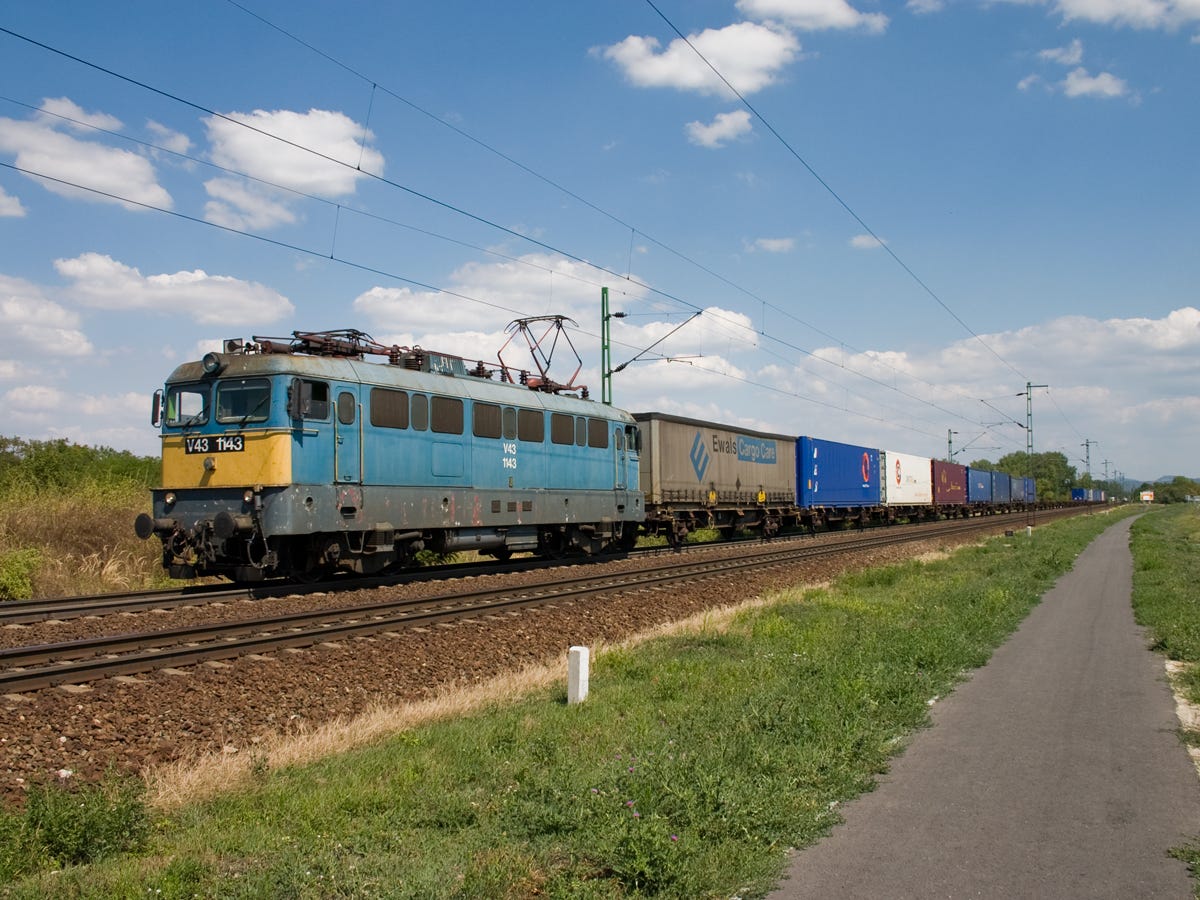
HUNGARY: Regular freight traffic has begun on the rebuilt Budapest–Kelebia rail line, putting Hungary’s section of the Chinese-financed Budapest–Belgrade corridor into regular use.
Freight services started on 27 February, when the first freight service departed Budapest’s Ferencváros yard as the upgraded route entered operational service. The line forms the Hungarian section of the wider Budapest–Belgrade modernisation programme.
The project has been largely financed through Chinese state-backed lending under a bilateral financing agreement outside standard EU funding frameworks. The financing structure has attracted scrutiny in Brussels and has been politically contentious within the EU.
Serbia has reopened sections for passenger services
The reopened line replaces a slower and capacity-constrained route and has been rebuilt to allow higher speeds and greater load capacity. Freight operations will initially run under controlled conditions while operating procedures are tested in live traffic.
The Hungarian section is the northern half of a corridor intended to connect Central Europe more directly with the Balkans and onward flows via the Greek port of Piraeus. Serbia has already reopened parts of its upgraded alignment for passenger services.
Hungary is also pursuing a broader rail investment programme beyond the Budapest–Kelebia upgrade, spanning both national priorities and TEN-T corridors.
EU-backed capacity works are progressing
The European Investment Bank has outlined a MÁV infrastructure modernisation programme focused on improving network performance and supporting a shift from road to rail.
Separately, EU-backed capacity and interoperability works are progressing on key approaches to Budapest, including the Kelenföld–Százhalombatta–Pusztaszabolcs section, where CEF funding has supported track renewal and trackside ERTMS.
Hungary is also developing a V0 freight bypass south of the capital to relieve the Budapest node, but the project has moved more slowly and remains at planning stage.