

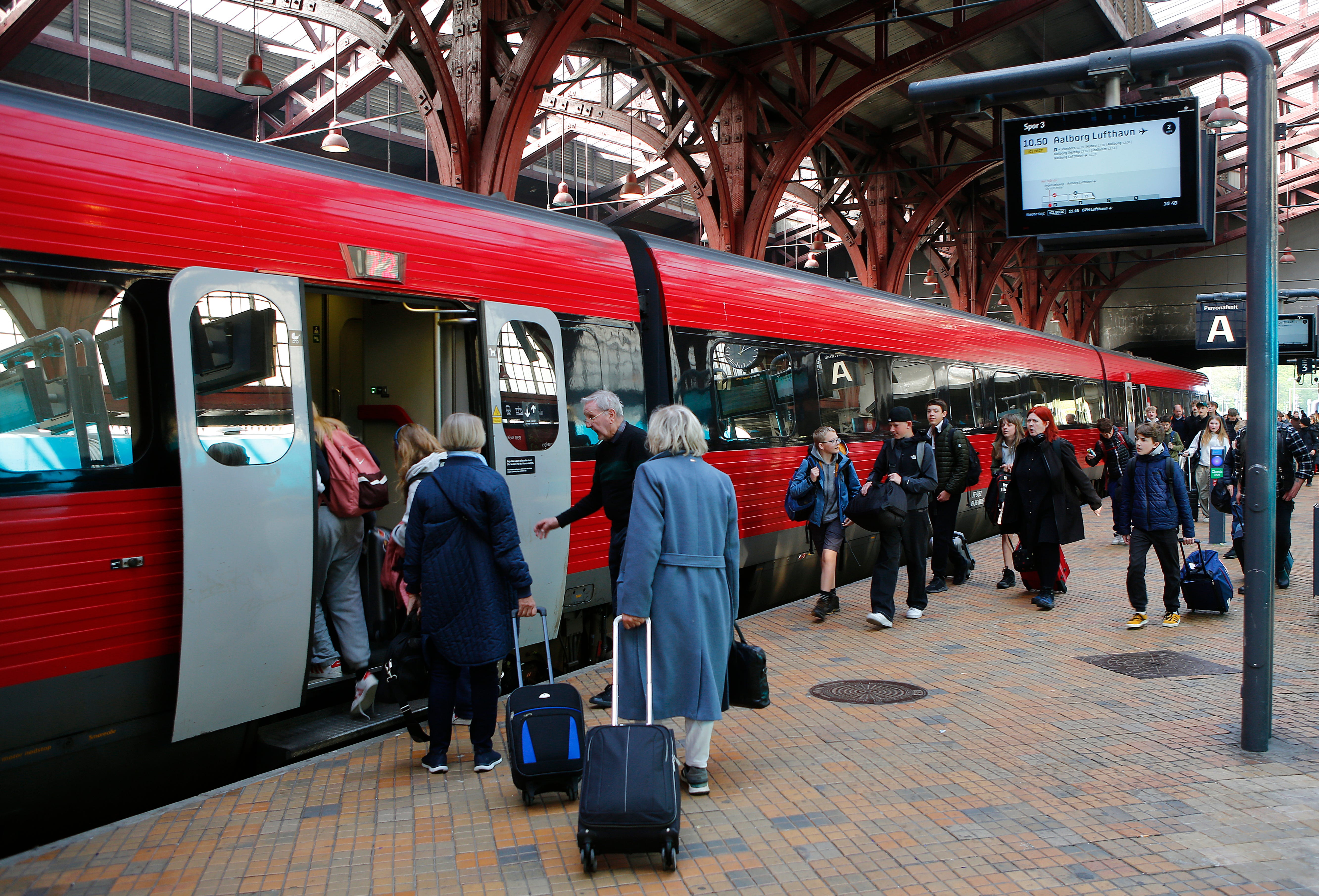
Every railway vehicle in Europe carries two obligations that cannot be negotiated away at the point of delivery: it must give passengers and crew time to reach safety if a fire breaks out, and it must not make more noise than the network's regulators have agreed to tolerate.
Neither obligation can be retrofitted cheaply. Both are locked in before the first vehicle is built.
That is what binds this section together: fire standards, noise limits, damping technology and certified safety electronics all act at the design stage.
Fire protection: materials and evacuation time
The engineering objective in railway fire safety is not to prevent ignition — that cannot be guaranteed across the life of a vehicle. It is to ensure that if a fire occurs, passengers and crew have enough time to reach safety before conditions become unsurvivable.
This framing is explicit in EN 45545, the European standard series for fire protection on railway vehicles. Published in 2013, it became binding through TSI LOC&PAS from 2015, with conflicting national standards withdrawn by March 2016.
EN 45545 prescribes no specific materials or system architectures. It sets reaction-to-fire performance requirements for 68 listed component types — seat foams, cable jackets, wall and ceiling panels, floor coverings — measured across 27 test methods quantifying ignitability, flame spread, heat release, smoke opacity and toxic gas production.
The stringency applied depends on the hazard level assigned to the vehicle, running from HL1 to HL3. Hazard level follows from a combination of operating category and design category: vehicles in the highest operating category — extensive tunnel and underground running — reach HL3 regardless of design, while sleeper and couchette stock reach HL3 even at a lower operating category.
Double-deck vehicles and automatic trains without onboard staff are not automatically HL3; their level depends on the same operating-category test.
Tunnels as the design scenario
A tunnel concentrates the consequences of fire in ways surface operation does not. Evacuation routes are constrained, smoke accumulates rather than dispersing, and the time available for self-rescue is shorter.
TSI SRT (Safety in Railway Tunnels) responds by dividing rolling stock into two rolling stock categories, each defined by a running capability requirement: the train must keep moving, not just keep braking, for long enough to reach a place where passengers can be evacuated safely. Category A must maintain running capability for a minimum of four minutes at an average speed of 80 km/h, with traction preserved and no automatic brake application — sufficient for tunnels up to 5 km.
Category B must sustain the same running capability for at least 15 minutes. That covers 20 km and enables safe egress from the longest tunnels on the network.
Active suppression systems — automatic agents deployed in engine compartments, traction bays and passenger spaces — work alongside the passive material requirements.
The regulatory structure for noise
Exterior noise above roughly 60 km/h is governed chiefly by wheel-rail contact, and TSI Noise (Commission Regulation EU 1304/2014) sets the pass-by, stationary and starting limits that apply across the European interoperable network. Brake block technology — cast iron against composite — is the single largest lever on whether a freight wagon meets those limits, addressed in detail in the noise damping article below.
Directive 2012/34/EU adds a financial lever: infrastructure managers may apply noise differentiated track access charges (NDTAC), so louder rolling stock pays higher access fees. That gives operators an economic incentive to retrofit faster than natural fleet renewal would deliver.
The Environmental Noise Directive (2002/49/EC) operates at infrastructure level, requiring member states to map exposure along major lines and maintain action plans.
Design-stage decisions and SIL
Fire safety and noise control share a characteristic that sets them apart from most railway engineering disciplines: both are determined before a vehicle enters production.
A vehicle’s hazard level is fixed at the start of the design process and governs every material selection that follows; changing it mid-programme means re-qualifying components already tested. Noise performance is locked in equally early — by bogie architecture, brake system selection and wheel specification.
Retrofit tools exist in both domains. They are more expensive and less comprehensive than correct original design.
Safety electronics add a third layer: control units governing fire detection, suppression activation and door safety each require a Safety Integrity Level (SIL) assessment under IEC 61508 and its railway implementations — EN 50126, EN 50129 and EN 50716. SIL certification cannot be economically added after the fact; it must be built into the system architecture from the outset.