

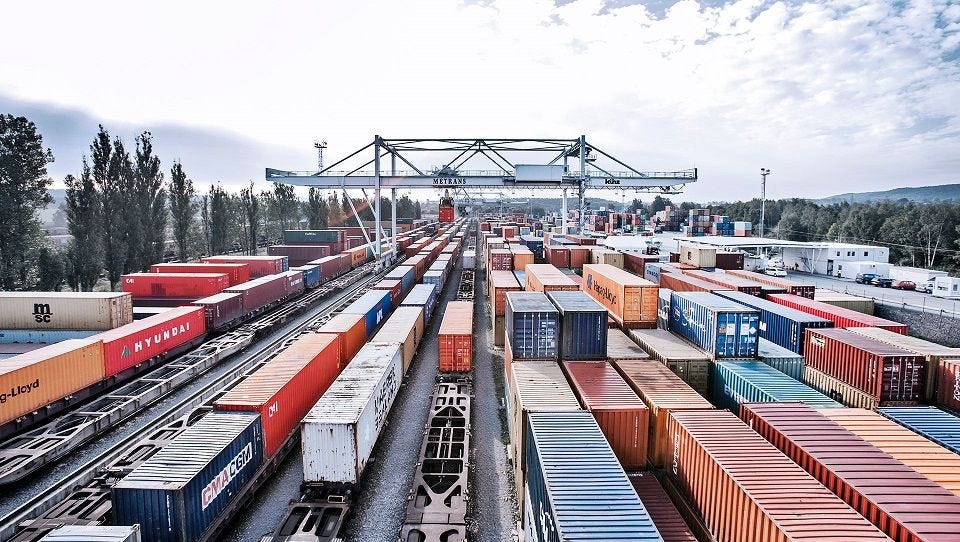
Europe’s rail-freight market has barely shifted in a decade. Even Switzerland — the country that has done most to favour rail — has seen its freight share slip from around 38% to 37%. The drop is small, but it highlights a deeper issue: Europe cannot move more freight from crowded roads to rail without both more capacity and fairer pricing.
By Dan Jensen
Global forecasts point to steady rail-freight growth through 2035, driven by intermodal demand, long-distance container flows and new corridors in fast-growing markets. Europe is not part of that trend. Its network is mature and saturated, with heavy passenger traffic, bottlenecks and cheaper road competition limiting rail even where demand exists.
Switzerland’s one-point drop shows the wider problem
Switzerland has taken many of the right steps: high road charges, the Gotthard and Lötschberg base tunnels, and policies designed to shift heavy freight to rail. Track-access rules also ensure freight can run in critical time windows.
Yet new data from the Swiss Federal Statistical Office show rail’s freight share edging down by one percentage point. If a country with this level of infrastructure, pricing and political consensus cannot maintain rail’s position, most of Europe faces an even harder task.
Why Europe is not following global growth
Unlike markets building new long-distance corridors, Europe depends on strengthening the network it already has. Freight shares tracks with dense passenger services, which usually get priority. Major routes such as the Rhine–Alpine corridor run close to capacity in peak hours. Maintenance and construction work regularly restrict available paths, and many terminals have little flexibility to absorb more volume. Reliability suffers — and that weakens rail’s competitiveness.
The capacity constraint
Europe’s core corridors face clear limits. The Rhine–Alpine route has little room for additional trains. The Scandinavian–Mediterranean corridor still includes single-track stretches and restrictive loading gauges. The Baltic–Adriatic axis depends on nodes such as Ljubljana and Koper, where upgrades are needed to meet future demand.
Intermodal terminals introduce another constraint. Many operate with limited space, equipment and access. Expanding existing sites is difficult; building new ones requires land and permits that are hard to secure near major urban areas.
Addressing these issues means completing electrification, double-tracking remaining single-line sections, deploying modern signalling and expanding terminals. Large cross-border projects illustrate how long this takes: the Brenner Base Tunnel entered construction in 2007; Lyon–Turin has been in development for more than two decades. These timelines reflect the complexity of delivering major infrastructure in Europe.
The pricing problem
Rail freight pays most of its direct costs — track access, energy, rolling stock, crews and compliance. Road freight covers only a fraction of its infrastructure wear and almost none of its wider impacts such as congestion, pollution and road safety.
This imbalance keeps road transport cheaper. Road-charging reforms remain uneven: some countries use distance-based tolling; others rely on vignettes or minimal charges. A pricing system that reflects external costs is still not applied in practice.
Neither capacity improvements nor pricing reform works alone. If road costs rise but rail cannot handle more trains, volumes stay on the road. If extra capacity becomes available but rail remains more expensive, shippers stick with trucking.
Overloaded roads limit the whole system
Road networks across Europe face rising freight volumes, persistent congestion and increasing wear. Even with electrification, trucks take more space and cause more damage per tonne than rail.
Rail can move long-distance freight with far lower external costs — but only if the system can offer reliable slots and competitive prices. That requires more track capacity, stronger terminal infrastructure and pricing that levels the playing field.
What’s next
Europe’s ability to shift freight from road to rail depends on two conditions: a network that can absorb more trains, and pricing frameworks that reflect real costs. Corridor upgrades, terminal expansion and more consistent road charging will determine whether rail can regain momentum.